
Opinions
16:06, 12-Aug-2018
Opinion: Sino-Japanese ties: Common interests are greater than differences
Updated
15:26, 15-Aug-2018
 ["china"]
Share







Copied
01:43
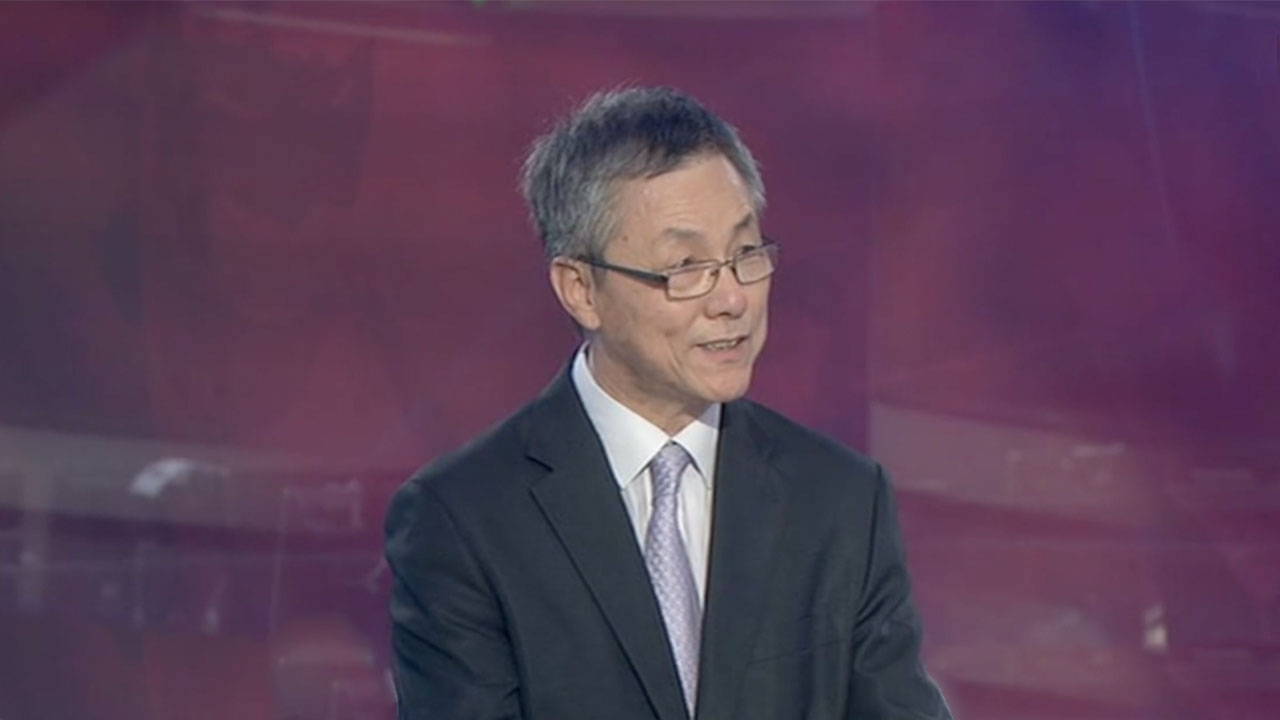
Editor’s note: This article is based on an interview with Yang Xiyu, a senior fellow at the China Institute of International Studies.
August 12, 2018, marks the 40th anniversary of the signing of The China-Japan Treaty of Peace and Friendship.
When the treaty was signed, it was a giant historical stride as it confirmed the principles of the China-Japan Joint Statement signed in 1972 as the peaceful and friendly relations between the two countries were legally ensured and fixed.
The treaty contains two main aspects. One is to develop durable relations of peace and friendship on the basis of the Five Principles of Peaceful Coexistence (proposed by former Chinese Premier Zhou Enlai in 1953) and settle all disputes by peaceful means without resorting to the use or threat of force.
And another is to develop economic and cultural cooperation and promote exchanges between the people of the two countries, and that neither would seek hegemony and each is opposed to any other country’s efforts to establish such hegemony.
But with the constant changes in the external strategic environment, the social status and political conditions of both countries have changed a lot. And bilateral ties between China and Japan have experienced ups and downs during the past 40 years.
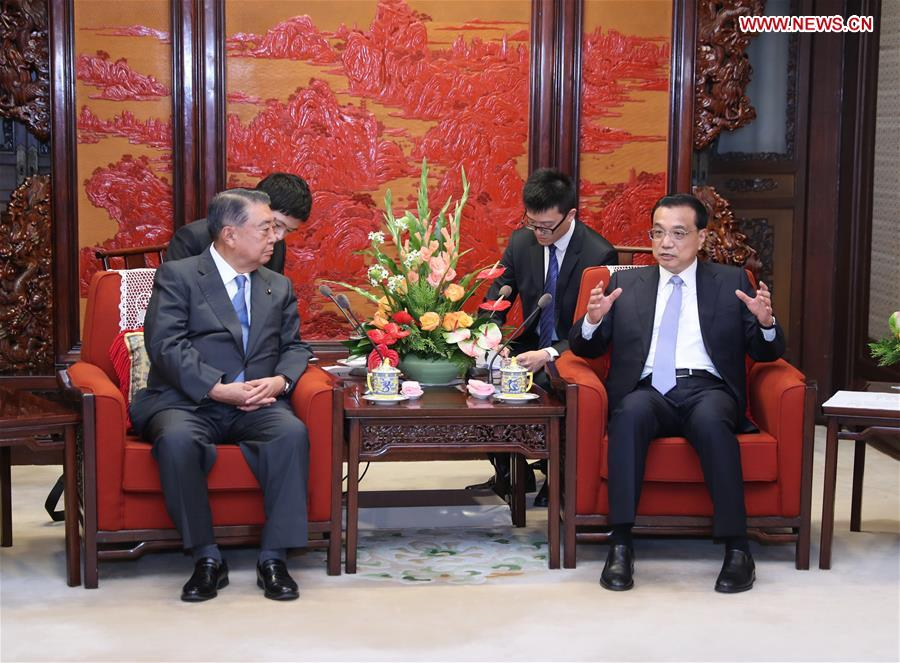
Chinese Premier Li Keqiang (R) meets Tadamori Oshima, speaker of the House of Representatives of the Japanese parliament in Beijing, on July 24, 2018. /Xinhua Photo
Chinese Premier Li Keqiang (R) meets Tadamori Oshima, speaker of the House of Representatives of the Japanese parliament in Beijing, on July 24, 2018. /Xinhua Photo
“Nevertheless, Japan and China relations are facing with great opportunities by all dimensions as the Japanese government has sent several positive signals of the determination of improving relations and both sides have made joint efforts to restore and normalize bilateral ties,” said Yang Xiyu, a senior fellow at the China Institute of International Studies.
Yang believes that the relations between China and Japan will move in a right direction as long as they continue practicing the four political documents – the 1972 China-Japan Joint Statement, the1978 China-Japan Treaty of Peace and Friendship, 1998 China-Japan Joint Declaration and 2008 Statement on Advancing Strategic and Mutually Beneficial Relations – signed during recent decades.
However, gazing at the current situation instead of providing a fruitful vision of China-Japan relations, it is obvious that the relations are rather complicated as enhancing the Japan-US alliance is still a general policy for Tokyo.
Yang pointed out that the common economic interests between the Japan and China are greater than the differences. But, from political and regional security perspectives, as the US desires to make Japan a military ally, the China-Japan geopolitical situation will become increasingly tense.
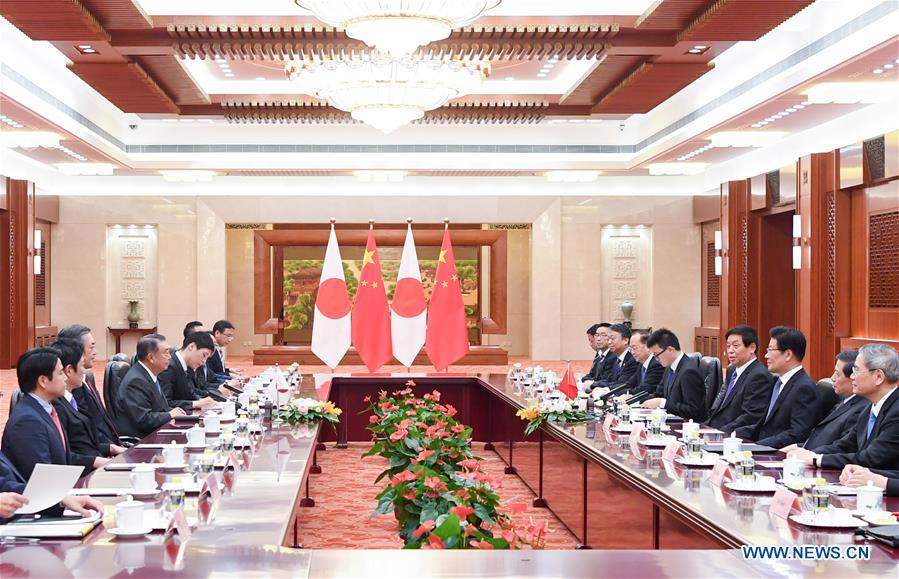
Li Zhanshu (4th R), chairman of the Standing Committee of the National People's Congress, China's top legislature, meets Tadamori Oshima (4th L), speaker of the Japanese House of Representatives, at the Great Hall of the People in Beijing, on July 24, 2018. /Xinhua Photo
Li Zhanshu (4th R), chairman of the Standing Committee of the National People's Congress, China's top legislature, meets Tadamori Oshima (4th L), speaker of the Japanese House of Representatives, at the Great Hall of the People in Beijing, on July 24, 2018. /Xinhua Photo
Japan’s general policy can also be seen in the so-called Indo-Pacific Strategy, which was first proposed by Shinzo Abe when he attended the 2016 African Development Conference held in Kenya.
In November 2017, during his first trip to Asia, US President Donald Trump and Japan jointly launched the Free and Open Indo-Pacific Strategy, thus officially putting the "Indo-Pacific Strategy" into these two countries’ agenda.
According to Yang, the Free and Open Indo-Pacific Strategy still needs space and time to evolve as the scope of the Indo-Pacific stays unclear.
“Non-material strategy cannot input substantive influences on Japan foreign policy, let alone China-Japan relations. But China will keep close eyes on the development of such a strategy and its influences on Japan-US ties to figure the potential of existing negative impacts on China-Japan bilateral relations,” added Yang.