
Opinion
21:50, 17-May-2019
Time for developing countries to bridge gap with developed countries in 5G
 ["china"]
Share







Copied
Editor's note: Zhang Zijian is an associate professor and dean assistant for the School of Computer Science and Technology, Beijing Institute of Technology. The article reflects the author's views, and not necessarily those of CGTN.
May 17, the World Telecommunication Day, celebrates the establishment of the International Telecommunication Union (ITU). On this day, ITU sings high praise for the continuous development of telecommunication technologies in our daily lives.
This year, the theme of World Telecommunication Day is “Bridging the standardization gap,” which mainly exists from standard-making to standard-implementing in different countries. The biggest standardization gap is between developing countries and developed countries. In my opinion, an opportune moment has come for developing countries to close such a gap, since they can now take a big stride forward in technology.
Frankly speaking, the technology gap between developing and developed countries is growing wider around the world, though it may seem that the developing world is catching up. For instance, in the 1990s, while mobile phones were already in the market for customers in North America and some European countries, they were still luxuries in some Asia countries. China at that time hardly had any its own mobile phone brand and was only a manufacturer for Motorola and Nokia.
Today, mobile phones made by Chinese companies like Huawei and Xiaomi are becoming more popular in the domestic market and even international market.
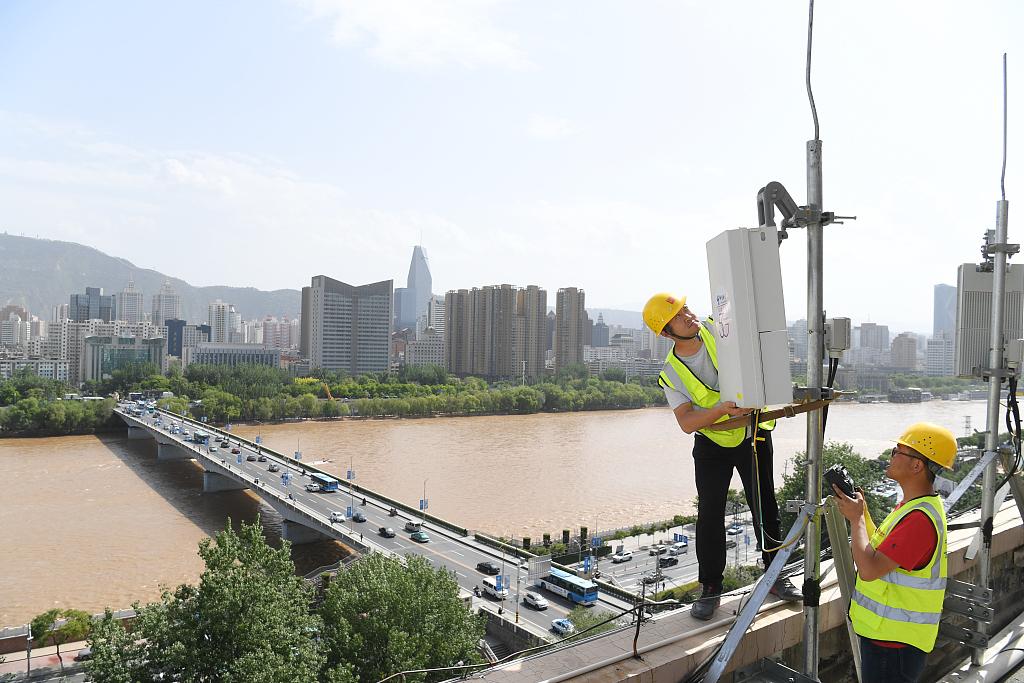
Technicians from China Telecommunications Corporation testing the 5G signal in Lanzhou, China's Gansu Province. /VCG Photo
Technicians from China Telecommunications Corporation testing the 5G signal in Lanzhou, China's Gansu Province. /VCG Photo
This is often regarded as proof of the technical gap disappearing among different countries due to economic globalization, and it is truly encouraging for scientists and engineers in developing countries to establish their confidence.
However, the conclusion might be different if we analyze the previous instance carefully. Although smartphones were prevalent in developing countries in the 2000s, signals and services for radio telecommunication did not cover everywhere and was not always stable in rural and remote areas for long periods of time. But these issues were already considered and solved in advance in developed countries as they rolled out mobile phone networks from the beginning.
In addition, although China's telecommunication giant Huawei has a competitive advantage in providing affordable 5G networks, Qualcomm still has a dominant position in the 5G standard-making and patents in the most used enhanced mobile broadband (eMBB) scenario.
Developed countries' long-term investment and policy support have cultivated a large number of top-notch scientists and leading research labs which developing countries can hardly be a match in a short period of time.
However, this does not mean that developing countries are doomed to be always behind in the standard-making process. Before 5G, China had basically no say in the standard-making process in the previous network generation and now it is also actively participating in the 5G standard-making. ITU's Bridging the Standardization Gap (BSG) program is also offering financial assistance and organizing remote participation from developing countries to promote more inclusive standardization.
In addition, closing the standardization gap not only means more participation from developing countries in the standard-making process but also means developing countries can efficiently implement those standards in their own countries. In an ever more connected world, 5G and Internet of Things are not there for only several countries but for the world to enjoy the benefits of a more intelligent future.
(If you want to contribute and have specific expertise, please contact us at opinions@cgtn.com.)