Chinese President Xi Jinping, Russian President Vladimir Putin and Indian Prime Minister Narendra Modi are gathering for the second time in less than two months, as the 10th BRICS summit takes place in South African city Johannesburg this week.
Their previous meeting was on June 9-10 in China's coastal city Qingdao, where the three leaders attended the 18th summit of the Shanghai Cooperation Organization (SCO).
Multilateral, non-Western platforms like BRICS and the SCO have provided regular opportunities for the three emerging powers to manage differences, coordinate stances and agree on important agendas. This is particularly significant today, with Beijing, Moscow and New Delhi facing common challenges such as unilateralism and trade protectionism.
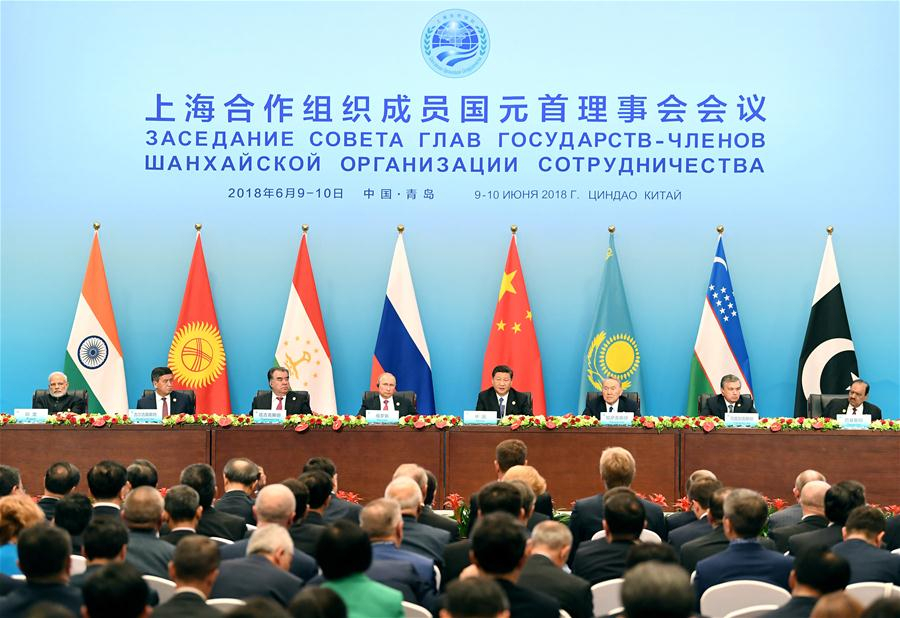
Chinese President Xi Jinping (R4), Russian President Vladimir Putin (L4) and Indian Prime Minister Narendra Modi (L1) attend a joint press conference at the 18th SCO summit in Qingdao, east China's Shandong Province, June 10, 2018. /Xinhua Photo
Chinese President Xi Jinping (R4), Russian President Vladimir Putin (L4) and Indian Prime Minister Narendra Modi (L1) attend a joint press conference at the 18th SCO summit in Qingdao, east China's Shandong Province, June 10, 2018. /Xinhua Photo
Growing China-Russia friendship
China, Russia and India are not just neighbors on the Eurasian continent, but also major developing countries with global influences. Bilateral relations between them have strong impacts on peace and prosperity in their region and the world. Generally speaking, China and Russia enjoy good relations and Russia-India ties are also strong, whereas Beijing and New Delhi disagree on some territorial and geopolitical issues.
China-Russia ties have been developing steadily since 1996, when the two sides established a strategic partnership of coordination. The year 2001 was crucial in the development of their relations, as they signed the Treaty of Good-Neighborliness and Friendly Cooperation and the SCO was founded under the leadership of Beijing and Moscow.
"The strategic partnership of coordination between China and Russia was the foundation for the SCO's creation," a report by three top Chinese think tanks said. The report, released ahead of the SCO Qingdao summit, noted that the bloc became a platform for the two countries to discuss their concerns, coordinate stances and expand cooperation.
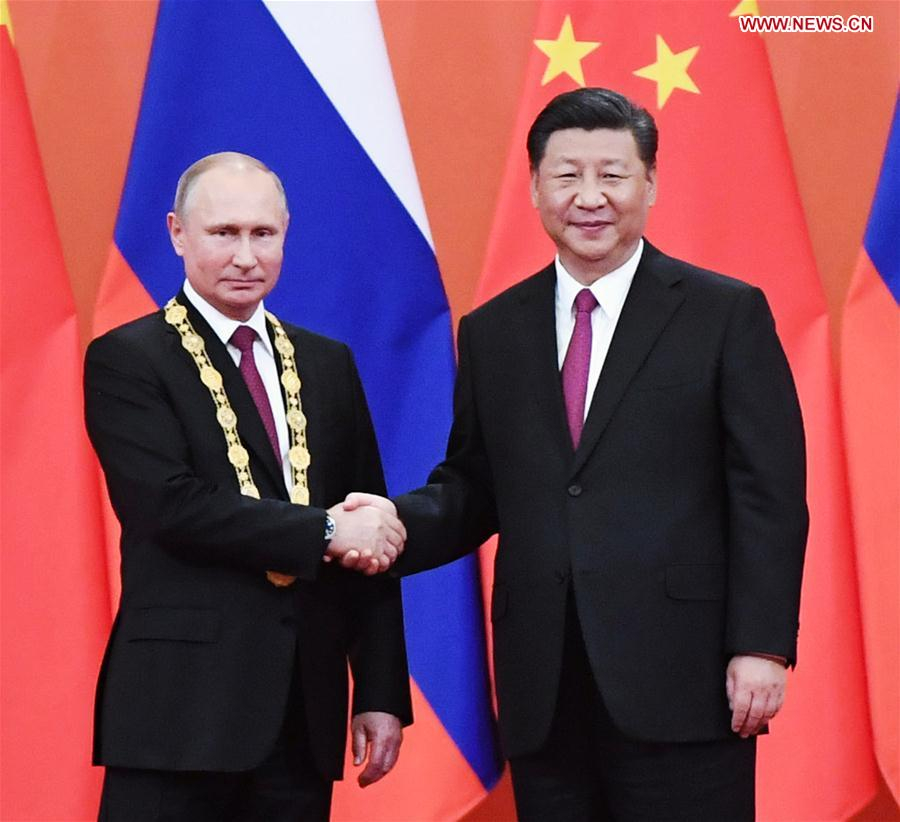
Chinese President Xi Jinping (R) awards his Russian counterpart Vladimir Putin the first-ever Friendship Medal of the People's Republic of China at the Great Hall of the People in Beijing, June 8, 2018. /Xinhua Photo
Chinese President Xi Jinping (R) awards his Russian counterpart Vladimir Putin the first-ever Friendship Medal of the People's Republic of China at the Great Hall of the People in Beijing, June 8, 2018. /Xinhua Photo
Since the first BRIC summit in 2009 (South Africa joined the forum in 2011, turning BRIC into BRICS), BRIC/BRICS has become another important platform for China-Russia cooperation.
In 2011, China and Russia elevated their ties to comprehensive strategic partnership of coordination. The two countries are getting increasingly closer in recent years in the context of deteriorating relations between Russia and the West.
"US/EU sanctions on Russia have … given Moscow little choice but to deepen ties with China," former Indian Foreign Secretary Kanwal Sibal wrote on DailyO last month.
The fact that Xi and Putin have presented each other their most prestigious state honors highlights the level of friendship between the two countries.
While visiting Russia in July last year, Xi was awarded by Putin the highest order of Russia, known as the Order of St. Andrew the Apostle the First-Called. Last month in Beijing, Xi presented China's first Friendship Medal to his Russian counterpart, describing Putin as his "best friend" and "confidant."
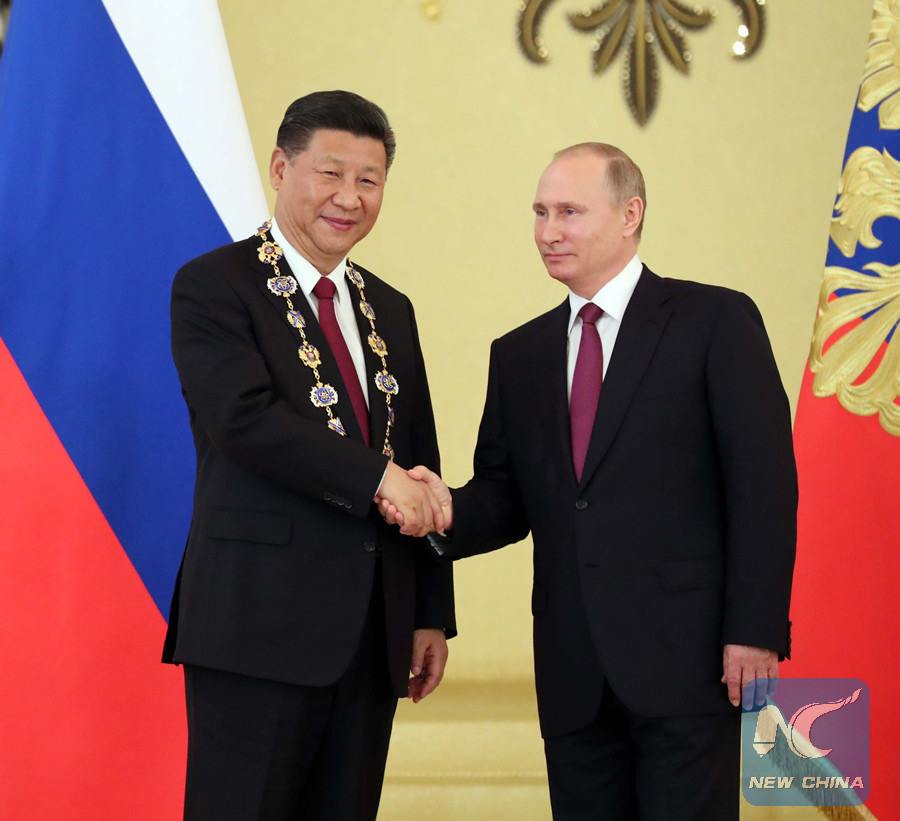
July 4, 2017: Chinese President Xi Jinping (L) is awarded by his Russian counterpart Vladimir Putin the highest order of Russia, or the Order of St. Andrew the Apostle the First-Called, after their talks in Moscow, Russia. /Xinhua Photo
July 4, 2017: Chinese President Xi Jinping (L) is awarded by his Russian counterpart Vladimir Putin the highest order of Russia, or the Order of St. Andrew the Apostle the First-Called, after their talks in Moscow, Russia. /Xinhua Photo
Traditional Russia-India partnership
As an ally of the former Soviet Union during the Cold War, India still maintains strong ties with Russia despite Moscow's concerns over New Delhi's growing closeness to Washington. During Modi's informal summit with Putin in Sochi two months ago, the two sides upgraded their relationship to a "special privileged strategic partnership."
Military cooperation between Russia and India has been robust for decades, with Russia supplying about 60 percent of India's imported military equipment by value, according to the Brookings Institution.
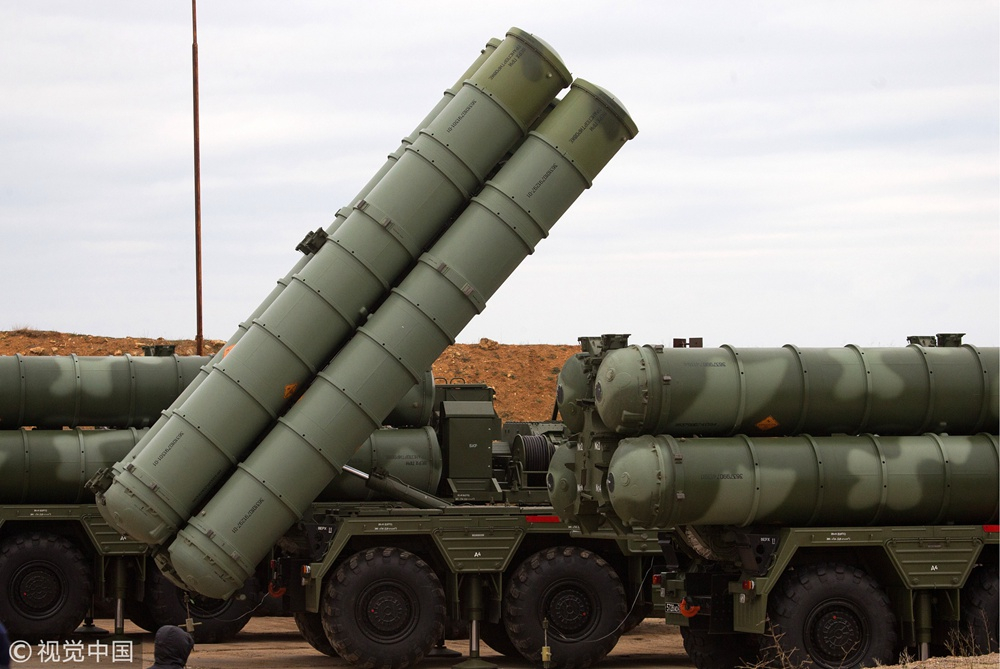
Despite US pressure and India's efforts to diversify its defense procurement, Indian Defense Minister Nirmala Sitharaman recently said her country would go ahead with the plan to purchase five advanced S-400 Triumf air defense missile systems from Russia.
"In all our engagements with the US, we have clearly explained how India and Russia's defense cooperation has been going on for a long time and that it is a time-tested relationship," she said earlier this month.
Russian President Vladimir Putin (R) and Indian Prime Minister Narendra Modi visit the Sirius Educational Center for Talented Children, Sochi, Russia, May 21, 2018. /VCG Photo
Russian President Vladimir Putin (R) and Indian Prime Minister Narendra Modi visit the Sirius Educational Center for Talented Children, Sochi, Russia, May 21, 2018. /VCG Photo
While New Delhi's ties with Moscow remains strong, its relations with Washington "are not in the pink," a report by Oneindia noted last month, explaining that the Donald Trump administration's "tough calls on visa and immigration and tariffs and also diktats on trade have put New Delhi-Washington ties under some stress."
On June 21, India retaliated against Washington's tariff hikes on steel and aluminum by raising import duties on various US goods such as almonds, apples and some metal products.
In today's circumstances, it is natural that India is improving ties with Russia and China, the Oneindia report suggested.
Eurasia Future, a website offering news and analysis on geopolitical issues, also said India is looking for "more diplomatic and economic engagement with Russia," particularly within the BRICS and SCO frameworks.
"The BRICS forum and the SCO are two important blocs where India sees Russia as the most important and trusted partner," geopolitical analyst Rajeev Ahmed wrote on Eurasia Future on June 22.
Russia's S-400 Triumf surface-to-air missile systems /VCG Photo
Russia's S-400 Triumf surface-to-air missile systems /VCG Photo
China-India ties on the mend
China-India ties are the trickiest among the three pairs of relations between Beijing, Moscow and New Delhi. The two countries still have unresolved border disputes, and India has yet to endorse the China-proposed Belt and Road Initiative. Last summer, China and India even had a two-month military standoff in the border area of Donglang (Doklam).
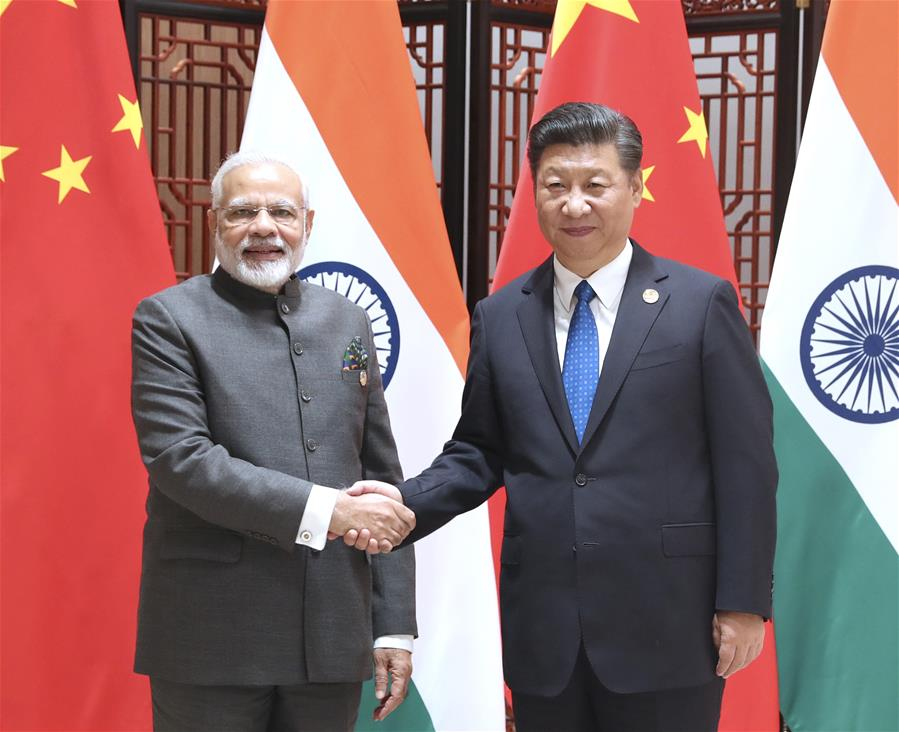
Nevertheless, gradual rapprochement has been going on since then. Days after the conclusion of the standoff, Xi and Modi held talks on the sidelines of the ninth BRICS summit in Chinese city Xiamen in September 2017, agreeing that the two countries should not see each other as rivals or threats. The Chinese president stressed that peaceful coexistence and win-win cooperation are the only right choice for the two sides.
Hence it was at last year's BRICS summit that the process of China-India rapprochement kicked off.
September 5, 2017: Chinese President Xi Jinping (R) meets with Indian Prime Minister Narendra Modi on the sidelines of the ninth BRICS summit in Xiamen, southeast China's Fujian Province. /Xinhua Photo
September 5, 2017: Chinese President Xi Jinping (R) meets with Indian Prime Minister Narendra Modi on the sidelines of the ninth BRICS summit in Xiamen, southeast China's Fujian Province. /Xinhua Photo
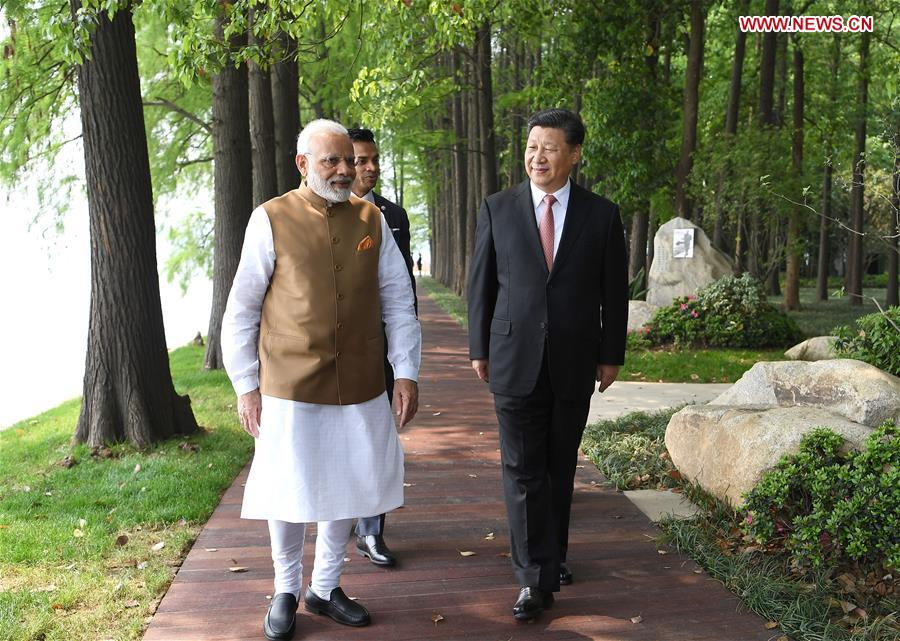
The process started to gather pace in late April, when the Indian prime minister came to central China's Wuhan for an informal meeting with Xi. The visit took place six weeks ahead of the SCO summit in Qingdao – the first SCO summit attended by Modi after India was admitted to the bloc last year.
"China and India should be good neighbors and friends," Xi said. "The two countries should regard each other as a positive factor in the balance of global power and take each other as partners for realizing the dream of development."
Modi suggested that the two sides should strengthen contacts and cooperation, enhance mutual understanding and trust, properly handle and control their differences and boost people-to-people friendship, so as to upgrade bilateral relations to a new level.
Chinese President Xi Jinping (R) walks with Indian Prime Minister Narendra Modi in Wuhan, central China's Hubei Province, April 28, 2018. /Xinhua Photo
Chinese President Xi Jinping (R) walks with Indian Prime Minister Narendra Modi in Wuhan, central China's Hubei Province, April 28, 2018. /Xinhua Photo
When they met in Qingdao last month, both leaders agreed to work on the basis of the successful Wuhan meeting to enhance political mutual trust and engage in mutually beneficial cooperation.
Despite ups and downs in their relations, China and India have been making efforts to enhance communication, expand common ground and deepen mutual trust.
In an interview with CGTN earlier this year, Indian economist Ajit Ranade said "it was wrong to say all of India sees China as a threat" and stressed that there were "huge opportunities" for cooperation.
The optimism originated from some fundamental factors binding the two countries together: both are major developing countries and emerging markets; they share common interests, concerns and propositions; their economies are complementary and there is huge potential for further cooperation.
Anti-protectionism triangle?
Chinese and Russian leaders repeatedly hail that bilateral relations are at their "best time in history." Traditional partnership between Russia and India is still robust. And China-India ties are back on the right track. Moreover, the three emerging powers agree on a broad range of principles in dealing with global issues.
After attending the 15th Meeting of Foreign Ministers of China, Russia and India in New Delhi last December, Chinese Foreign Minister Wang Yi said the three sides had agreed to make joint efforts to rebalance globalization, uphold the global multilateral trade system, and oppose all forms of protectionism.
The three key members of BRICS enjoy closer understanding today than they did before the Xiamen summit last year, India's former envoy to South Africa Rajeev Bhatia stressed in an article for the Mumbai-based Gateway House think tank.
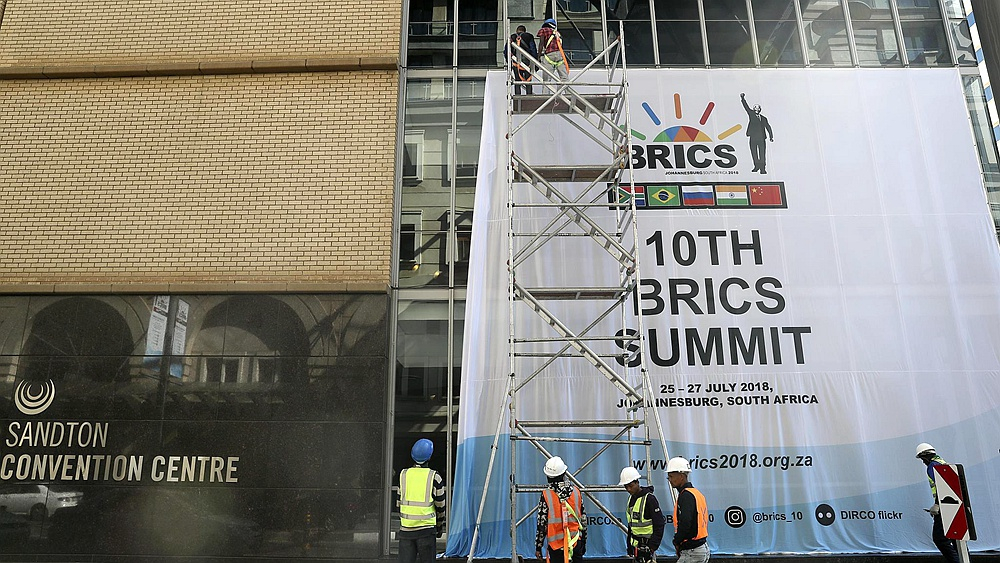
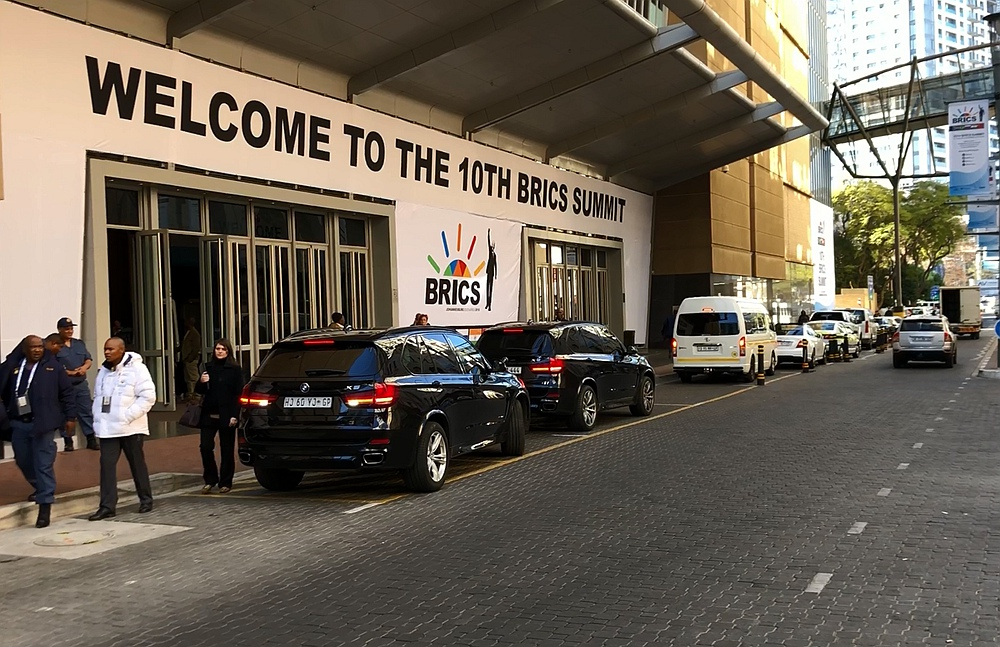
The entrance of the Sandton Convention Center in Johannesburg, South Africa, which is the venue for the 10th BRICS summit, July 23, 2018. /CGTN Photo
The entrance of the Sandton Convention Center in Johannesburg, South Africa, which is the venue for the 10th BRICS summit, July 23, 2018. /CGTN Photo
These are encouraging signals ahead of the BRICS summit in Johannesburg, where the leaders are expected to present a united front against unilateralism and trade protectionism.
In the context of escalated trade tensions between the US and China as well as other countries, the threat of a global trade war could top the agenda of the summit, an AFP story said on Tuesday.
"This is a trade war, so leaders' discussions are particular important in coordinating out positions," Russian Economy Minister Maxim Oreshkin said last week.
Sreeram Chaulia, a professor at the Jindal School of International Affairs of India's O.P. Jindal Global University, said BRICS leaders would "concur that the US has unleashed punitive trade wars that are hurting all the BRICS members," according to the AFP report.
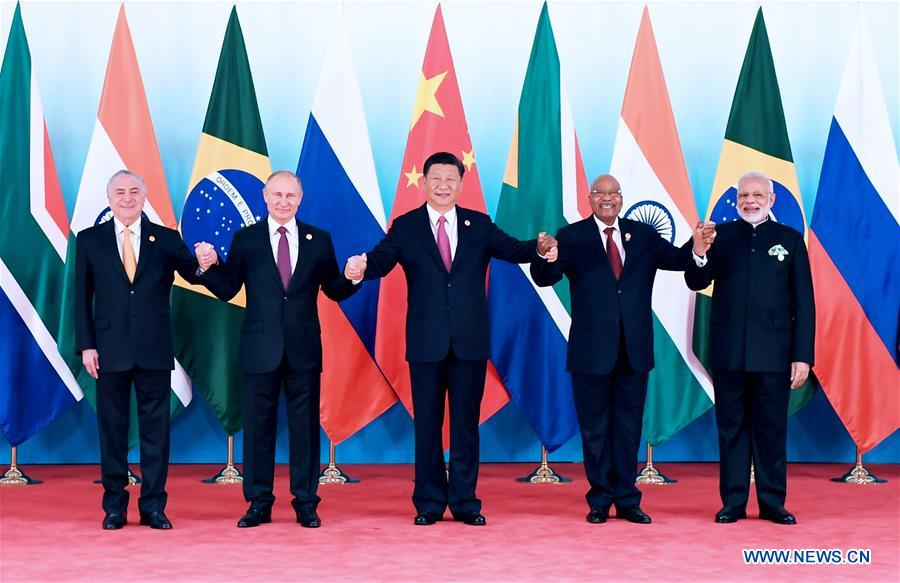
September 4, 2017: Chinese President Xi Jinping (C) and other leaders of BRICS countries pose for a group photo before the 2017 BRICS summit in Xiamen, southeast China's Fujian Province. /Xinhua Photo
September 4, 2017: Chinese President Xi Jinping (C) and other leaders of BRICS countries pose for a group photo before the 2017 BRICS summit in Xiamen, southeast China's Fujian Province. /Xinhua Photo
A planned meeting between Xi and Modi on the sidelines of the summit is likely to feature the topic as well. "The US protectionist and unilateral acts have caused widespread and grave concerns worldwide," Chinese Foreign Ministry spokeswoman Hua Chunying said last Friday in response to a question about the agenda of the meeting. "China and India are both staunch supporters of multilateralism and an open world economy, and we both oppose protectionism."
A BRICS summit alone will not resolve all outstanding issues between China, Russia and India, but it is an opportunity for major developing countries of the world to focus on their commonalities and take concerted action to tackle common challenges and pursue common goals.

 ["china"]