
Analysis
16:14, 05-Apr-2019
Americans predict a diminished U.S. by 2050
Updated
16:57, 05-Apr-2019
 ["north america","china"]
Share







Copied
Tucker Carlson, the Fox News host, faced a backlash in the United States in December when he said that mass immigration "makes our country poorer, and dirtier, and more divided."
Tucker stood his ground and refused to apologize even though he received significant criticism and his program lost advertisers. He clearly had his pulse on his audience base, if one were to judge from the results of a recent Pew Research Center survey.
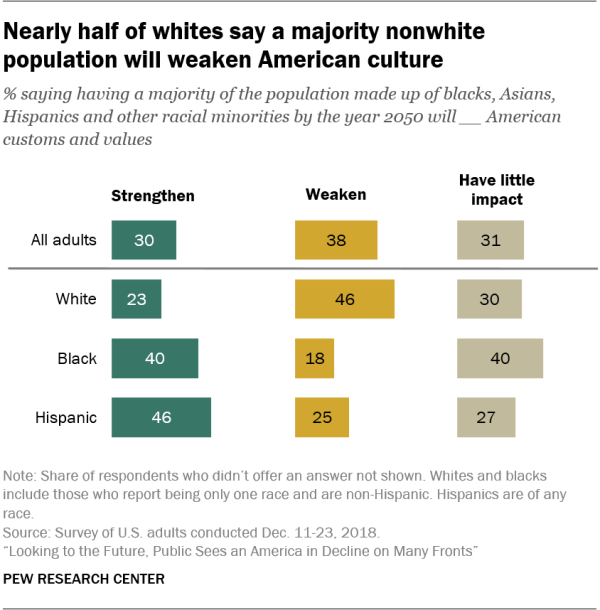
Almost half of white Americans say the U.S. becoming a majority nonwhite nation would "weaken American customs and values," the survey found, though one is left to guess what "customs and values" mean as the term wasn't defined.
The U.S. Census Bureau predicts that the county will become “minority white” before 2050, so the survey sought to gauge Americans' views about the political, economic and societal changes that could come by that year.
Pew Graphic
Pew Graphic
For the most part, they see a country in decline economically, politically and globally, even though a majority (56 percent) more broadly express a measure of optimism about the future. In other words, their outlook becomes more negative when specific subjects are raised, such as America's place on the world stage.
'China will supplant U.S.'
Americans expect the standing of the U.S. internationally to weaken and the influence of China to grow. Just over half of all adults expect that China definitely or probably will overtake the United States as the world's main superpower during the next three decades.
It is a view that fits with the Donald Trump administration, which sees the containment of China, labeled a "strategic competitor," as a major foreign policy objective.
The majority of Trump's Republican party seems to believe that he will, at least make some headway. A little less than half of Republicans predict that China will move ahead of the U.S. but that number grows to 59 percent among Democrats.
Yet the president would do well to first look into the mirror at home. The report found that the majority of Americans have little confidence that their national government and elected officials are up to the job of handling the challenges of the future. More than 80 percent say they are worried about the way Washington works and about the ability of political leaders to solve the nation's biggest problems.
Pew Graphic
Pew Graphic
The big differences among party supporters are evident in other areas as well. A quarter of white Americans say greater diversity would be good, as do more than half of blacks (53 percent) and Hispanics (55 percent). Fifty-three percent of white Americans say it would lead to more conflict between racial and ethnic groups compared with 43 percent of nonwhites.
Views also differ by age, according to the report. Young adults are more likely than their older counterparts to say that a majority nonwhite population will benefit the country. "These differences reflect, in part, the fact that the younger group is more racially and ethnically diverse than the older groups," it said. The census actually projects that in 2060, whites will comprise only 36 percent of the under-18 population, with Hispanics accounting for 32 percent.
Divide over race relations
Strikingly, on some issues, the gap across major demographic and political groups narrows. Pew said that 73 percent of all Americans expect the chasm between the rich and the poor to grow over the next 30 years, reflecting large majorities across these groups.
Majorities of both political parties also believe that the country will be more politically divided in 2050 than it is now.
When it comes to race relations, a very narrow majority (51 percent) overall expect things to improve. "A slight majority of whites (54 percent) predict that race relations will improve in the next 30 years, while 39 percent say they will worsen," the report said. "Blacks split down the middle: 43 percent predict better relations between the races and the same percentage predict they will be worse. Hispanics also split roughly equally, with 45 percent expecting improved relations and 42 percent saying they will get worse."
The survey offers a snapshot of Americans' thinking, and what it reveals is not just a divided country that expects more division but pessimism in their expectations for "a weaker economy, a growing income divide and a broken political system."