
Economy
17:54, 25-Apr-2019
Business Inroads: BRI brings multi-billion dollar opportunities in insurance
Updated
08:00, 26-Apr-2019
 ["china"]
Share







Copied
03:29
Switzerland is about to sign on to the Belt and Road Initiative (BRI), and with that could come multi-billion dollar opportunities in insurance, according to Guido Furer, the chief investment officer of Swiss Re, the world's second-largest reinsurer.
Switzerland will sign an accord backing the BRI. In a joint interview with Chinese media, President Ueli Maurer of the Swiss Confederation said the BRI has created a new dimension for the development of the world economy, which so far has barely seen a long-term strategic plan.
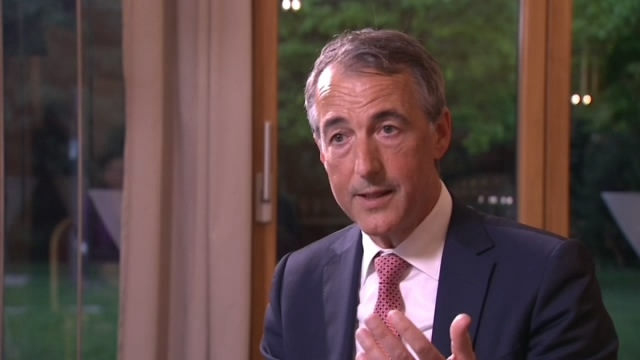
Switzerland's largest insurer Swiss Re sees enormous potential in insurance along the BRI, Furer said, noting that the company's own studies showed that there are billions of additional premium coming out of those BRI projects – "the additional insurance premium which is created out of those BRI projects is about 34 billion U.S. dollars. And annual engineering premium is around 21 billion U.S. dollars."
"It's not only at the construction side. Once the projects are done, they need protection. Just think about property risk, liability risk – all those continuations of coverage we can provide," Furer said, adding that the company can provide capacity as well as “knowledge expertise.”
Furer hoped that BRI can create a pilot program that makes it easier to introduce institutional money since "right now, it's hard to enter infrastructure projects as they are complex."
CGTN Photo
CGTN Photo
"We see it as a good opportunity to bring in private market to a much bigger extent than we have seen so far, because a lot of institutional money is looking for long-term deployment. So we are highly interested in getting into the funding side," he stated.
Sustainable investing pays off
Environmental, Social and Governance (ESG) are the criteria that establish the framework for assessing the impact of the sustainability and ethical practices of a company on its financial performance and operations.
Swiss Re is one of the earliest re-insurers to adopt the criteria, which is applied to 100 percent of its investment portfolio, and claims that the benchmarks make economic sense.
Furer considered ESG as "topics beyond individual companies," saying that Swiss Re is trying to figure out "the most meaningful way to implement them."
And its ESG portfolio has outperformed. "Our expectation is that it will be a safer portfolio. That means it's less volatile. To our surprise, the return is higher. So that step made a lot of sense in every respect. Not only supporting it by smart risk coverage, but also supporting it from the investment side."
Swiss Re helps Chinese insurers fend off risk
As the world's second-largest insurance market, China has always been one of the most highly regarded markets for Swiss Re Group. From Furer's perspective, the group is aligning with China's priorities in aging, the middle class and smart cities.
Meanwhile, he is confident that Swiss Re can help China understand, construct and engineer their way out of the challenges.
"Good example is the government's push in the Greater Bay Area, creating smart cities and green technologies – we can support a lot in those areas. Our Swiss Re Institute does risk mapping, to understand what are the new risks, such as smart city – dependency but also connectivity."