
Opinions
11:20, 13-Aug-2018
Opinion: China-Africa strategy goes beyond economic cooperation
Updated
10:22, 16-Aug-2018
 ["china"]
Share







Copied

Editor’s note: Shen Shiwei is a research fellow of the Charhar Institute and former government relations and business consultant for Chinese enterprises in Africa and the Middle East. The article reflects the author's opinion and not necessarily the views of CGTN.
With the 2018 Beijing Summit of the Forum on China-Africa Cooperation approaching, many observers may be curious about what will be Beijing’s next move on China-Africa strategic cooperation.
Strategy for joint economic transformation
Where there is a will, there is a way. For China and African nations, they all share a strong will to accumulate a fortune and boost robust economic development for decades.
The African Union 2063 Agenda has outlined the African development blueprint over the next 50 years. Accordingly, many African nations have their own national development strategy for the coming decades. In this field, China is an important strategic partner.
The Ten Major China-Africa Cooperation Plans unveiled in the Johannesburg Summit of the FOCAC in 2015 charted a comprehensive strategic cooperative partnership.
In recent years, a large number of strategic cooperation projects like the Nairobi-Mombasa railway in Kenya and the Abuja-Kaduna railway in Nigeria have been operating smoothly. Many other strategic projects in areas such as agriculture, industrial capacity building, public health and security have effectively laid a solid foundation for Africa’s economies and effectively supported the continent's sustainable development goals.

Kenyan President Uhuru Kenyatta flags off a cargo train on the Chinese-built Nairobi-Mombasa railway, Kenya's largest infrastructure project since its independence, on May 30, 2017. /VCG Photo.
Kenyan President Uhuru Kenyatta flags off a cargo train on the Chinese-built Nairobi-Mombasa railway, Kenya's largest infrastructure project since its independence, on May 30, 2017. /VCG Photo.
Many African countries have specific strategies and conditions. Achieving diversified development and identifying priority fields for cooperation in accordance with local conditions are essential.
For example, in Namibia, Senegal and Djibouti, developing the marine economy, port-neighboring industrial parks and free trade area could explore new economic growth points. In Kenya, Nigeria and Ethiopia, accelerating industrialization via infrastructure construction, industrial parks and industrial capacity cooperation is a key outlet for advancing economic development.
For more advanced technical cooperation, China launched the China-Africa Science and Technology Partnership Plan following the Fourth FOCAC Ministerial Conference in 2010. It aims at promoting technology transfer to Africa and expanding the sharing of scientific and technological achievements.
Food security – a top priority
China and African nations always put their economic security and integrity as a top priority. Only independent and sound economic development can generate a promising future.
Africa has a population of over one billion. Agriculture is not only crucial for stable development and poverty reduction efforts, but also a pillar industry and a priority field for sustainable development.
"Hunger breeds discontent," is an old Chinese saying reflecting the same understanding.
Some observers have alleged that China’s agriculture cooperation is grabbing precious land and food resources. However, defying expectations, China actually exports more food to Africa than it imports. Also, it is continuing efforts to help Africa to ensure food security.
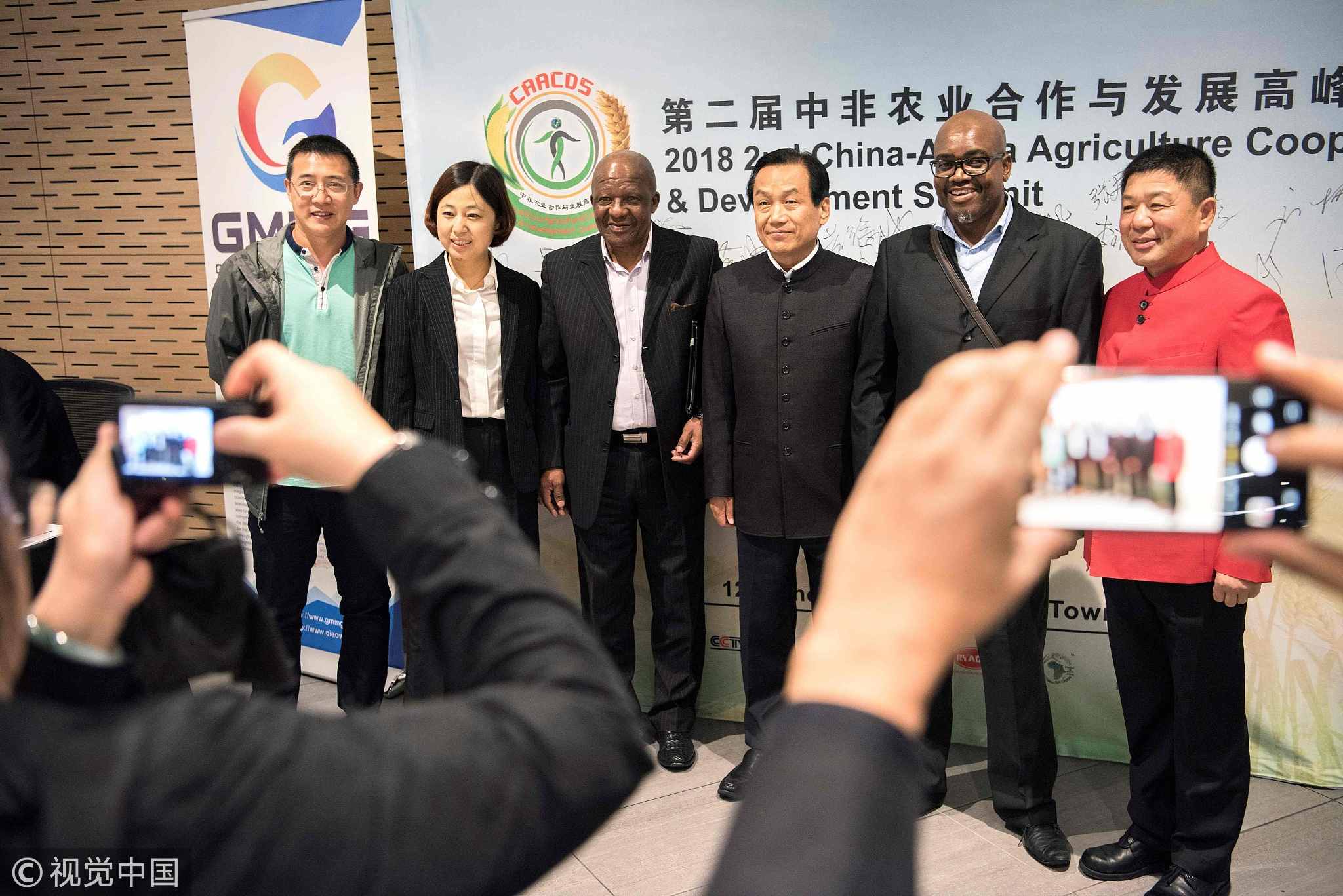
Attendees at the Second China-Africa Agricultural Cooperation and Development Summit in Cape Town on July 12, 2018. /VCG Photo
Attendees at the Second China-Africa Agricultural Cooperation and Development Summit in Cape Town on July 12, 2018. /VCG Photo
The book titled "Will Africa Feed China" by Deborah Brautigam, one of the leading experts on China and Africa, probes the myths and realities behind the media headlines.
From my observation, China has scaled up its agricultural cooperation with Africa. New agricultural technology demonstration centers for Africa have been established and agricultural technology expert teams have been dispatched to build up local technical capacity.
In Mozambique, for example, 300 hectares of experimental paddy fields supported by Chinese investment yielded 9-10 tons per hectare for three successive years. With the help of Chinese rice experts and China Wanbao Co. Ltd, local farmers have seen their paddy fields yield five tons per hectare, two tons more than previous yields. All these achievements have improved local food security dramatically.
Chinese enterprises have invested in Africa in areas like breeding improved seeds, planting grain and cash crops, and processing agricultural products. Though the generation of profit takes much longer, local agriculture policies have changed rapidly.
Key fields include exchanges on agricultural policies, agricultural infrastructure improvement, development of systems of agricultural support services, modern agricultural development capacity building, and investment in the complete value chain of agriculture to improve Africa's agricultural production and strengthen its capability to ensure food security.
China is today exploring new commercial paths with African nations to turn resource advantages into developmental ones and sustainably develop their agricultural capacities. Therefore, agriculture should be one of the potential avenues for future cooperation between China and Africa.
The new fronts, the new potential

A Chinese manager for a construction company visits a road construction project run by Chinese in central Addis Ababa, Ethiopia. /VCG Photo
A Chinese manager for a construction company visits a road construction project run by Chinese in central Addis Ababa, Ethiopia. /VCG Photo
In 2000, cooperation between Africa and China was institutionalized through the establishment of the Forum on China- Africa Cooperation (FOCAC). Since then, mutual economic cooperation has been enhanced and become prominent.
Many Chinese enterprises and personnel have expanded their business in many African countries either by themselves or with local partners. On the other side, many African businessmen have achieved their dream fortunes in China, such as Yiwu in eastern Zhejiang province and Guangzhou in southern Guangdong province.
The provinces and cities in China have diversified natural conditions, specific advantages and experience in economic and social development. Situations across the African continent are also diversified.
Therefore, the promotion of exchanges and cooperation between local governments, and support for the establishment of more sister provinces/cities relationships, as well as the institutionalization of the China-Africa Forum on Cooperation among local governments could facilitate and accelerate in-depth cooperation.