
Opinions
10:41, 26-Jul-2018
Opinion: Is the Fourth Industrial Revolution a new chance for Africa?
Updated
10:07, 29-Jul-2018
 ["china"]
Share







Copied
Editor's note: Zhang Yongpeng is the Senior Research Fellow at the Institute of West Asian and African Studies, Chinese Academy of Social Sciences. The article reflects the author’s opinion, and not necessarily the views of CGTN.
The Fourth Industrial Revolution has been described as “the advent of ‘cyber-physical systems’”, which transfers artificial intelligence into realistic powers of production, human behavior and ability, resulting finally in taking the place of human beings in creating their own society. For Africa, the option facing the fourth industrial revolution is nothing but to embrace it.
For every reason, like it or not, the fourth industrial revolution is not an option. Like gifts from God, it, or precisely the artificial intelligence-dominated power, will bring great convenience to our lives. With smart technology, a ”circular economy” will soon come to truth with less waste discharged; “internet of things” will help us to use energy efficiently; new energy will be developed continuously and in consequence, environmental problems caused by climate change will be largely solved. Considering the tough reality in Africa and suffering from climate change and difficulties in obtaining new energies, the coming “cyber power” may provide sound solutions.
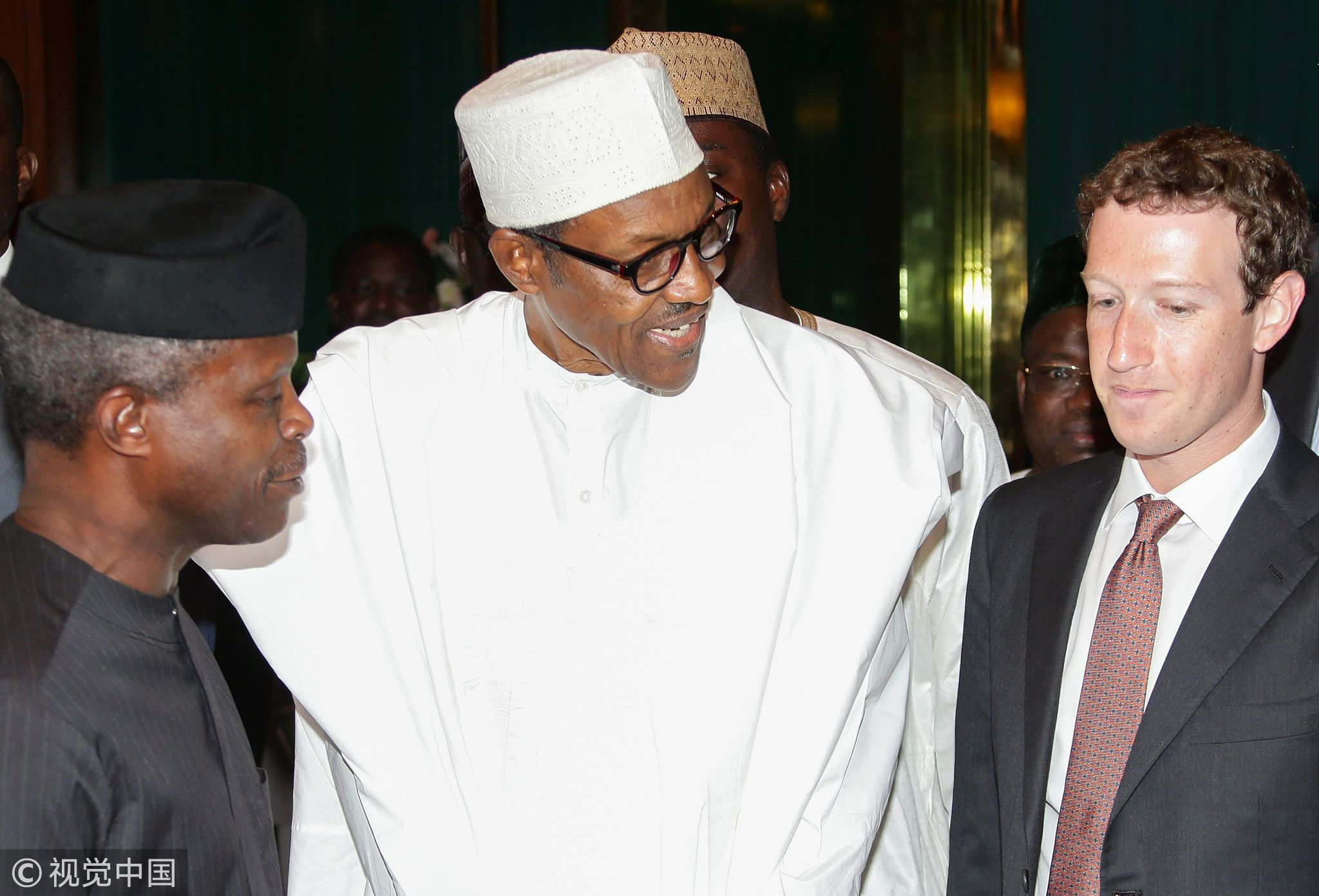
Nigerian President Muhammadu Buhari (C) and Vice President Yemi Osinbajo (L) talk with Facebook founder Mark Zuckerberg (R), during his visit to the presidential palace in Abuja, on September 2, 2016./VCG Photo
Nigerian President Muhammadu Buhari (C) and Vice President Yemi Osinbajo (L) talk with Facebook founder Mark Zuckerberg (R), during his visit to the presidential palace in Abuja, on September 2, 2016./VCG Photo
While the Fourth Industrial Revolution and its iconic technologies promote changes in economies and societies in other parts of the world, especially with progress in productivity and great improvement in production efficiency, there is no reason for Africa to refuse such a revolution. As with previous industrial revolutions, the Fourth Industrial Revolution will not only affect some aspects of human life, but will lead to overwhelming changes in our way of life. As a result, human society will change correspondingly. Obviously, Africa cannot afford to neglect the new revolution. The only option is to stand and embrace it, and to go with it. Historically being backward, Africa has no longer “opportunity” to choose to lag.
Like any new technology in history, the new technologies developed under the Fourth Revolution could also be two-edged weapons, presented in the form of opportunities and challenges co-existing. Doubtlessly, if Africa can take the opportunities from the new revolution, challenges may be transformed into advantages of development.

The magnificent view of Johannesburg at night. /VCG Photo
The magnificent view of Johannesburg at night. /VCG Photo
Looking back at the previous three industrial revolutions, all were accompanied by positive and negative influences on the development of specific societies. The first and second industrial revolutions, marked by the advent of machines and electricity, greatly enriched Europe's wealth and capacity to act. As a result, Asia and Africa became the victims of European colonialism. This means that technology is really a power. Today, those who will or are dominating the new industrial revolution will naturally control the power of future development. In view of the fact that new technologies are usually developed by the developed parties, the parties in developing or backward situations might be pressed into further marginalized situations in global competitions or more seriously, eliminated. As a continent with more than 30 developing countries, it is likely that Africa would be harmed by the new revolution of new technology. The most direct challenge is the robot that will largely take place of human forces. As a continent with a fast-growing population, employment is no doubt the priority in its development agenda. And harm to employment will be detrimental to economy and development.
A way out for Africa when facing this new industrial revolution is to enlarge its cooperation with the current emerging or developing economies. The latter usually faces the same tasks of development as Africa does, with their economies and technologies complementary with those of Africa and the production and consumption costs at similar levels. This means it is helpful in extending the adaptation period to any new technology, mitigating any sudden impact. In this way Africa could lessen or avoid its pains in embracing the Fourth Industrial Revolution.