
Opinions
10:08, 24-May-2018
Opinion: Moon’s Tough Trip to Washington
 ["china"]
Share







Copied
Editor's note: Cheng Xiaohe is an associate Professor at the School of International Studies under Renmin University of China, and he is also a senior researcher with Pangoal Institute. The article reflects the author’s opinion, and not necessarily the views of CGTN.
What had happened on the Korean Peninsula was too good to be true: The abrupt decision of the Democratic People's Republic of Korea (DPRK) to suspend a planned high-level inter-Korean meeting and the threat to reconsider attending the highly expected Kim-Trump summit remind us that the Korean Peninsula, now bathed in the hilarious rapprochement, is still vulnerable to diplomatic brawls and setbacks.
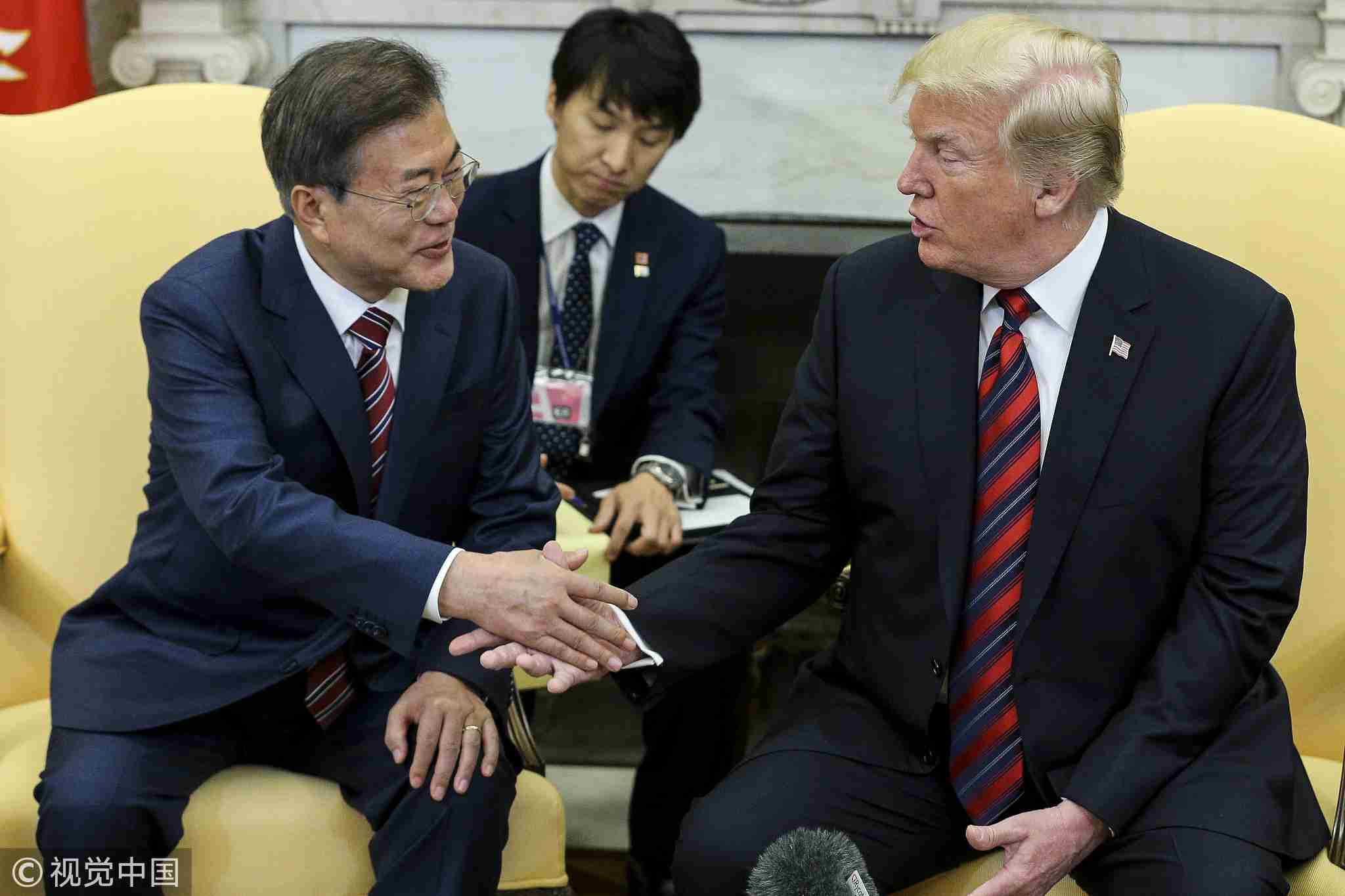
US President Donald Trump shakes hands with South Korean President Moon Jae-in during a meeting in the Oval Office of the White House in Washington, DC, May 22, 2018./VCG Photo
US President Donald Trump shakes hands with South Korean President Moon Jae-in during a meeting in the Oval Office of the White House in Washington, DC, May 22, 2018./VCG Photo
DPRK’s decision certainly did not come from nowhere. Three major reasons came into play.
First, as pointed out by first vice minister of foreign affairs Kim Kye Gwan and Chairman of the Committee for the Peaceful Reunification of the Country (CPRC) Ri Son Gwon, the ongoing US-South Korea joint air combat exercises, dubbed “Max Thunder,” should be blamed.
From DPRK’s perspective, the largest-ever drill is “a reflection of the invariable stand of the US and South Korea to persist in the ‘maximum pressure and sanctions’ against the DPRK” and “an undisguised challenge to the Panmunjom Declaration and a deliberate military provocation to the trend of the favorably developing situation on the Korean Peninsula.”
Even though the DPRK could unilaterally freeze its nuclear and missile tests as the United States and South Korea, or the Republic of Korea (ROK), continued to carry out their joint military drill, this time, the DPRK broke its silence and took action in order to register its anger and protest.
Second, the DPRK did not hide its disappointment with the ROK government, with whom it just signed the Panmunjom Declaration. The DPRK believed that the ROK government not only failed to live up to the declaration by reining in anti-DPRK activities in the ROK, but also failed to persuade the United States to scale down, if not cancel, the "Max Thunder" exercise.
Third, the DPRK became increasingly fed up with the heavy-handed American approaches in the behind-the-scenes negotiation in the run-up to the Kim-Trump summit.
It perceived National Security Adviser John Bolton’s unbridled denuclearization remarks as “a manifestation of awfully sinister move to impose on our dignified state the destiny of Libya or Iraq which had been collapsed due to yielding the whole of their countries to big powers.”
By voicing its vocal opposition to the hardliners’ proposals, the DPRK tried to gain more initiative and extract more concessions in the preparatory game with the United States.
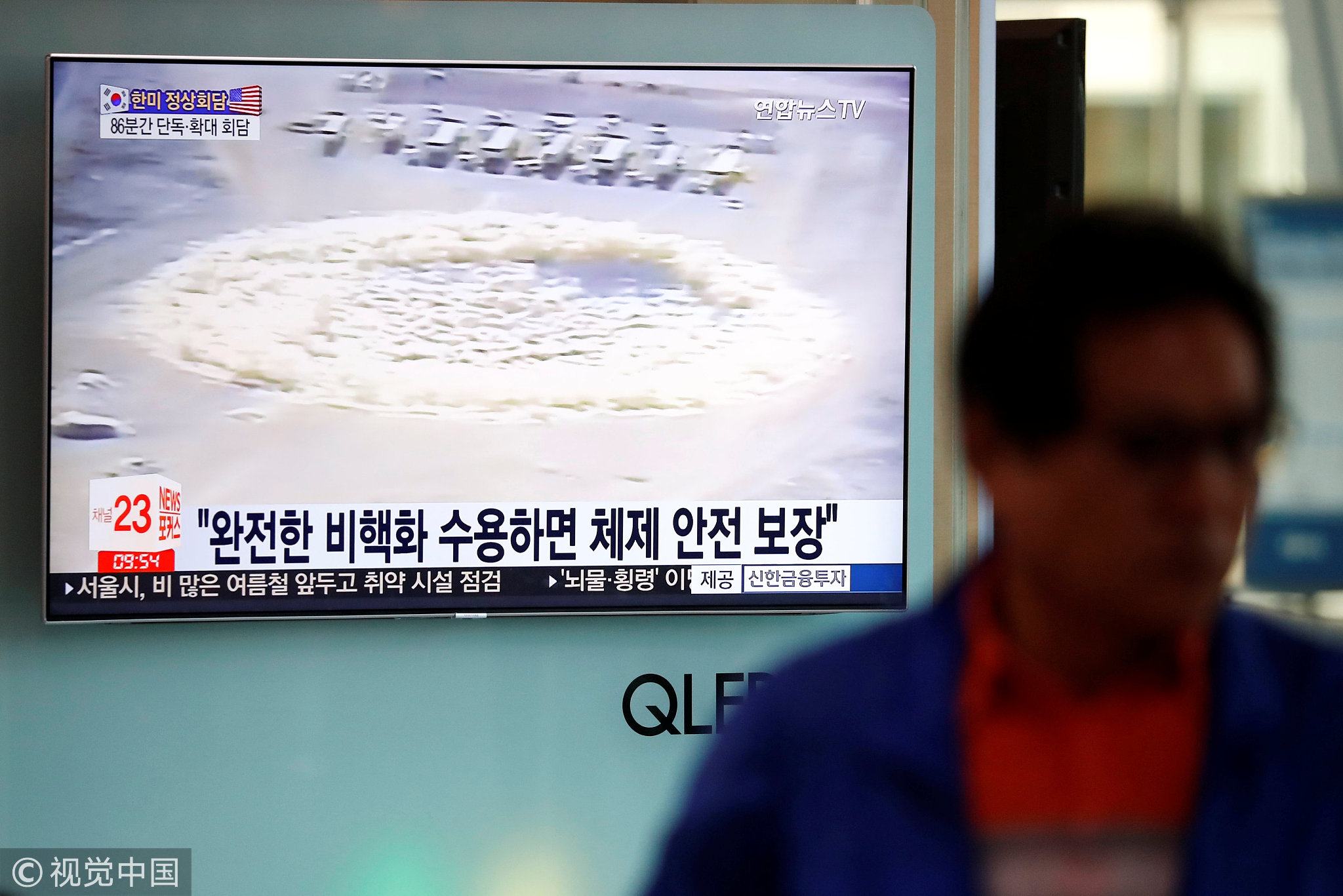
A TV news broadcast of the upcoming dismantling of the Punggye-ri nuclear testing site, in Seoul, May 23, 2018. /VCG Photo
A TV news broadcast of the upcoming dismantling of the Punggye-ri nuclear testing site, in Seoul, May 23, 2018. /VCG Photo
Even though the suspension of the inter-Korean meeting and the exchange of threatening words between the DPRK and the United States cast a shadow over the upcoming Kim-Trump meeting in Singapore, they are minor hiccups in the preparatory process.
President Moon made a trip to the United States on May 21 and met President Trump the very next day. Moon and Trump had a one-on-one private meeting, in which Moon might share his first-hand knowledge about Kim Jong Un and his policies and offer his personal advice to Trump as he is gearing up for a meeting with Kim next month.
Certainly, both leaders might also try to iron out their differences in their policies toward the DPRK and map out a united stand on two interconnected issues: How to seek a complete, verifiable and irreversible denuclearization of the Korean Peninsula, and how to reward the DPRK if it agrees to do so.
Moon came to Washington with an obvious mission to ensure the planned Kim-Trump summit stays on track and make sure the meeting proceeds to a successful conclusion, but the mission was quite challenging.
First of all, ROK’s relations with the United States are now troubled by many issues.
The ROK felt squeezed in the free trade negotiations that were reopened by the United States; the ongoing negotiation for a new Special Measures Agreement on cost-sharing for the US military presence in the ROK has made little progress as the United States insists that the ROK should pay more; and various ROK export products are subject to arbitrary tariffs unilaterally imposed by the US government.
Moreover, the ROK and the United States are not always on the same page when dealing with the DPRK. The Trump administration chose Singapore, rather than the DMZ suggested by the ROK, as a venue for Trump’s meeting with Kim Jong Un.
Second, Moon came to Washington to persuade Trump to be more receptive to DPRK’s concerns just as everything seemed to be going well, but inter-Korean relations hit a snag, with Moon finding himself in an awkward position to conduct mediation.
More importantly, the suspension of the inter-Korean high-level meeting deprived Moon of a precious chance to convey updated messages from the DPRK to the United States in his meeting with Trump.
Nonetheless, with all the twists and turns, the Kim-Trump summit is poised to take place soon. Any delay of the planned meeting has its own political costs for all the parties involved and will generate new uncertainties that further complicate the new preparatory process.
The time for the United States and the DPRK to work out their differences is short and they may need even more time to forge a minimum consensus over the denuclearization issue.
I believe, if Kim and Trump have their political will and are willing to cut a deal, they will keep to their words and find a solution to the long-standing nuclear problem in the region with their skills and courage.