
Opinions
15:59, 07-Jun-2018
Opinion: Teachers key in making Chinese history classes successful in Hong Kong
 ["china"]
Share







Copied
Editor's note: The author is a journalist for CGTN Opinion. Hsiung Ping-Chen, Professor of History at the Chinese University of Hong Kong, was interviewed. The article reflects his views, and not necessarily those of CGTN.
Recently, the Education Bureau of Hong Kong Special Administrative Region announced that Chinese history will become a compulsory course for middle schools in Hong Kong from the next semester. It is seen as a good way to cultivate students' interests to learn Chinese history, understand the profundity of China’s 5,000 years of civilization and even encourage them to foster the spirit of patriotism.
Hsiung Ping-Chen, Professor of History at the Chinese University of Hong Kong, believes that the decision may bring great benefits to students in Hong Kong wanting to learn about Chinese history. In her opinion, making history compulsory will give students a greater understanding of Chinese history, giving them insight into its depth and diversity. The main purpose of the Education Bureau is to help Hong Kong teens develop an interest in the past.
Distractions posed by the Internet
The 21st century is the era of the Internet. The questioning of authority is a distinctive feature of this era. Many students do not believe in teachers because they can easily find answers on the Internet. This is highlighted so strongly by the prominence of web-based information sources, such as Wikipedia or from TV dramas or so called online literature.
In this context, there is a lot of wrong and incorrect information about Chinese history on the Internet. Students are vulnerable to this wrong information.
Sometimes the Internet can have a negative effect on the way that middle school students in Hong Kong view Chinese history in the sense that a lot of things do not get taught explicitly in the classroom, meaning that students do not get a wide experience.
Students then try to make sense of the things that they find on the Internet by themselves which is not very helpful at all because of the amount of fake and distorted news that is floating about. It is very easy for students to take lies as truth and vice versa.
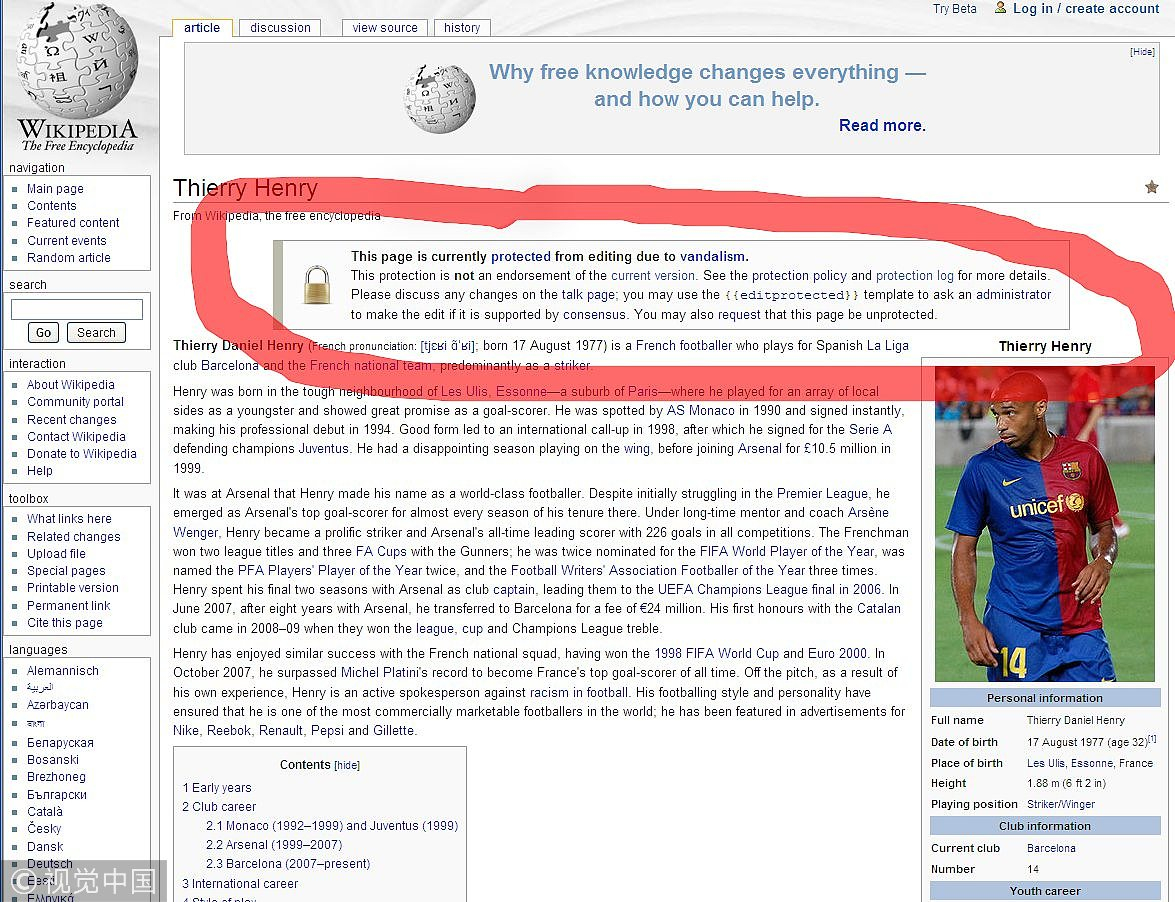
There is a lot of fake information online, where students go for information. Former footballer Thierry Henry's Wikipedia entry was vandalised with a stream of abuse on Nov 18, 2009. /VCG Photo
There is a lot of fake information online, where students go for information. Former footballer Thierry Henry's Wikipedia entry was vandalised with a stream of abuse on Nov 18, 2009. /VCG Photo
Well-trained teachers are the key to success
If students only go to school for information, and all that information is online, then school is pointless. Thus an excellent history teacher plays a vital role in the delivery of information.
Education is about equipping the new generation to become greater than the previous ever was - to be able to think, to discuss, to have the ability to overcome unforeseen challenges and obstacles.
Learning at school is merely the method people have implemented to teach children different ways of thinking: In history, people look at evidence, and evaluate the reliability of different points of view.
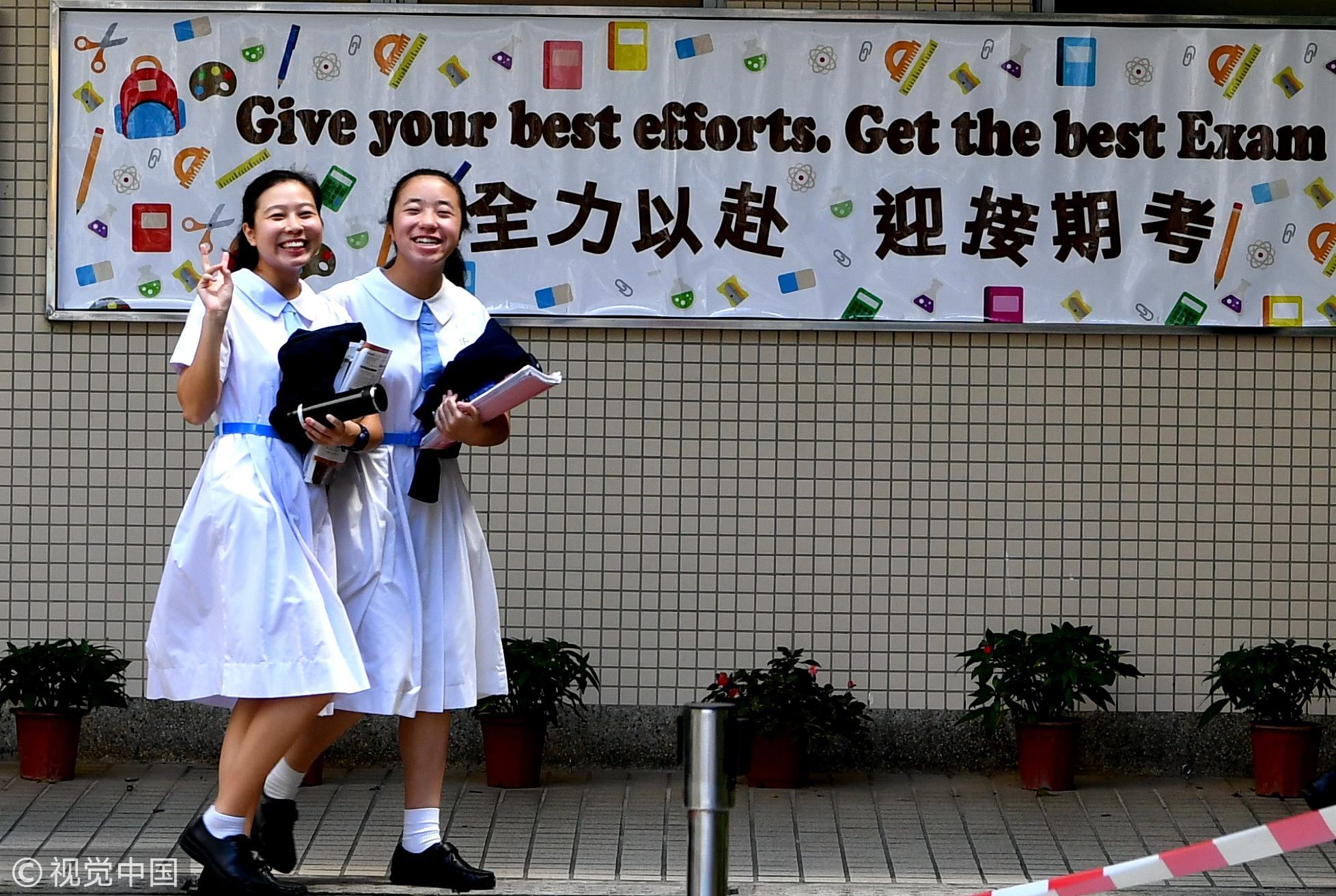
Students in Fukien Secondary School in Hong Kong./VCG Photo
Students in Fukien Secondary School in Hong Kong./VCG Photo
A good history teacher can not only tell students about historical knowledge, but more importantly, help students master the ability to distinguish right from wrong.
Specifically, in the face of various kinds of information on the Internet, the history lesson can help a student identify which information is correct and which information is wrong. They are able to help their students' learn the important life skills of research, assessing evidence, arguing a point of view, and evaluating conflicting points of view.
Take the War of Resistance against Japanese Aggression as an example. A good teacher can help students understand why the Communist Party of China was the mainstay of resistance against Japanese aggression. This requires a high level of skill in teaching, helping students to differentiate false information from truth online.
In Hong Kong's case
Hsiung argues that there are many teachers in Hong Kong highly qualified to teach history in middle schools.
They are well-versed in Chinese history and passionate about the area. However, the Internet will divert students' attention from class, especially when improper education methods are applied in the class such as rote learning.
Indeed, sometimes the Internet can be more appealing to today’s students, given the broad array of easily accessible information on Chinese history. It is without a doubt more challenging for teachers in the current modern climate to achieve results and it is crucial that we train and support teachers to do this.
Although Chinese history classes in Hong Kong may face challenges brought about by the Internet, the positive effects will be long-term. However, to achieve its goal, the government of the Hong Kong Special Administrative Region is supposed to help the teachers update their education methods in order to thrive in the age of the Internet.
(Cover photo: History chalk text./VCG Photo )