
11:07, 13-Aug-2017
DPRK Threats: How missile defense systems work against DPRK
 []
[]
Share







Copied
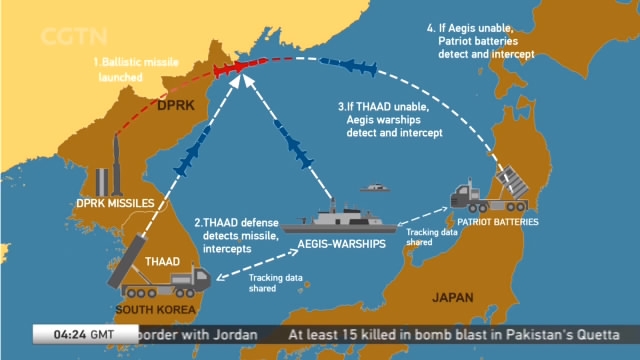
The US and the DPRK have been exchanging heated rhetoric these days. Pyongyang has vowed to target the island of Guam in mid-August, which is just about now. And the US has deployed counter-measures. Let's look at how the US missile defense systems work.
The US has not just one, but three missile defense systems in the Asia-Pacific. The THAAD system in South Korea, the Aegis and the Patriot systems in the Pacific. THAAD is designed to shoot down short-and medium-range ballistic missiles in the latter stage of their flights.But more importantly, it boasts a powerful radar system. It could provide the first warning of any missile fired from the DPRK. Once THAAD detects a missile launch, its battery will send radar tracking data to US Navy warships equipped with the Aegis missile defense system, sailing between South Korea and Japan. Aegis will then fire interceptors at the missiles in mid-flight. If Aegis fails, data from its own radar and THAAD's will be sent to Patriot missile batteries. Only Patriot missile defenses have been tested in combat in the Gulf War in 1991 and the Iraq War in 2003. The wartime operational control is in the hands of the US though the South Korean government has been working to take it back. And differences between South Korea and Japan have been a sour point in the trilateral cooperation.