
10:50, 01-Oct-2017
The Global Fight Against Poverty: Different situations call for different remedies
 []
[]
Share







Copied
We now continue our special series The Big Picture. Today we focus on the fight against poverty. In the past few decades, China has lifted over 200 million people out of poverty, a record never equaled anywhere else. In the global picture, the scorecard is mixed. More than a billion people still continue to suffer. The UN describes extreme poverty as living on less than 1 dollar a day.
CGTN reporters Han Bin and Tony Cheng have gone into the heartlands of poverty in China and Iraq. They found that the fight against poverty remains a daunting challenge for the world.
Sometimes, heaven seems so close. The Pamir Mountains stretch throughout China's western frontier in Xinjiang. Water comes from the melted snow. It's the source of life for villagers, animals, and plants. The highland plateau is home for China's Tajiks. Every day, the family of 71-year-old Nazimu Dila, get their water from the stream in front of their home. They are among the 700 herders of Reskamu village in Taxkorgan County. In Tajik, Reskamu means Truly Short of Everything.
NAZIMU DILA, HERDSMAN RESKAMU VILLAGE, TASHKURGAN COUNTY, XINJIANG "This is where we've lived since childhood. This place has a good environment, clean water, fresh air -- that's why I love it. We tend fruit trees without chemical fertilizer. "
15-year-old Bahatijiang Bisuyike is Nazimu Dila's granddaughter. She goes to high school in Kashgar, over 300 kilometers away. Bahatijiang only returns home during holidays, because the road conditions in the mountains are so poor. Life in the village is very different from where she studies in the city. Here, the mountains are everything, no vegetables, no traffic, no hospitals, no shops, and no telecommunications.
BAHATIJIANG BISUYIKE, STUDENT RESKAMU VILLAGE, TASHKURGAN COUNTY, XINJIANG "During the wheat harvest, my parents will be extremely busy. But I can't always stay at home to help them. Because life here is too hard."
Education is one way to get away from Reskamu. Bahatijiang doesn't want the life of her mother. Traditionally, women in the village must stay at home, taking care of the family and looking after livestock all their life.
Reskamu is is among the poorest places in rural China. Though most families are already above the poverty line, there's little chance to go any higher, because resources are so few. Money alone can't solve the problems. The government's solution is to relocate all villagers to a new settlement by 2019.
This bridge is the key link between Nazimu Dila's family and the outside world. Today, he is taking Bahatijiang to the summer ranch to check on their sheep and cattle. They're taking some beans for the ewe, and something to eat on the way. The journey takes several hours. Today, herders have to travel farther to find forage. Unlike China's better-off regions, economic development in rural areas, like Reskamu, largely depends on the government.
China has targeted goals to reduce poverty through measures like rural tourism and eco-agriculture or e-commerce. But in the remote areas, where the environment is fragile, and in the ethnic minority regions, where people keep their traditional lifestyles, reaching the anti-poverty goals can seem like walking on ice.
Their animals are the herders' greatest assets. But their income fluctuates with price changes. And the government has issued regulations to restrict herding to protect the grasslands.
HAN BIN RESKAMU VILLAGE, TASHKURGAN COUNTY, XINJIANG "For generations, Tajiks have been living a semi-nomadic life here, mainly relying on raising livestock. Life is hard on the Pamir Plateau, where there are vast stretches of the Gobi Desert. Eliminating poverty is a challenge for all."
The challenge has been met for the most part in China's cities. It's the countryside that's so difficult. The government aims to eliminate all poverty by 2020, including in Reskam.
BAHATIJIANG BISUYIKE, STUDENT RESKAMU VILLAGE, TASHKURGAN COUNTY, XINJIANG "They have their lives and I have mine. I can't raise livestock on the plateau all my life. I want to study and come back to make some changes."
NAZIMU DILA, HERDSMAN RESKAMU VILLAGE, TASHKURGAN COUNTY, XINJIANG The anti-poverty efforts by the government are really helpful, but I hope the development won't change the environment here.
The centuries-old way of life is changing. Nazimu Dila is not clear about what the future holds. But he believes the Pamirs will always be there.
TONY CHENG ERBIL, IRAQ Obviously trying to alleviate poverty in remote areas of western China is a huge challenge, but what do you do in a country blessed with natural resources? Here in Iraq they have the second highest reserves of oil in the world, yet in conflict areas, poverty levels are running at a stunning 45%. We met a family in Mosul, who are trying to survive, after 9 months of war.
This is an all too common sight on the streets of Mosul these days. Gangs of children swarming the traffic at the lights, washing windscreens, selling snacks and water. For Aya, Farrah and their younger brother Ali, this is the only way the family can make a living and its exhausting work in the 45 degree heat.
AYA MOHAMMED 10-YEAR-OLD WATER VENDOR "We come in the morning, at midday we go home and eat, then we go back and work till night."
Their father walks them to work, and back home again every day. But he can't work with them because he's suffering from severe epilepsy. He used to be employed by the local council but that job disappeared when ISIL overran the city two years ago. Then their house was destroyed in the fighting with all of their possessions.
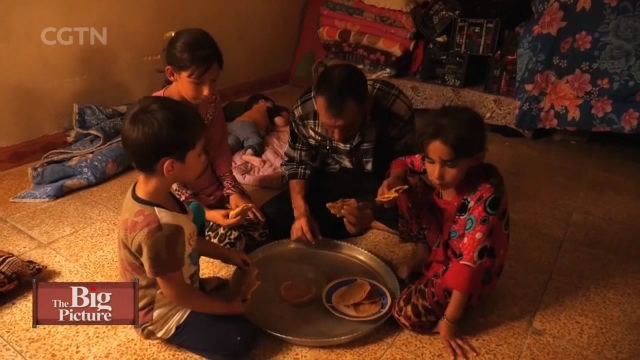
Now they live in a small rented room they share with another family. Local people have donated some blankets, a TV and an old fridge but they've had no help from the government and the money the children earn is just enough to pay for food. But even that isn't enough. Their mother prepares food for the children first only taking for herself what's left over. For their father, it is a profoundly distressing situation.
MOHAMMED JASSEM 41-YEAR-OLD UNEMPLOYED "In the morning when I wake up I cry my kids have to sell water I feel so ashamed."
In the short breaks they have between working the streets their father tries to home school them. It's all he can do to try to give them a better future.
MOHAMMED JASSEM 41-YEAR-OLD UNEMPLOYED "I see kids going to school, and my kids are going to sell water, but what can I do, my pockets are empty"
The problem is, in a city that has been ravaged by war, social welfare schemes and poverty alleviation usually take a back seat.
TONY CHENG MOSUL, IRAQ When you see the level of destruction here in Mosul, it seems unrealistic to think that the government might start to tackle problems like poverty alleviation. But it is a very urgent problem for the Iraqi government to resolve, if they don't want the issues let the birth of ISIL to come back.
That is often a problem in conflict zones, because it further exacerbates the feelings of resentment and anger felt by the poor.
RYAN MEINTJES UNDP "Often we have credibility issues with the governments in place, and it's difficult to convince them because their focus might be on other areas and no necessary the people, and the evidence is quite strong that as poverty increase, people will get unhappy and take it out on the government."
For Mohammed and his family however there is no time to complain. After a quick rest, they head back to the streets, and back to work. Tony Cheng CGTN Mosul Iraq.