
13:08, 08-Sep-2017
Building Infrastructure: China's roads: From expressways to high-speed railways
 []
[]
Share







Copied
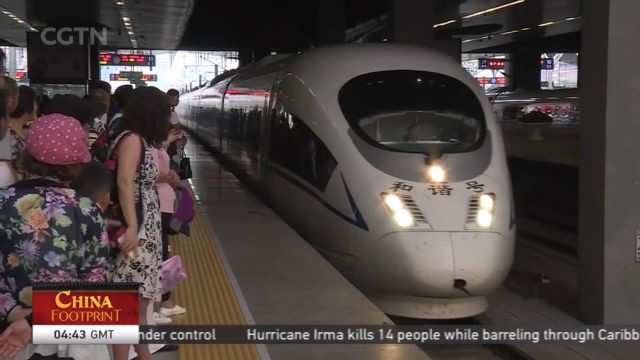
China has been making unremitting effort in infrastructure construction since starting its reform and opening up process in 1978. Taking transport for example, China has invested heavily in developing modern expressways and high-speed railways. CGTN's Lindy Mtongana went to northern China, and discovered how key cities around the country are being connected, while also helping the economy grow rapidly.
QI HEHE, TRAIN COMMUTER My name is Qi Hehe. I live in Tianjin. Right now, I am leaving for work in Beijing. And I am going to take the High-Speed Railway.
The port city of Tianjin lies 130km south-east of China’s capital Beijing. It’s a hub city for trade, tourism and business. But the distance to Beijing was often a challenge for big industry and individuals like Qi Hehe. All that has changed since the 2008 launch of the high-speed railway connecting the two cities. For these commuters, the 130km distance and hours spent in traffic are a thing of the past.
QI HEHE, TRAIN COMMUTER I have been taking this train from Tianjing to Beijing for the last 2 years. And I’ve really gotten used to this lifestyle. It is convenient for me. It just takes about 30 minutes which means I get to work on time, even before 09:00am.
Staff at the Tianjin Station told us this is one of the most popular daily routes.
GAO XIAODONG, STAFF MEMBER, TIANJIN RAILWAY STATION People do business by the High Speed Train, people do tours by this High Speed Train, people visit their relatives by this High Speed Train. More and more people choose to live in Tianjin and work in Beijing. They not only save lots of time but also lots of money.
QI HEHE, TRAIN COMMUTER This train service has also led my personal growth. Beijing offers more opportunities in terms of good salaries and better jobs.
As the first high-speed railway in China, the Beijing-Tianjin line is becoming busier by the day.
ZHANG YING, TRAIN CONDUCTOR, BEIJING-TIANJIN INTER-CITY TRAIN We carry around 80,000 passengers per day. Over weekends and holidays that increases to 100,000, and over the Golden Week holiday, the number rises to 120,000. Passengers say the train is convenient, fast and comfortable. They really enjoy our service.
LINDY MTONGANA, TIANJIN, CHINA Well I have to agree with the thousands that use this train every day. Its quick, comfortable and cost effective. Certainly the most efficient way to travel from Tianjin to the nation's capital Beijing.
The Beijing-Tianjin Intercity High-Speed Railway has been playing a key role in boosting the local economy.
YAN HEXIANG, DIRECTOR-GENERAL, SCIENCE-TECHNIQUE & LAW DEPARTMENT, NATIONAL RAILWAY ADMINISTRATION The Beijing-Tianjin High-Speed Railway effectively merges the two cities, providing convenient conditions for the exchange of commerce and trade between Beijing and Tianjin. The high-speed railway is becoming more and more important to national economic and social development. Since it was launched in 2008 - the overall passenger transport volume of China’s railways has increased by 10% annually, reaching 2.8 billion passengers in 2016.
Despite the popularity of the high speed railways - road users have not been forgotten. China has modernized and extended its road network, adding new expressways to key routes.
WU DEJIN, DIRECTOR GENERAL, CHINA HIGHWAY BUREAU By the end of 2016, we had a total of 4.7 million kilometers of road in use, with expressway mileage of 130,000 kilometers. China now has the world's biggest road network.
Most of China’s expressways are built with partly government funding, bank loans and other sources of financing, and most are toll roads. But road users are largely positive
SONG SHUSHUN, DRIVER I’m a driver so I use this expressway regularly. The cost of the toll from Beijing to Tianjin is about 50 Yuan. For me, I think it’s a bit expensive. But at the same time this expressway is very new and very convenient for me.
WU DEJIN, DIRECTOR GENERAL, CHINA HIGHWAY BUREAU The expressways toll policy has broadened financing options for expressway construction. We have a diversified investment and financing model that includes national investment, local fundraising, social financing and foreign capital.
According to a Chinese saying, if you want to be rich, build roads first. Add railways to the equation – and indeed even in the modern era this saying rings true.
LINDY MTONGANA, BEIJING, CHINA China's development of modern expressways and world-class high speed railways has truly transformed the country. It
s contributed to rapid economic growth and it changed the way people travel across the country.
And this is not the end.
WU DEJIN, DIRECTOR GENERAL, CHINA HIGHWAY BUREAU The next step is to gradually improve the expressways toll policy system. And we also want to ensure that in every phase -- from construction to road use – we meet the goals of a green, smart and safe road traffic system.
Using road and rail to grow the economy is a strategy that has worked for China. And more roads are planned on the country’s blueprint. LM, CGTN, BEIJING, CHINA