
13:27, 22-Nov-2017
Joint-Venture Airline: Himalaya Airlines strengthens Nepal's aviation industry
 []
[]
Share







Copied
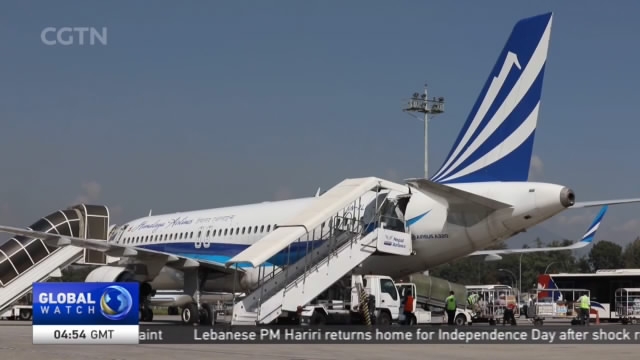
The Belt and Road Initiative is also elevating the aviation industry. Nepal's civil aviation industry used to lag behind domestic demand. But three years ago, a small Chinese airline formed a joint-venture with Nepal's Yeti Airlines. Once again, our reporter Ge Yunfei brings us the story from Kathmandu.
Sitting at the foot of the Himalayas and surrounded by China and India, Nepal is a landlocked country. Nearly 1.7 million air passengers arrived in Kathmandu in 2016. But for a country so reliant on tourism, its own aviation industry is somewhat weak.
ZHAO GUOQIANG PRESIDENT, HIMALAYA AIRLINES "Around 2014, there were more than 30 international airlines operating in Kathmandu but Nepal Airlines was the only local company. But its planes got too old to fly."
Nepal is still seen as an underdeveloped place in the aviation world, and a Chinese company Tibet Airlines saw an opportunity.
ZHAO GUOQIANG PRESIDENT, HIMALAYA AIRLINES "Tibet Airlines is a young and small player in the cut-throat Chinese market. In 2014, it was still only three years old. But the Chinese government started encouraging companies to go abroad four years ago as part of the Belt and Road Initiative, so we decided to take this opportunity to work with Nepal. And they also had a strong desire for a partnership, so an agreement was made."
Himalaya Airlines was founded in September 2014 with Nepal's Yeti Airlines holding a controlling 51% stake and China's Tibet Airlines having 49%.
ZHAO GUOQIANG PRESIDENT, HIMALAYA AIRLINES "In 2013, Nepal was on the flight safety black list issued by the International Civil Aviation Organization. But after we entered the Nepali market, we worked with Nepali authorities to improve laws and regulations. And in July, Nepal was removed from that list."
Zhao Guoqiang, president of Himalaya Airlines, says the airline now has more than 300 employees and most of them are locals. Tsering Raut is one of the local staff. Tonight, her colleagues are throwing a pregnancy party for her. Raut has been with the company since the very beginning. She started as a stewardess and now she's a cabin crew manager.
TSERING KHANDO RAUT CABIN CREW MANAGER, HIMALAYA AIRLINES "The airlines gave us a lot of opportunities to every people, even I got the same opportunity. I learn new things everyday."
CUI XIUQING, GENERAL MANAGER CABIN CREW, HIMALAYA AIRLINES "85 of the 91 cabin crew are locals. Only two are Chinese."
Zhao Guoqiang says the company is also fostering local pilots and most of its co-pilots are Nepalese.
GE YUNFEI KATHMANDU Exporting labor is one of the most important pillars of Nepali economy. And this joint-venture airline is making the journeys of Nepalese easier and safer.
ZHAO GUOQIANG, PRESIDENT HIMALAYA AIRLINES "Most of our air routes are between the Middle East and Nepal because it's the main destination for Nepal's migrant workers. And our flights to the Middle East are popular because workers are confident about our flight security."
Himalaya Airlines still has only three A320 airbuses, but Zhao says it will have 15 planes in five years time, with at least three of them larger airliners like the A330. And with a growing number of Chinese businesses coming to Nepal, the company's next step is to open direct routes to Hong Kong and Beijing. Ge Yunfei, CGTN, Kathmandu.