
Tech & Sci
17:49, 20-Mar-2017
Over 13,000 Chinese alligators end dormancy
Updated
11:04, 28-Jun-2018
 []
[]
Share







Copied
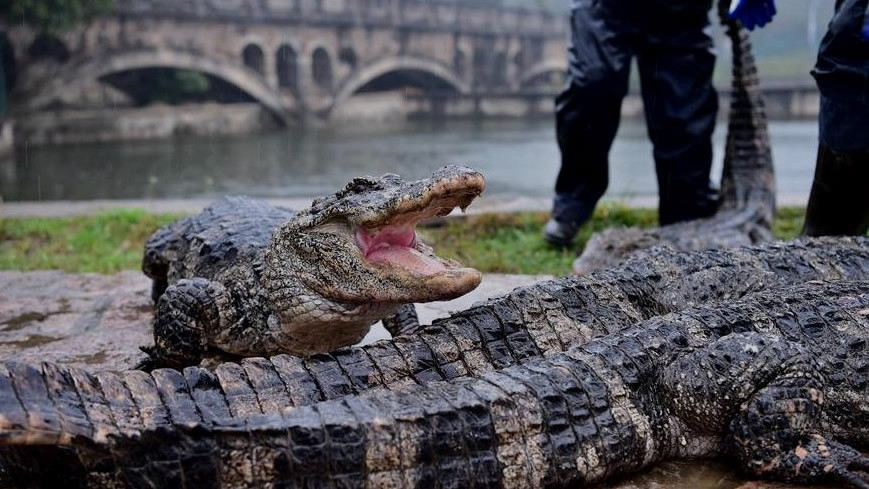
With the days getting longer and the mercury starting to rise, many animals are emerging from their winter hibernation. One such creature beginning to stir after a months-long slumber is the Chinese alligator, with more than 13,000 of the reptiles in one Chinese nature reserve having now been moved out of their hothouses.
Wild Chinese alligators often find a cave to spend the winter in, while alligators bred in captivity stay indoors during the colder months. Workers at Anhui Yangtze Alligator Reserve in east China move their alligators outdoors in March, when the temperature hits around 13 degrees.
Every alligator at the reserve has to undergo a thorough physical examination before being brought outside. Having been in hibernation for so long, it takes a while for the reptiles to be fully functional. They continue to live on their saved energy for several weeks, and typically don’t begin to eat until April, when temperatures rise above 25 degrees Celsius. Workers at the reserve begin weaning their animals back onto solid food with mussels and snails.
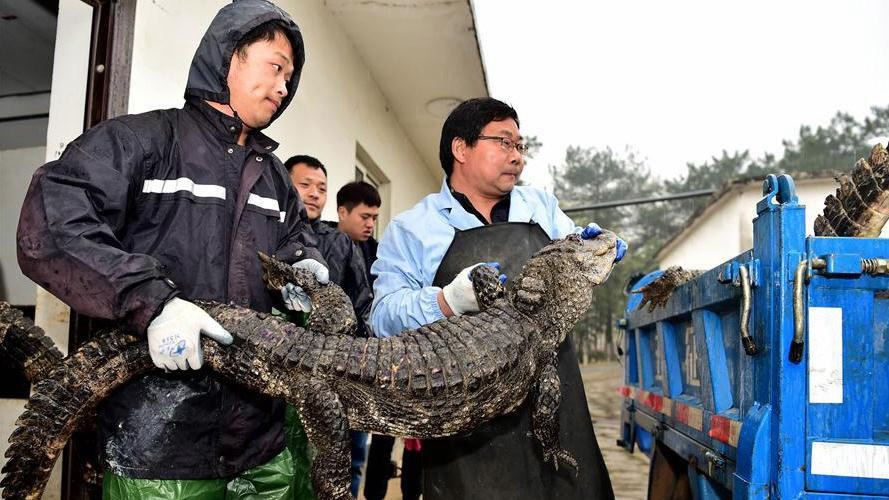
Staff members carried Yangtze alligators beside their living area outside in Xuancheng, east China's Anhui Province, March 19, 2017.
Staff members carried Yangtze alligators beside their living area outside in Xuancheng, east China's Anhui Province, March 19, 2017.
The Chinese alligator is critically endangered and is endemic to eastern China, with the country listing the species as a first-class protected animal in 1972. The Anhui Yangtze Alligator Reserve is the world’s only artificial breeding base for the Chinese Alligator, with several batches of the reptiles having been released into the wild since 2003.
Research shows they have generally adapted well and have begun to reproduce. Numbers in the wild currently range from around 130 to 150.
(Source: Xinhua)
1019km