
21:51, 07-Dec-2017
China-Russia Plane Production: Agreements signed to work on new joint aircraft
 []
[]
Share







Copied
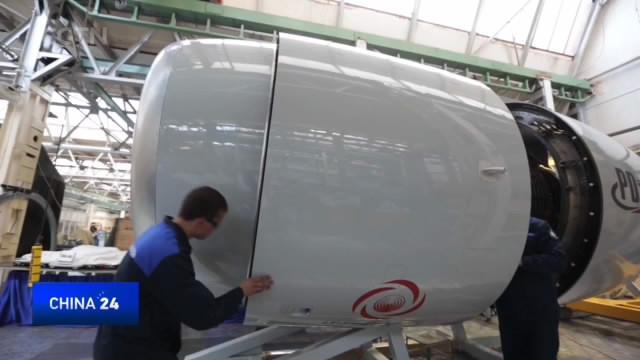
China's Aero Engine Corporation signed a memorandum of understanding on cooperation with the Russian state-owned United Engine Corporation in September this year. The agreement covers the development and production of an engine to power the new joint CR929 aircraft. It is the first wide-body long-range commercial aircraft that will not be produced by either Boeing or Airbus. CGTN's Aljosa Milenkovic at the Moscow factory of participating manufacturer Salyut brings us this report.
This was a proud moment for Russia's aviation industry. It happened in May this year. The maiden flight of the MS-21, the first Russian indigenous airliner of such class.
But perhaps more important, this liner will use a milestone engine, the PD-14, the first to rival the Western analogues.
Now, China and Russia are looking to capitalize on that breakthrough, by agreeing on a 50:50 joint venture that will hopefully see a new PD-35 engine power the CR-929 airliner.
A project in which many Chinese and Russian companies are excited about.
ALJOSA MILENKOVIC MOSCOW "Salyut company has existed for 105 years and, during that time, it has produced some state-of-the-art aircraft engines, including those for the legendary Su-27 fighter jet. Now they hope to participate in one of the biggest and most important aircraft production endeavors in recent Russian history."
Salyut is just one of many state-owned enterprises, part of the ROSTEC corporation, that are participating in the development of the CR929.
And they say they are proud to work with their Chinese colleagues on this ground-breaking project to build the PD-35 engine.
FEDOR MIRONOV, HEAD OF MARKETING UEC, ROSTEC "The PD-35 engine will have characteristics that can be competitive not just with existing British or American analogues, but also with future projects that will be created after the year 2020. That's why we are implementing in this PD-35 engine such technologies like composite fan blades, a high-effectiveness compressor, a low-emission combustion chamber, a high-temperature turbine, and other polymer-based parts."
The CR929 will also have other features which its direct competitors don't have, such as wider aisles, more stowage capacity, as well as less noise and exploitation costs.
OLEG PANTELEYEV, AVIATION EXPERT AVIAPORT ANALYTIC AGENCY "Besides that, a new generation of aviation equipment is emerging with a new concept of electrical plane controls. And the implementation of these breakthroughs brings reductions in fuel consumption of 15%, compared with existing aircraft."
Experts say that if both China and Russia maintain their commitment to this project and provide stable financing, we could see the CR929 in our skies by 2025. It's expected the joint project could take about 10 percent of the world's market share in that aviation class, and become primary airliner for Chinese and Russian carriers. Aljosa Milenkovic, CGTN, Moscow.