
21:18, 30-Nov-2017
China Dark Matter Explorer: 'Wukong' satellite sheds light dark matter
 []
[]
Share







Copied
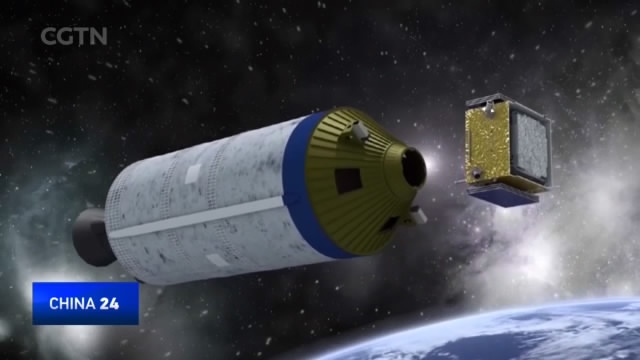
Chinese scientists believe they have made a breakthrough in dark matter research using data from China's first astronomy satellite - a telescope in space called "Wukong" -- or Dark Matter Particle Explorer. Their findings have been published in the scientific journal Nature, detailing how the satellite is able to measure a high-energy cosmic ray influx in space.
The universe is mostly made up of dark matter -- a non-luminous material that scientists cannot directly observe. It's five times more abundant than normal matters known to human beings, which makes this the greatest mystery scientists have been trying to crack for decades. And Wukong's recent measurement of energy distribution of cosmic ray electrons with energies as high as 5 teraelectronvolts may shed light on this. Scientists say this data might suggest that dark matter is not necesssarily "dark", meaning that with more data, they might be one step closer to discovering what it really is.
CHANG JIN DEPUTY DIRECTOR, PURPLE MOUNTAIN OBSERVATORY CHINESE ACADEMY OF SCIENCES "Dark matter is not visible, but when it annihilates or decays, it produces ordinary particles that can be detected and studied. Wukong is able to detect, and most importantly, distinguish different particles, which can help us study them."
The annihilation and decay of dark matter particles in the Milky Way and nearby galaxies, are expected to leave relics in high-energy cosmic rays and gamma rays. By observing these cosmic and gamma rays when they propagate to earth's neighbourhood, scientists can, in turn, determine the properties and origins of them.
WU JI DIRECTOR, NATIONAL SPACE SCIENCE CENTER CHINESE ACADEMY OF SCIENCES "The explorer weighs 1.4 tons and the heaviest compartment is the BGO crystal calorimeter, used to detect energy of particles. Our team has developed the world's longest crystal bars, which we've installed inside Wukong to expand the area of data collection."
During the first 17 months of exploration, Wukong was able to detect 1.5 million cosmic ray electrons out of a total of 25 billion events, with unprecedented low particle backgroud contamination and high-energy resolution. Since it's launch in December 2015, Wukong has recorded about 3.5 billion cosmic ray events, with a maximum event energy exceeding 100 trillion electron volts. The satellite is expected to record more than 10 billion cosmic ray events in the next few years. By collecting more data, scientists are hoping they will give new revelations on the nature of dark matter.