By CGTN'S Wang Duan
April 23 was designated World Book Day in 1995 by UNESCO. Over the past few years, Chinese writers have increasingly been attracting attention from book lovers around the world.
In 2014, 93-year-old professor Xu Yuanchong became the first Asian winner of the Aurora Borealis Prize, the world's top award for translation. Xu has dedicated himself to translating traditional Chinese literary works into English and French, or vice-versa.
Chinese science-fiction authors have also won the Hugo Award for Best Novel, referred to as the "Nobel prize of the science fiction world," and Cao Wenxuan became the first Chinese author to win the coveted Hans Christian Andersen Award for children's literature.
Through translation, Western readers can now appreciate not only classic Chinese literature but also more modern works, even trending online fantasy novels.
Though online literature has been considered bottom-tier by bookworms in China, it is a popular category overseas. In the past, we always heard that Chinese traditional classics traveled abroad, but now it is the emerging Chinese web novels that are being introduced to foreigners.
Lai Jingping, popularly known as RWX, founder of wuxiaworld.com – an influential online platform for translating Chinese fantasy into English – told CGTN's "The Point with Liu Xin" that his website has over five million daily views. Unlike traditional novels which are mainly about Chinese culture, modern Chinese fantasy web novels share more similarities with Western works of the same genre. They are easier for Westerners to understand.
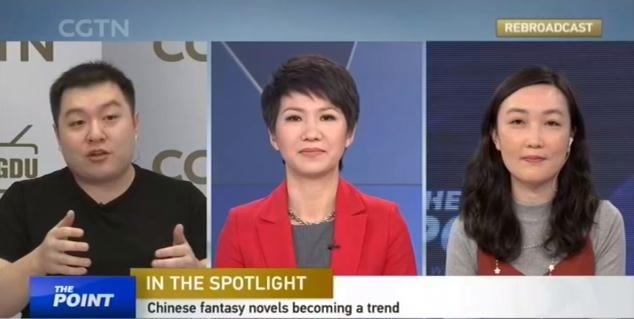
Lai Jingping (L), the founder of the website wuxiaworld.com and Zhang Yalin (R), a translator of Twilight/ CGTN Photo
Zhang Yalin, a lecturer at the China Foreign Affairs University who translated Twilight, the famous novel by Stephenie Meyer, into Chinese, told "The Point" the most meaningful part for her of being a translator is that her work inspires other people. One of her students told her she started aiming to do the same job as Zhang after she read Zhang's translation work.
Both of the translators said the most stressful part of translation is to find the exact word connecting English with Chinese. Some translators call for innovation in literary translations, but others say this would deviate from the original text. The argument is an ongoing dilemma for all translators.
Program host Liu Xin closed the discussion by saying, "Two translators, one working from Chinese into English, the other from English to Chinese, they are different processes but both perform a similar role. You need to be equally good in both languages to be able to do this job well."