
Guest commentary by Lyu Jinghua
On February 22, Russian Defense Minister Sergei Shoigu announced the formation of a new military unit to conduct “information operation."
In fact, the speculation of the existence of Russia’s cyber force has been there for several years. Back in 2013, it was widely reported that Russia was planning to establish a new command equivalent to the US Cyber Command. But related news afterwards was never confirmed by Russian official sources.
It is not surprising that Russia decided to form new forces to deal with cyber threats. Since May 2009 when the US Cyber Command was set up, most of the developed powers including the UK, Japan, Republic of Korea (ROK), Germany and Australia started to develop their own cyber forces.
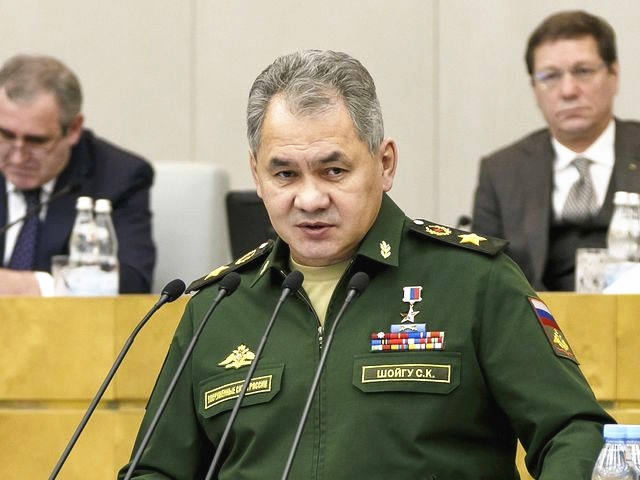
Russian Defense Minister Sergei Shoigu addressed at the State Duma, Russia, Feb. 22, 2017. / Xinhua Photo
According to a study by the United Nations Institute for Disarmament Research (UNIDIR) in 2015, at least 40 countries have owned military cyber capabilities, among which 12 have offensive capabilities. North Atlantic Treaty Organization (NATO) even confirmed last year that Article V is applicable to cyberspace, which means any severe cyber attack on one member is considered an attack on all and would trigger collective defense.
What’s more alarming for Russia is that it has long been accused of spreading propaganda in western countries. In December, then US President Obama publicly alleged Russia for interfering with the election via hacking and propaganda approaches, and declared an array of retaliatory measures.
Michael Flynn, the US National Security Advisor recently resigned due to his contact with Russia's ambassador about the sanctions before President Donald Trump took office. In Europe, there are much gossip that Russia plans to conduct propaganda campaign against NATO operations and incoming elections.
From Russia’s perspective, these allegations just show how hostile the western world is toward it. That’s why Minister Shoigu mainly focused on propaganda mission when he talked about the information operation force. In his words, "propaganda needs to be clever, smart and efficient." But, of course, propaganda force can only be one part of the new force. According to retired Russian General Vladimir Shamanov, who leads the defense-affairs committee in the lower house of parliament, the unit would "protect the national defense interests and engage in information warfare."
It is unclear now what form the new force takes, nor is clear what other components and missions of this force are. However, as cyberspace is now viewed as the fifth domain, no big power can ignore the significance of cyber security. Viktor Ozerov, chairman of the Defense and Security Committee of the upper house of parliament, was quoted that the information operation force will be tasked with protecting data from being attacked, rather than launching cyber-attack against other countries.
This is in accordance with Russia’s consistent position. In the two editions of International Code of Conduct for Information Security submitted to the UN General Assembly, the Shanghai Cooperation Organization called for reaffirmation of all States' rights and responsibilities to protect their information space and critical information infrastructure from threats, disturbance, attack and sabotage.
We sincerely hope that in the irreversible international trend of establishing cyber forces, every country can stick to the principle of developing defensive, rather than offensive, strength, so as to avoid cyber arms race and unexpected occurrence and escalation of cyber crisis.
(Lyu Jinghua is senior fellow at Pangoal Institution. The article reflects the author’s opinion, not necessarily the view of CGTN.)