
By CGTN’s Joel Richards
From studying the skies to the characteristics of globalization, Argentina and China are increasingly cooperating to share knowledge and resources.
Felix Aguilar Observatory, one of Argentina’s most important astronomy complexes, will be home to the largest radio telescope in South America thanks to a joint project between Argentina and China.
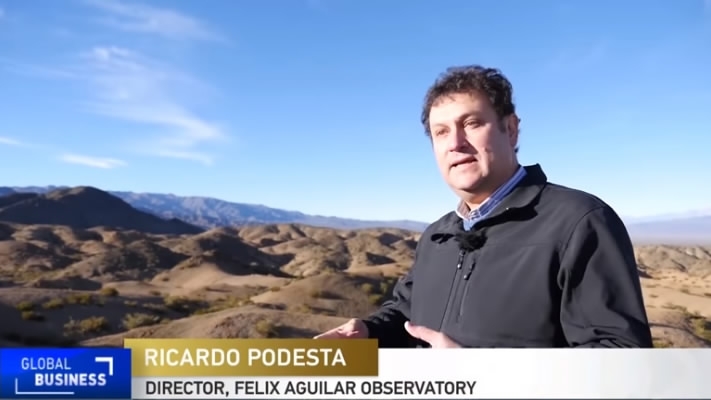
Ricardo Podesta is the director of the observatory. He has worked closely with the Asian country since the first bilateral agreement in astronomy was signed in 1992. He said the installation of the radio telescope is a major project for his country and the region.
CGTN Photo
“With your eye you see a star. And with the heart you hear it. A radio telescope penetrates deeper into the galaxy, star clouds and stars, and can study the interior of the galaxy and what happens there. It can study black holes, there are an infinite number of studies can do with a radio telescope,” Podesta said.
Weighing 1,000 tons and spanning 40 meters in diameter, the radio telescope measures tectonic movement down to the millimeter and to do so, it requires the conditions found at the Felix Aguilar Observatory.
In order for work to begin, a new road must be built to access the site and there have been delays. However, there is hope that the project will progress on time and the radio telescope will be operating by 2018.
This is just one example of cooperation in science between the two countries.
The University of Shanghai and the Argentine Science and Technology Research Council have already launched a mixed research center in Argentina to study globalization and society, the first of its kind in Latin America.
From astronomy to the social sciences, Argentina and China are sharing infrastructure, technology and knowledge to better understand the world, its people and beyond.