TECH & SCI


Smithfield makes move on market for pig-human transplants
2017-04-12 18:34 GMT+8






Editor
Gao Yun
Smithfield Foods, the world's largest pork producer, has established a separate bioscience unit to expand its role in supplying pig parts for medical uses, with the ultimate goal of selling pig organs for transplantation into humans.
Routine pig-human organ transplants are years away, but recent scientific advances are breaking down barriers that frustrated prior attempts to use pigs as a ready supply of replacement parts for sick or injured people, making it an attractive new market.
"Our bread and butter has always been the bacon, sausage, fresh pork - very much a food-focused operation," Courtney Stanton, vice president of Smithfield's new bioscience unit, told Reuters in an exclusive interview. “We want to signal to the medical device and science communities that this is an area we're focused on - that we're not strictly packers."
Signage stands outside of Smithfield Foods Inc. headquarters in Smithfield, Virginia, US. /CFP Photo
Smithfield, the 14-billion-US-dollar subsidiary of China’s WH Group, in its first move has joined a public-private tissue engineering consortium funded by an 80 million US dollars’ grant from the US Department of Defense. Smithfield is the only pork producer, joining health-care companies including Abbott Laboratories, Medtronic and United Therapeutics Corp.
Transplants are used for people diagnosed with organ failure and who have no other treatment options. Transplants from animals could help close a critical gap to help those in need. The United Network for Organ Sharing estimates that, on average, 22 people die everyday while waiting for a transplant.
Smithfield already harvests materials for medical use from the 16 million hogs it slaughters each year. The company owns more than 51 percent of its farms and hopes to sell directly to researchers and health-care companies, which now typically buy from third parties.
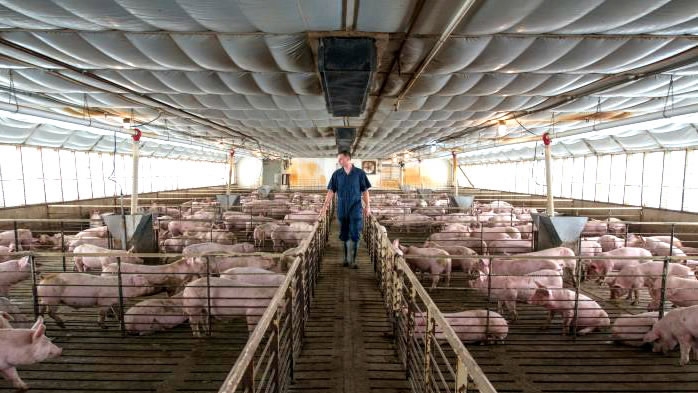
A staff is working at a Smithfield Foods, the world's largest pork producer farm in the United States. /Reuters Photo
Stanton said the US market for pork byproducts used for medical, pet food and non-food purposes stands at more than 100 billion US dollars, and that excludes any potential market for animal-to-human transplants, known as xenotransplants.
Smithfield has deals in the works to supply pig organs to two entities, though Stanton would not disclose the names.
"It's just a huge potential space, and to be at the leading edge and focused on building those relationships is critical,” Stanton said.
Pigs have long been a tantalizing source of transplants because their organs are so similar to humans. A hog heart at the time of slaughter, for example, is about the size of an adult human heart. Other organs from pigs being researched for transplantation into humans include kidney, liver and lungs.
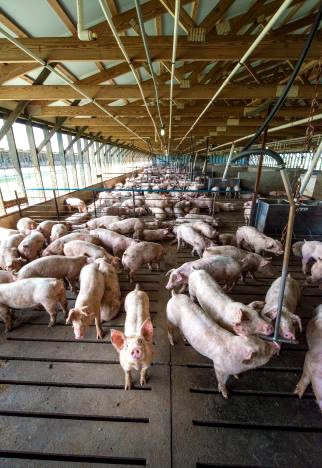
Pigs are seen at a Smithfield Foods, the world's largest pork producer farm in the United States in this image released on April 11, 2017. /Reuters Photo
Prior efforts at pig-to-human transplants have failed because of genetic differences that caused organ rejection or viruses that posed an infection risk.
George Church, a Harvard Medical School genetics professor and researcher, tackled that problem two years ago, using a new gene-editing tool known as CRISPR to trim away potentially harmful virus genes that have impeded the use of pig organs for transplants in humans.
Church has since formed a company named eGenesis Bio to develop humanized pigs that do not provoke a rejection response or transfer viruses to people. He estimates the first transplants involving humanized pig organs could occur in a clinical trial later this year, but these would only be used on people too sick to receive human organs.
Church welcomes the involvement of a big pork producer. "Even though we've got companies like eGenesis that would make the first pigs, you still need someone who will breed them and do it to scale," he said.
(Source: Reuters)
Copyright © 2017
SHARE
- EXPLORE
- MORE
FOLLOW US