
12:58, 10-Sep-2017
Integration into the Global Economy: Long Yongtu: China's WTO entry benefits all
 []
[]
Share







Copied
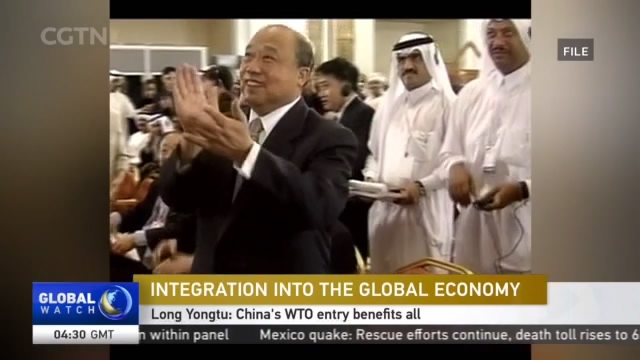
After years of arduous negotiations, China finally gained entry into the World Trade Organization in 2001, marking its full integration into the global economy. But what were the untold stories behind the negotiation process? How did Chinese enterprises cope with the sudden competition from abroad when China opened its markets under the WTO rules? Our reporter Zou Yun sat down with Long Yongtu, China's chief negotiator for accession to the WTO, who spoke about the many ups and downs of the marathon negotiations, and what China has learned since the accession.
16 years after China’s entry into the WTO, Long Yongtu still vividly remembers the historic moment. n nOn November 10th, 2001, a final gavel officially confirmed the WTO's endorsement of China’s membership. It was very hard-earned fruit after FIFTEEN years of demanding negotiations.
LONG YONGTU, CHIEF NEGOTIATOR, CHINA’S WTO ACCESSION “It takes some time for both China and its negotiating partners to understand the nature of the negotiation.”
Long Yongtu was a key figure in this process. As the chief negotiator, he's had to always strike a balance between defending the interests of China and making compromises to meet the demands of its counterparts. For instance, the United States and many other countries pressed hard on China to open up its auto industry to foreign investors. In the beginning, China was wary that once the market was open, foreign auto-makers would swarm in and crush this crucial industry. As hard as it seems, both sides finally managed to find a meeting point.
LONG YONGTU, CHIEF NEGOTIATOR, CHINA’S WTO ACCESSION "We eventually agreed that auto industry investment has to abide by the rules, that joint ventures should be established, with 50-50 equity shares, that will guarantee interest for both foreign and local industries. ”
And this was just one example of the numerous thorny cases that Long and his colleagues had to deal with... Described by his counterparts as a tough, experienced negotiator, Long shared with us the secrets he brings to the negotiating table..
LONG YONGTU, CHIEF NEGOTIATOR, CHINA’S WTO ACCESSION "I have studied the WTO and GATT rules very carefully. So at least I’m very professional. Because you are professional, you can be reasonable. So goodwill and being a good professional are the secrets of my negotiations.
Long said he’s familiar with every paragraph, every sentence, and even every punctuation of the 500-page agreement between China and the WTO. But, he said, it took more than just professionalism to seal the deal. In the early morning of November 15, 1999, Long and some of the members of his delegation sensed there might be a break-through in negotiations with the United States. He made an exceptional decision to call the then-premier Zhu Rongji about the potential opening.
LONG YONGTU, CHIEF NEGOTIATOR, CHINA’S WTO ACCESSION "When Zhu Rongji asked me: 'do you believe we can have a deal with the Americans?', I answered: 'yes, I believe so' without hesitation. That made Zhu come all the way to the negotiation table and we got the deal. Even until today, I’m still very proud of my political courage and sense of responsibility for the country. It was very risky to make that phone call, but I did it. And we made the deal.
China's accession in 2001 was a watershed moment for the country and the world. The country has become much more integrated with the global economy and has grown steadily to become the world's second largest economy. From 2001 to 2016, China’s annual trade volume hiked from half a trillion US dollars to more than three trillion. And the country’s contribution to the world's economy also sky-rocketed from under one percent to more than 30 percent.
LONG YONGTU nCHIEF NEGOTIATOR, CHINA'S WTO ACCESSION "Because China is the biggest market in the world, when China benefits from economic globalization, the others are also benefiting from China’s opened market, which is the biggest in the world.”
Before China’s entry into the WTO, there were fears that many of the country’s sectors – under extreme pressure from foreign companies – would be crushed and the whole economy would collapse. Yet, those fears never materialized. In fact, the Chinese companies became even more competitive and resilient. Competition is not a bad thing as long as everyone plays by fair rules. That's a lesson China has learned from its WTO accession. Since 2001, China’s commitment to promoting free and fair multilateral trade has never wavered. And now the country has become a bellwether for trade and a champion of globalization. ZY, CGTN, BJ