
19:49, 21-Dec-2017
China-Thailand Railway: First 'test section' to be completed in six months
 []
[]
Share







Copied
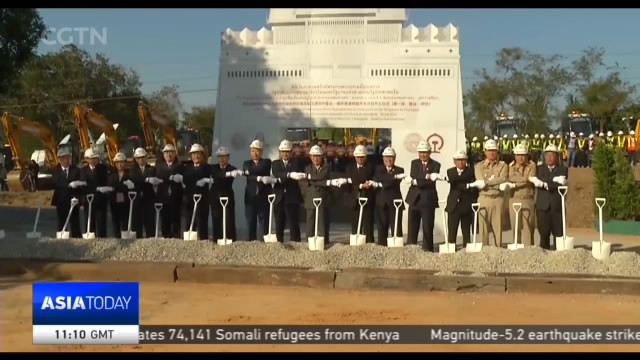
At the spot where more than a hundred years ago Thailand's first major railway was completed, the ground is broken to signal a new era in rail travel.
Wang Xiaotao, of the Chinese Development Commission, and the Thai Prime Minister Prayut Chan-o-Cha, lead the start of construction of the China-Thai high-speed railway.
Thailand's first high-speed trains will travel at up to 250 kilometers per hour, slashing journey times on the 600-kilometer route from Bangkok to its north eastern border at Nong Khai, from 10 hours to just over three.
The network will be paid for by Thailand, but designed by Chinese engineers, and China will supply the trains. The project's been on the table for a decade, with detailed planning over the last three years.
ARKHOM TERMPITTAYAPAISITH THAI MINISTER OF TRANSPORT "I think in three years we've been able to understand each other very well. The way we're doing the project and the way the Chinese are doing the project is quite different, but in the end we came together."
Phase One, stretching 250 kilometers from the Thai capital to the city of Nakhon Ratchasima, should be completed in three years. Engineers hope the second section to Nong Khai can be built more quickly. In the future it's planned to extend the line north through Laos to China, and south through Malaysia to Singapore, creating a truly Trans-Asian rail network.
DR. AMORN WANICHWIWATANA CHULALONGKORN UNIVERSITY, BANGKOK "I think this is a good sign for new development and according to the Chinese policy of the Belt and Road Initiative, I think this could link other nations in this region. Thailand and her people will gain a lot from this project."
MARTIN LOWE MOH LHAK-HIN, NAKHON RATCHASIMA The rail scheme, believes the Thai government, will bring a much-needed economic and construction boom here in the north east which has always been Thailand's poorest region.
ARKHOM TERMPITTAYAPAISITH THAI MINISTER OF TRANSPORT "Wherever the high-speed rail goes, it will bring economic activity and business. Along the route from Bangkok to Nong Khai we have 11 stations - all 11 stations are big cities. We should take advantage of high speed rail and build more cities."
Rail passengers in Thailand have long suffered ageing trains, breakdowns and derailments due to old track, but the future could see a network to rival any rail system, anywhere in the world. Martin Lowe CGTN Nakhon Ratchasima, Thailand