SOCIAL


University employs WeChat to crack down on library seat-hogging
2017-03-14 12:41:18 GMT+8
1357km to Beijing






Editor
Cai Mengxiao
Study rooms devoid of people but cluttered with personal belongings are nothing new in universities across the country: Students routinely keep their seats by placing their books, bags and other stuff on them.
To put a stop to this practice, a university in central China’s Hunan Province has recently introduced a seat management system through the popular instant-messaging app WeChat. The school wants to ensure that those stepping into the library can immediately get down to study, instead of having to mope away, defeated by the blocked seats.
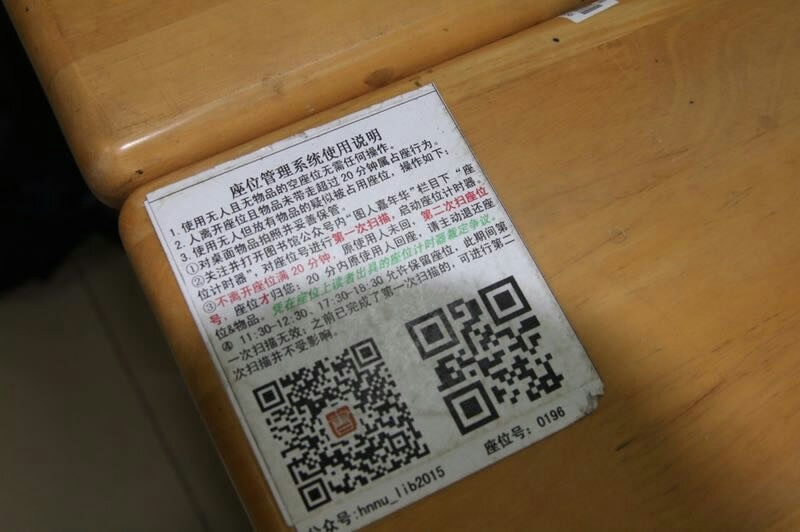
Instructions for the WeChat seat management system / China Daily Photo
The system's instructions and a QR code are posted on library desks in Hunan Normal University. Students who fail to find vacant seats in the study rooms can temporarily take saved ones by scanning the code and logging into the system, even if a seat has been marked as saved by a pile of belongings but the owner is nowhere to be found.

China Daily Photo
“The successor should return the seat, however, if the owner comes back within 20 minutes,” the instruction says.
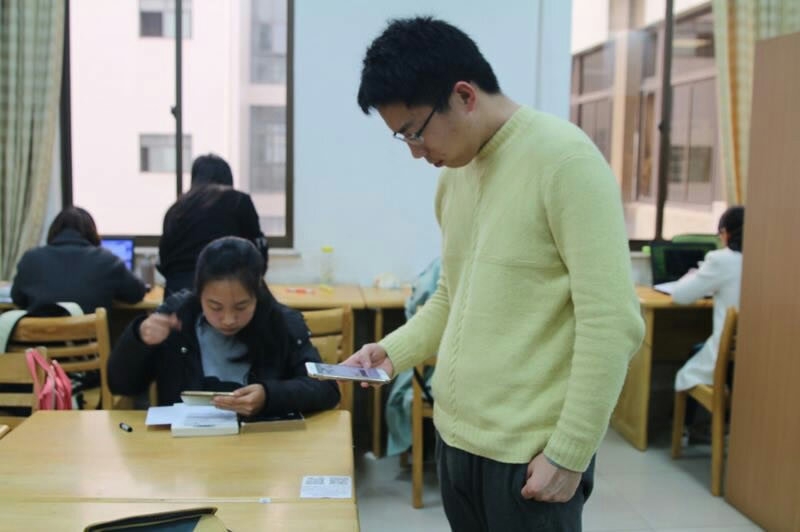
Student finds a place in the study room by scanning the QR code. / China Daily Photo
If the previous seat owner remains absent after 20 minutes, the seat is automatically assigned to the late-comers as long as a further confirmation is completed by rescanning the QR code.
A student surnamed Liu told local media that though he is in favor of the move aiming at the annoying seat-hogging, “20 minutes is a bit too short” for those who might leave for dinner or classes.
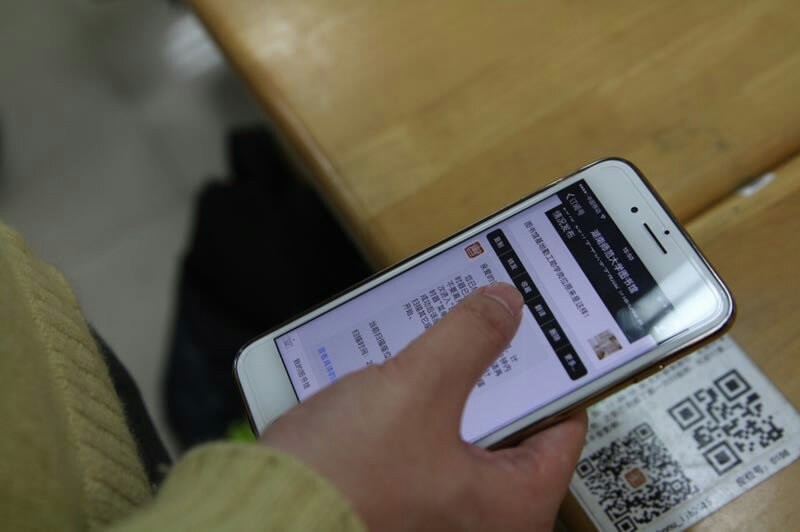
Student logs into the seat management system. / China Daily Photo
“Deliberate seat-hogging would directly lead to a low seat utilization rate, and it remains a hard problem to be solved,” said Yan Zhaohui, one of the library's management staff. He further noted that the seat management system is not only effective in promoting the full use of vacant seats but also low in cost since it simply entails a QR code.
At a time when seat-saving has become an almost common practice among campus students in China -- especially at the end of the semester or amid graduate seasons when exams are in full swing -- universities over the years have resorted to various methods to address the booming seat-occupying phenomenon.

A university in Xi'an cleared out unattended books used to save seats, to discourage seat-hogging. / Cnwest Photo
A university in Xi’an, northwest China Shaanxi Province, even cleared out all the unattended personal items used to save seats in the campus library in January, in an attempt to prevent students from unscrupulously seizing study places. This made a splash on China’s social media, with some showing support to the university’s stance and others condemning it.
1357km
Copyright © 2017
SHARE
- EXPLORE
- MORE
FOLLOW US