
11:07, 29-Oct-2017
Brazil's Levitating Train: New rail prototype competing with technology of Germany & China
 []
[]
Share







Copied
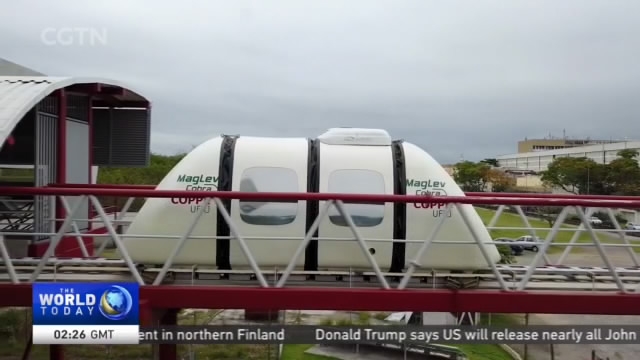
A prototype for a new kind of superconducting magnetic levitation train is being tested in Rio de Janeiro. What many might not know is that the Brazilian technology is ahead of similar projects being developed in others parts of the world. CGTN's Lucrecia Franco, in Rio, has the story.
This 200-meter experimental line might seem short, but it's enough to show the world's most modern technology when it comes to superconducting magnetic levitation trains and it's Brazilian. The first working prototype of the Maglev-Cobra train is now open to the public, connecting two technological buildings in Rio's Federal University campus.
PROFESSOR ALICIA FERRUCCIO RIO'S FEDERAL UNIVERSITY "I am very happy to see how the project went from being studied in a classroom to being put into practice and now we can ride it."
Just take a very close look and you will see the train runs one centimeter above the ground. Instead of wheels, it has superconductors that repel the magnetic rails so it floats in the air.
China and Germany are developing similar projects but the Brazilian technology is the most advanced, says the project coordinator.
RICHARD STEPHAN, PROJECT COORDINATOR ENGINEERING SCHOOL, RIO'S FEDERAL UNIVERSITY "The main difference between our project and the projects in Germany and in China is that ours is already outside the laboratory not inside."
The train is powered by electricity and designed especially for high density urban centers. The testing speed is about 12 kilometers an hour, but it will be able reach speeds of 100 kilometers an hour in urban areas.
LUCRECIA FRANCO RIO DE JANEIRO This prototype is the result of more than 15 years of research. The train has several advantages. It is non-polluting, silent and stable. The next step is to test it on longer tracks. And to make that viable, Stephan is counting on partnering with China.
RICHARD STEPHAN, PROJECT COORDINATOR ENGINEERING SCHOOL, RIO'S FEDERAL UNIVERSITY "We are in fact in contact with some investors in China , some colleagues from research centers in China to try to turn this prototype into a real scale operating system."
The tests will continue until the prototype is certified. Then it will be ready to move into production. It could take some time, but experts say this is the future of train travel. Lucrecia Franco, CGTN, Rio de Janeiro.