
12:20, 14-Dec-2017
Learning Chinese: The Chinese language to be added to Ireland's school curriculum
 []
[]
Share







Copied
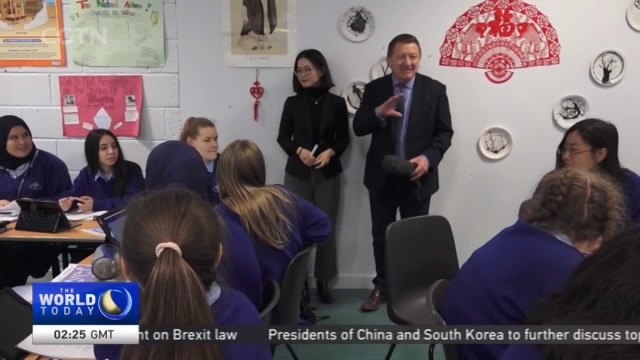
Mandrin Chinese will soon be added to Ireland's school curriculum in a bid to prepare the next generation of the country's business people for a post-Brexit world. The aim, says the Dublin government, is to target a huge potential export market and avoid the 'economic threat' posed by Britain's departure from the European Union. Richard Bestic reports from Dublin.
Miss Wu Xue here is a long way from home, but what she's bringing from China's North Eastern Heilongjiang province, could radically change Ireland's education system.
Because Miss Wu Xue's in the vanguard of a Chinese language revolution, all about widening opportunity, says school deputy head, Colm Dooley.
COLM DOOLEY DEPUTY HEAD JESUS & MARY COLLEGE, DUBLIN "China is a superpower and knowing China gives them opportunities at 3rd level and in further education with courses that offer Chinese, plus with business into the future for their lives in employment."
A Brexit roadblock created by the row over the Republic's border with Northern Ireland was a reminder of how closely the economies of the UK and Ireland are intertwined.
And breaking the ties that bind has the potential for economic collateral damage. The Chinese Language, says Ireland's Education Minister, is the window on a new world of trade.
RICHARD BRUTON EDUCATION MINISTER, IRELAND "As you know Ireland is a small trading economy. Britain has made a decision to withdraw from the European Union and we need to be looking further afield. Ninety per cent of the growth of the world's economy will not be in Europe, it will be in countries like China. So from every point of view our young people need to be considering a much wider range of languages and Mandarin is one of the most important."
At Dublin's $12 million dollar Confucius Centre, still under construction, the man who campaigned a decade for Mandarin to be taught in Ireland's schools has identified a problem: A shortage of Chinese teachers.
PROF. LI MING WANG CHINESE CONFUCIUS CENTRE DUBLIN "Currently we have visiting teachers, lecturers from China to deliver Chinese language and culture in the secondary schools and universities. But that's not a sustainable way to leading for many years to come. We have to have a localized solution."
Back in the classroom, Miss Wu Xue and I find out if the students are as keen on learning Mandarin as the politicians and the teachers are for them to learn it.
"Is it easy or is it hard, what is it learning Chinese?"
"Hard."
The verdict then, it's hard. But possibly worth the effort. RB CGTN Dublin.