
16:32, 07-Oct-2017
Che Guevara 50 Years Later: Village where Che died has become popular tourist attraction
 []
[]
Share







Copied
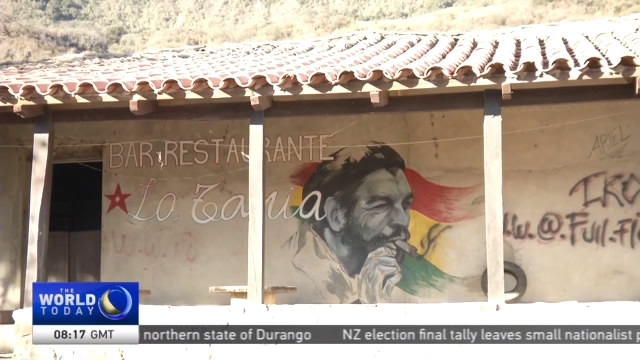
This month marks the 50th anniversary of the death of Ernesto "Che" Guevara. The Argentine Marxist medic turned guerilla fighter, became a hero of the Cuban revolution. He tried to launch a similar uprising in Bolivia, but it failed, and he was captured and then executed. Now, as CGTN's Michael Voss reports, the village where he died, La Higuera, has become a tourist attraction.
La Higuera is a tiny isolated village in the arid foothills of the Andes. The nearest town is two-and-a-half hours away on a dirt road. But this is a well-travelled route, part of what has become the Che Guevara trail.
This renovated former school house is where the Argentine Marxist revolutionary, Ernesto Che Guevara, was taken when captured and then executed by the Bolivian army.
Today, it's the village museum, and each month a different local woman is responsible for unlocking it and showing visitors around.
LOLA ARTEAGA TOUR GUIDE "There is an association with 10 of us. We then share out all of the money we collect."
Among the visitors two German students who had come to learn more about Che.
MARKUS WEINER GERMAN TOURIST "I am reading some books about him, I think he is a very impressive man. It is nice to be here, and it like gives me goose bumps to be here."
La Higuera's population has shrunk to just 80 people; most of the young have left to find work elsewhere. Ismael Flores ekes out a living growing corn. His wife is one of the museum guides while he is available to take tourists on the three-hour hike to where Che was captured. Without the tourists, he fears, this would be a ghost town.
ISMAEL FLORES FARMER "We would probably be abandoned, forgotten because remote areas are not usually in the eye of the authorities."
The Che trail was created 10 years ago, partly with funds from Britain's development agency, to help bring tourists to this impoverished region.
MICHAEL VOSS BOLIVIA The center of the village has turned into a miniature Che Guevara theme park with statues of him as well as portraits painted on many of the walls.
In anticipation of the upcoming 50th anniversary of his death, many of Che's portraits were cleaned up while his statues were painted black, green and gold.
The town of Vallegrande is also on the Che Trail. Its where his body was taken by helicopter to be paraded before the press. He was laid out in this former hospital laundry room, which today is covered with visitor's graffiti.
Che was buried in secret in the corner of a nearby airfield, only to be rediscovered in 1997, his remains flown back to Cuba. Today, there is a mausoleum covering the site, and it isn't just tourists who come to pay their respects. Some locals now consider him a Saint.
LUZ ROJAS VALLEGRANDE RESIDENT "His soul is a miracle maker for me. I come here now and then and light a candle and ask him for things, and he makes them happen."
The Bolivian authorities buried Che Guevara in a hidden grave because they didn't want the site to become a place of pilgrimage. Now there's the Che Trail aimed at attracting as many visitors as possible. Michael Voss, CGTN, Bolivia.