
15:43, 04-Nov-2017
Black in Brazil: Once banned, samba now part of Brazil's national identity
 []
[]
Share







Copied
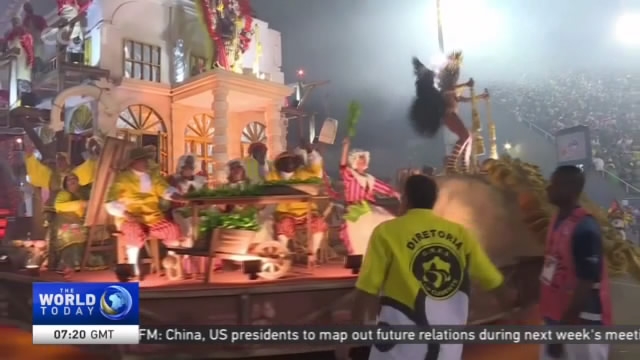
The music and dance style known as samba - invented by slaves - was once banned in Brazil. Now, it's a fundamental part of the nation's identity. Today, we bring you the second episode of our Black in Brazil series. CGTN's Lucrecia Franco has the story from Rio de Janeiro.
It is hailed as the greatest show on earth, Rio de Janeiro's samba school parade. A unique competition of color and pageantry and based one of the triumphs of African culture: the musical and dance form known as samba. This annual event was held at the sambodrome stadium. Each samba school parade represents one of the Rio's poor neighborhoods, where most Afro-Brazilians live today. Mangueira is one of the oldest samba schools. Community supporters gather to sing and dance samba at monthly fundraisers. And after generations, samba has become a lifestyle.
MARCIO PERROTA COMMUNICATIONS VP, MANGUEIRA SAMBA SCHOOL Samba is happiness, samba is a protest, samba is a statement but above all samba is the love that unites everyone.
While historians agree about samba's essential roots, they differ on its exact origins and even the word, which is believed, by some, to come from an Angolan rhythm called semba.
HELENA THEODORO AFRO-BRAZILIAN STUDIES, RIO DE JANEIRO FEDERAL UNIVERSITY Samba is the combination of different African cultures. It comes from the blacks from Angola, the blacks from Nigeria and with this intertwining you have the samba carioca.
Cariocas, what Rio residents call themselves, claim samba belongs to them in part this is because the first recording of a samba song happened here one hundred years ago. And after decades of original compositions, made popular on the radio and television, almost every Carioca carries the music in their veins.
Samba is played throughout city streets, in cafes, bars, parks and is sung by young and old alike. It is an amazing display considering there was a time, at the turn of the 20th century, when it was banned.
HELENA THEODORO AFRO-BRAZILIAN STUDIES, RIO DE JANEIRO FEDERAL UNIVERSITY Basically samba came from the poor suburbs of Rio. Why? Because it represented a way for the excluded black community to communicate, their sorrows, their joy and their need to get together.
There are many samba variations but one, quite possibly the original, known as root samba, is what musicians play in this part of Rio, known as Little Africa in the shadow of one of Rio's most visibly iconic landmarks.
LUCRECIA FRANCO RIO DE JANEIRO It is here at Pedra do Sal, or Salt Rock that historians say samba was born. On these steps, slaves unloaded salt and sang the songs that were the basis of this musical form and today this is one of the best places to listen to samba outside of Carnival.
This roda de samba samba circle, sets up around a table, is a typical samba formation. Djanir Pacheco, one of the musicians says Pedra do Sal is sacred.
DJANIR PACHECO SAMBA MUSICIAN Because it was the first place where a samba circle happened, where everything began, where all they great samba players performed and today I am a professional that can support my family thanks to samba.
Over the centuries, samba has created an essential cultural bond, shared by whites, blacks and mulattos together. It is authentic Rio de Janeiro, said by many to have one of the world's most unique cultural blends. Lucrecia Franco, CGTN, Rio de Janeiro.