TECH & SCI


No need for eggs: Ancient 'live birth' reptile found in China
2017-02-15 11:01:06 GMT+8






Editor
Gong Zhe
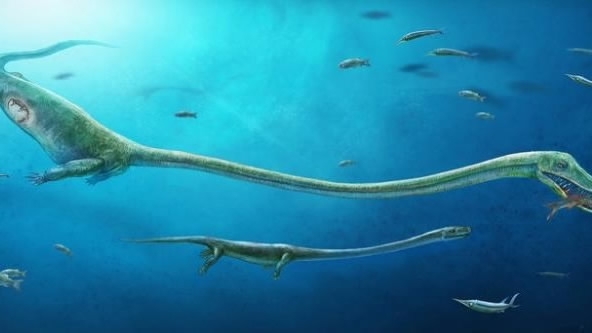
An extraordinary fossil unearthed in southwest China's Yunnan Province shows a pregnant long-necked marine reptile that lived millions of years before the dinosaurs complete with a developing embryo, indicating this creature gave birth to live young rather than laying eggs.
Scientists in China on Tuesday said the fossil of the unusual fish-eating reptile called Dinocephalosaurus, which lived about 245 million years ago during the Triassic Period, changes the understanding of the evolution of vertebrate reproductive systems.
Mammals and some reptiles including certain snakes and lizards are viviparous, meaning they give birth to live young.
Dinocephalosaurus is the first member of a broad vertebrate group called archosauromorphs that includes birds, crocodilians, dinosaurs and extinct flying reptiles known as pterosaurs known to give birth this way, paleontologist Liu Jun of China's Hefei University of Technology said.

Luoping Biota National Geopark, where the fossil was found. /Liu Jun
It boasted one of the longest necks relative to body size of any animal that ever existed. Dinocephalosaurus, unearthed in Yunnan Province, was estimated at 4 meters long, including a slender neck roughly 1.7 meters long, Liu said. It had paddle-like flippers, a small head and a mouth with teeth, including large canines, perfect for snaring fish.
"I think you'd be amazed to see it, with its tiny head and long snaky neck," said University of Bristol paleontologist Mike Benton, who also participated in the research published in the journal Nature Communications.
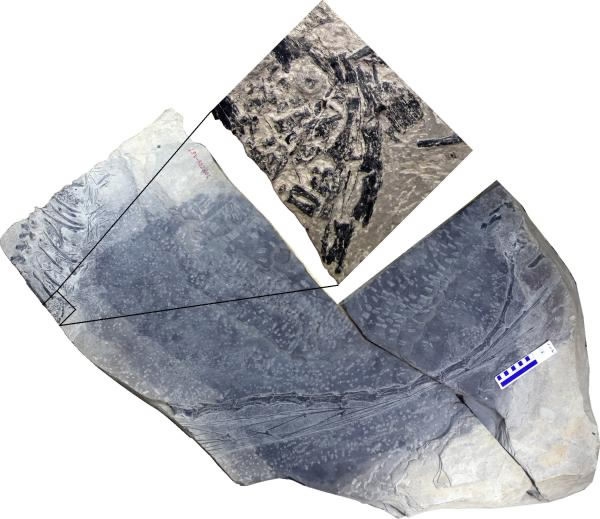
Picture of the discovered fossil. /Liu Jun
Not laying eggs provided advantages to Dinocephalosaurus, the researchers said. It indicated the creature was fully marine, not having to leave the ocean to lay eggs on land like sea turtles, exposing the eggs or hatchlings to land predators.
(Source: Reuters)
Copyright © 2017
SHARE
- EXPLORE
- MORE
FOLLOW US