TECH & SCI


NASA developing high-speed space "internet"
2017-03-23 10:15 GMT+8






Editor
Xie Zhenqi
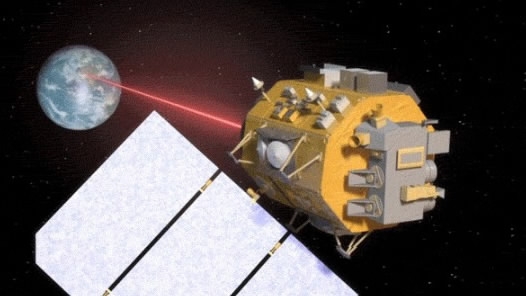
NASA is planning to launch laser communications technology into space in the hope that it "could become the high-speed internet of the sky."
The agency said in a statement on Wednesday that the mission, known as Laser Communications Relay Demonstration (LCRD) and scheduled for launch in summer 2019, "recently successfully passed a key decision point review and has moved on to the integration and test stage of development."
Laser communications, also known as optical communications, encodes data onto a beam of light, which is then transmitted between spacecraft and eventually to Earth terminals.
NASA said this technology offers data rates that are 10 to 100 times better than current radio-frequency communications systems, and that the technology is very compact – much smaller than radio systems.
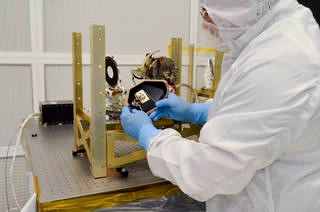
An engineer examines a LCRD component. / NASA Photo
It plans to build two ground stations, one on California’s Table Mountain, and another in Hawaii, to demonstrate communications capabilities to and from LCRD, which will be located in an orbit that matches Earth's rotation, called a geosynchronous orbit.
The mission will build on the Lunar Laser Communications Demonstration (LLCD), a device that flew aboard the Lunar Atmosphere Dust and Environment Explorer in 2013.
While LLCD was first to demonstrate high-data-rate laser communications beyond low-Earth orbit, LCRD will demonstrate the technology's operational longevity and reliability, NASA said.
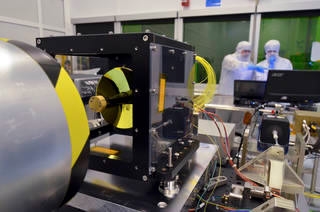
Engineers are currently testing optical module assembly for the LCRD mission. / NASA Photo
"LCRD is designed to operate for many years and will allow NASA to learn how to optimally use this disruptive new technology," according to the agency’s Don Cornwell, who led the development of the instrument.
The NASA team is also designing a laser terminal for the International Space Station that will use LCRD to relay data from the station to the ground at gigabit-per-second data rates.
"We plan to fly this new terminal in 2021," Cornwell said. "Once tested, we hope that many other Earth-orbiting NASA missions will also fly copies of it to relay their data through LCRD to the ground."
(With inputs from Xinhua)
Copyright © 2017
SHARE
- EXPLORE
- MORE
FOLLOW US