
10:57, 13-Oct-2017
The Yuan's Journey: Endpoint clear, path may be winding
 []
[]
Share







Copied
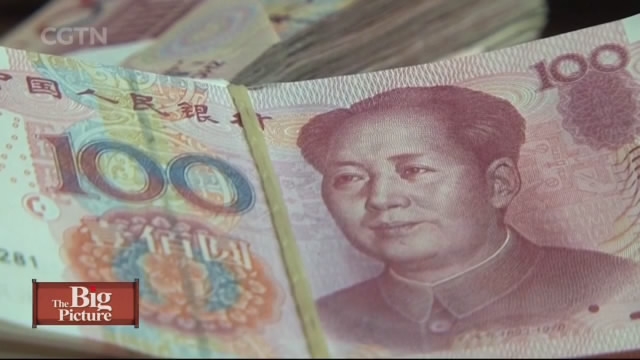
8am, banks may still be closed but bankers are already at work. Jean Lu leads an international team of RMB experts at Standard Chartered Bank, the world's no.2 trade bank. This morning she is meeting her African colleagues.
JEAN LU, CIB STANDARD CHARTERED BANK "It becomes my daily work. along with b&r. talk to clients in solutions, embed solutions into what we offer clients. They benefit. When we go to African countries, meet bankers, clients, rmb is inevitable topic in our work."
Mid-morning, at the Beijing branch of the world's largest bank – ICBC –Irina Kuligina, the chief representative of Russia's Promsvyazbank – is exchanging yuan for roubles. Having been in China since the two countries piloted currency trading, she has seen the yuan-rouble trade grow.
IRINA KULIGINA, CHIEF REPRESENTATIVE PROMSVYAZBANK BEIJING REP. OFFICE "Now for financing in rmb, very substantial portion that we're doing in rmb, we're issuing LCs in rmb, business 58% of our total."
Russia is the first country to offer Yuan trading on its currency exchange. Important for a future world, oil may not be priced in US dollars.
IRINA KULIGINA, CHIEF REPRESENTATIVE PROMSVYAZBANK BEIJING REP. OFFICE "Even for banking business itself, we are going to enter Chinese market now. We are no longer limited to ending qualification for a long time."
Lunchtime, Sunny Li – accountant at Austcham, is using yuan to pay for goods, something that can be done increasingly in countries ranging from Sri Lanka to Zimbabwe.
SUNNY LI, ACCOUNTANT AUSTCHAM When we go travelling abroad, we don't have to take a lot of foreign currency. Local shops take rmb as payment, that is a good trend. For us consumers. RMB internationalization reduces the exchange process, more convenient. Nowadays most people like to travel abroad. There's no need to exchange money beforehand. In the future, I think the yuan's role would grow steadily in the world."
Midday, at the mother of all Chinese banks – the central bank – which decides how much money to channel into the 165 trillion yuan money supply.
CHENG LEI BEIJING "For the yuan to become a truly global currency, more countries need to trade in it, hold it as reserve and the central bank itself needs more transparency."
Huang Yiping, PBOC advisor and banking veteran, tells us the key ingredient to getting currency reforms back on track.
PROFESSOR HUANG YIPING NATIONAL SCHOOL OF DEV'T, PEKING UNIVERSITY "What you really need is kind of confidence that we are able to. What happened in the past is that whenever the currency depreciate, people lose confidence and that becomes a problem. So you really want to internationalize you currency, you need a strong economy, you need a liquid and large financial market but you also need good institution that protect property. Whether or not RMB will become a dominant reserve currency like US dollar, I think that will be a very long term story."
Venezuela's recent announcement it would switch to yuan for trade settlement from the USD -- Is another sign of the yuan's street cred, but does that mean the de-USD process is in motion? That would partly depend on what happens under the trump administration.
There are two formal ways of referring to China's currency. Renminbi is its official name. But when Chinese people buy things they say Yuan. The Yuan is a unit of the Renminbi - like dimes, quarters and dollars here in the United States. Some American tourists in Times Square find saying Yuan is rather easier than Renminbi. "Rem - Un - beeb?" "I don't know ...what is this?" "Renminbi? Yes ... well done ..."
Good thing the Chinese also have another name for the Yuan that's easier to say - "Kwai".
JOHN TERRETT NEW YORK "I think coming from England originally helps me to understand it too - because in Britain we pay for things with Pounds but the currency is known globally as Sterling - Yuan, Renminbi - Pound, Sterling . it's the same thing.”
When he was campaigning to win the White House President Trump was very rude about China and its currency - accusing Beijing of planning to manipulate the Renminbi in the future - deliberately devaluing it - to make China's exports cheaper for overseas customers. Since then President Xi and President Trump have met in Mar-a-Lago in Florida. They got along famously - holding frank discussions on trade and the DPRK which continues to focus minds in Beijing and Washington DC. President Trump is slated to visit Beijing very soon.
JOHN TERRETT NEW YORK So now that he's moved out of trump Tower and has settled in the White House - what effect - if any - has President Trump had on the Renminbi?
Analyst Dan Alpert says while the Renminbi tracks a basket of currencies these days - the US dollar's a major component of that basket - so while for most of this year the Renminbi has spiked against the dollar. In the same time frame it's declined quite sharply against the European Single Currency for example.
DAN ALPERT, ANALYST WESTWOOD CAPITAL "They have the best of both worlds they have the advantageous trading position with currencies that have risen against the dollar - which has weakened considerably since the Trump administration began. On the other hand they're pretty much in the same boat as they always were with the dollar."
The dollar initially soared after trump's 2016 election but his failure to get legislation through Congress - the Russia investigation - and an economic rebound in Europe have hit the once mighty Greenback hard - sending it tumbling.
DAN ALPERT, ANALYST WESTWOOD CAPITAL "At the end of the day China cannot abandon its mercantile structure. It has to continue. It has created so much overcapacity and it doesn't really have the political environment to constrain that capacity."
The view of many in the US is that the Belt and Road initiative is partly an attempt to find additional markets outside the developed world - even though - those same folks say - Beijing still needs demand from developed countries to help it employ more and more people and reduce over capacity.
JOHN TERRETT NEW YORK "In other words what China needs more than anything is consumerism pretty much wherever it can find it and with the Renminbi rising a little against the dollar - that helps with imports but it's not really enough to stop Americans buying Chinese goods and with the Renminbi falling against the Euro and other non-dollar currencies, well that simply helps China sell its exports more."
China often talks about the Renminbi having become a major global reserve currency like the dollar, the Euro, and Swiss Franc - a move that would give China more clout in politics as well as trade. Some media pundits hype this - saying Beijing is on a quest to displace the dollar. A slim majority on Wall Street see this as inevitable - given China's size and influence in the world. Not so fast says Dan Alpert - it's most likely a long way off!
DAN ALPERT, ANALYST WESTWOOD CAPITAL "I don't believe the Chinese currency will become the global reserve currency. That is something I think is basically a media conceit and a conceit of a few lesser informed non-economic analysts. The number of trades - both directions - that are resolved in Chinese currency is infinitesimally small in comparison to the dollar."
To become the world's dominant currency he says China would have to be a major importer as well as an exporter over a sustained period. The Renminbi would have to be freely traded on global exchanges.
DAN ALPERT, ANALYST WESTWOOD CAPITAL "I don't believe that the free exchange ability and free convertibility of the RMB is in the offing - at least in the next decade - and probably within our lifetimes."
Of course one sure way to test if the Renminbi is ready for the world stage is to see if a New York taxi driver can even recognize a Yuan note when offering one as payment for a fare. 'I'd like to pay with Chinese currency? "No, sorry we only accept dollars!"
Oh well, maybe it's a bit too soon, after all one day, one day. John Terrett, CGTN, New York