SOCIAL


Analysis: Is Trump pushing global talent toward China?
2017-04-20 20:11 GMT+8






Editor
Wang Lei
By CGTN's Wang Lei
As the United States, Australia and New Zealand tighten their work visa policies, China is taking steps to lure top talent from across the world. In the global competition for talent, are Donald Trump and his followers doing China a favor?
'Buy American, Hire American'
President Trump signed an executive order on Tuesday, directing federal agencies to implement a policy of "Buy American, Hire American" and calling for a review of the H-1B visa program for skilled workers.
Trump signs "Buy American, Hire American" order.
"Right now, H-1B visas are awarded in a totally random lottery, and that’s wrong," Trump said during the signing ceremony at the headquarters of Snap-On Tools, a Wisconsin-based manufacturer.
H-1B visas allow 65,000 workers and another 20,000 graduate student workers to enter the US each year. Under the current system, visas are awarded on a lottery basis. Critics say the program is often abused by firms to hire lower-paid employees from overseas at the expense of Americans.
Trump suggested the program should be reformed to ensure H-1B visas go to the "most-skilled or highest-paid" so that more jobs would be reserved for American labor. "It's America first, you better believe it," he said.
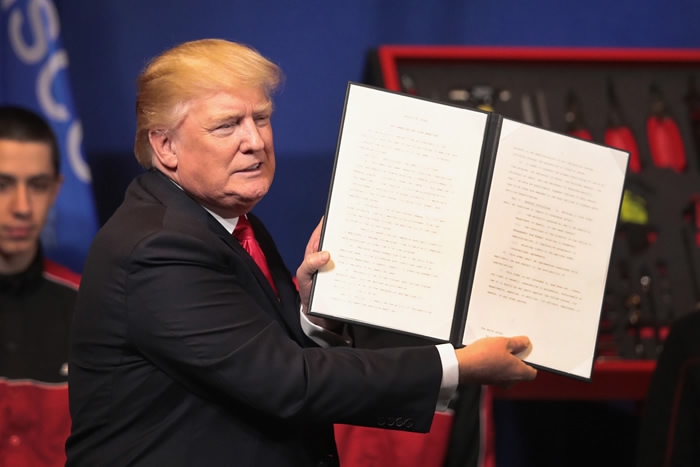
US President Donald Trump signs an executive order to try to bring jobs back to American workers and revamp the H-1B visa program in Kenosha, Wisconsin, the US on April 18, 2017. /VCG Photo
The latest move is the second major attempt by Trump to fulfill his campaign promise of overhauling America's immigration system, after the controversial travel ban intended to keep citizens of several Muslim-majority countries from entering the US.
The American business community voiced concerns over the latest move, worrying that it could harm the country's ability to attract top talent.
"It's not a zero-sum game," Eamon Jubbawy, co-founder of software solution start-up Onfido, told CNBC, adding that the changes could restrict new talent and prevent new business innovation.
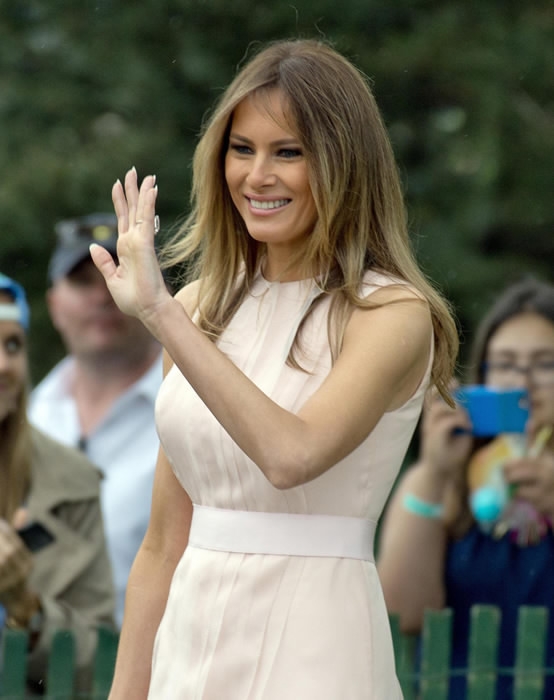
Slovenia-born Melania Trump, American First Lady, worked as a model on an H-1B visa, according to The New York Times. /VCG Photo
Peter Hebert, co-founder and managing partner at Lux Capital, said Trump’s protectionist policies are self-destructive. "The tech talent pool that transformed Silicon Valley into an American economic marvel, sending US technology to the entire world, is itself a pastiche of people from the entire world – India, China, Pakistan, Israel and Iran," he told Vanity Fair.
Hebert stressed that "talent, like capital, goes where it's welcome and stays where it is best treated" and slammed the Trump administration for "foolishly protecting the past from the future."
Trump is trying to "wall off America from some of the most talented human beings on the planet," he indicated.
'Australians first,' 'Kiwis first'
Prime Minister Malcolm Turnbull announced his "Australia first" commitment on Tuesday by scrapping the 457 visa program which permits skilled migrants to work in the country for up to four years.
"We're putting jobs first. We're putting Australians first," Turnbull declared in a video posted on Facebook. "We'll no longer allow 457 visas to be passports to jobs that could and should go to Australians."
Australia terminates the 457 visa program.
Turnbull's announcement has drawn widespread criticism from Australian companies and leading universities, which fear the changes could create a dearth of expertise in both business and academic communities, damaging the country's competitive edge in the world.
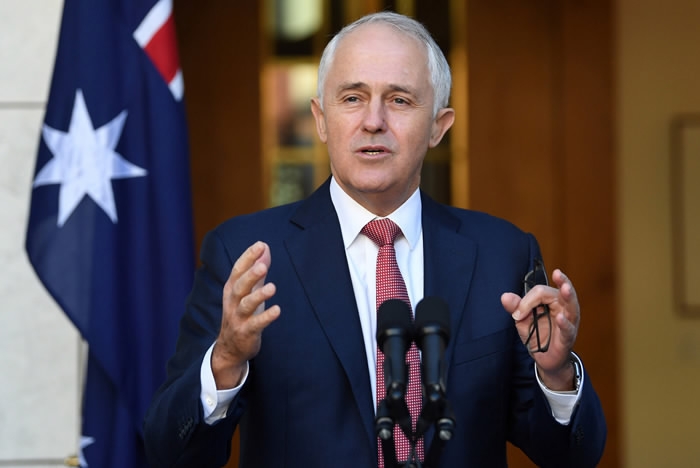
Australian Prime Minister Malcolm Turnbull speaks out on Australia's citizenship test during a press conference at Parliament House in Canberra, Australia on April 20, 2017. /VCG Photo
Similarly, the New Zealand government has announced plans to tighten access to skilled work visas. "The government has a Kiwis-first approach to immigration," Immigration Minister Michael Woodhouse said on Wednesday.
"It’s important that our immigration settings are attracting the right people, with the right skills, to help fill genuine skill shortages and contribute to our growing economy," he stressed.
The changes include raising the income threshold to be classed as a skilled migrant to nearly 50,000 New Zealand dollars (about 35,222 US dollars) a year, classifying anyone earning 73,000 New Zealand dollars (about 51,424 US dollars) and above as high-skilled and restricting work visas to low-skilled workers to three years.
'Great opportunity' for China
As major immigrant nations turn inward amid populist sentiments and economic uncertainties, China – the world's second largest economy and an engine for global growth – is welcoming talented people worldwide with open arms.
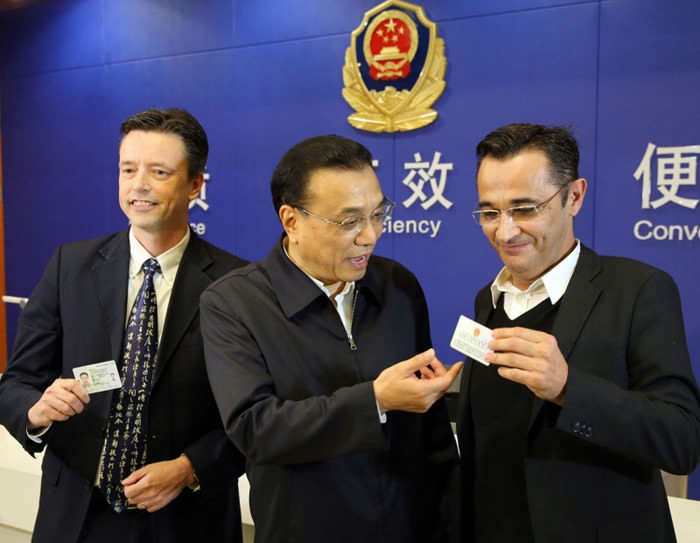
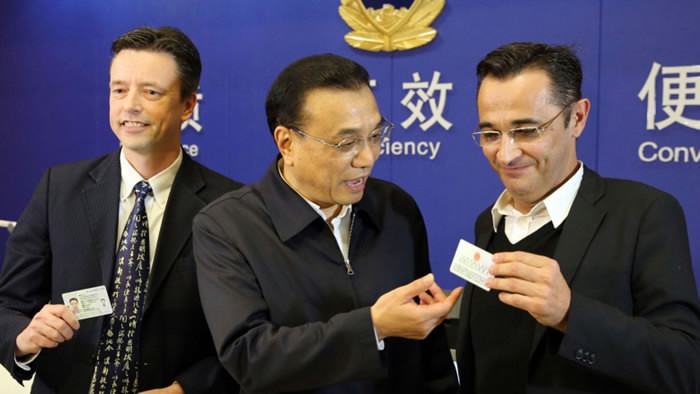
Chinese Premier Li Keqiang (C) talks with green card recipients from the Netherlands and France in Shanghai on November 25, 2015. /Gov.cn Photo
"China should be more open in its immigration policy" and seize the "great opportunity" offered by Trump to attract skilled workers, Robin Li Yanhong, chief executive of Internet giant Baidu and a member of the Chinese People's Political Consultative Conference (CPPCC), said in March during China's annual Two Sessions.
And this is exactly what China has been doing.
At a meeting of the Central Leading Group for Deepening Overall Reform chaired by President Xi Jinping on February 6, China's top leaders agreed to optimize the rules and processes for issuing certificates of permanent residence to foreigners, known as the Chinese green cards.
According to a reform plan issued by the Chinese Ministry of Public Security, the green cards will be upgraded to make them machine-readable and give holders easier access to a range of social services, such as traveling by train and air, purchasing properties and doing business in banks. The reform will be completed by the end of June.
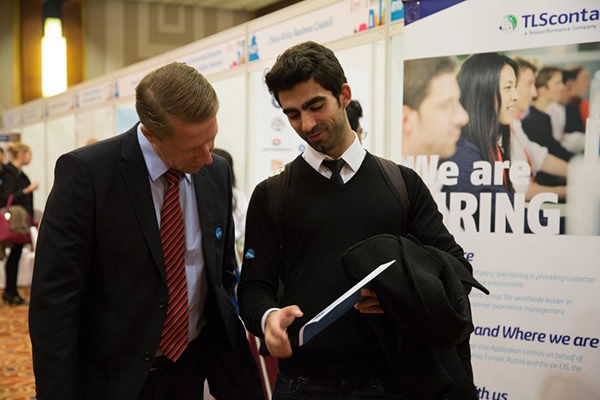
Foreign jobseekers attend a job fair in Beijing, China on November 5, 2016. /VCG Photo
It is good news for foreigners living and working in China. Last year, more than 900,000 foreigners were employed on the Chinese mainland and 1,576 were granted green cards, an increase of 163 percent over 2015, when the country eased its residence policy.
Chinese green card holder Mark Levine, an American who received China's Friendship Award in 2014, told CCTV that Beijing is as full of opportunities as Los Angeles, which attracts "dream chasers" from the whole world.
This year, China also eased work visa requirements for foreign graduates. Previously, two years of work experience were mandatory in most cases for a foreigner to find a job in China. It had been almost impossible for foreign students to be employed right after graduation.
Now those with a postgraduate degree or higher from Chinese or "well-known" foreign universities can be offered employment within a year of graduation, according to a new policy released in January. Successful applicants will be given a one-year work permit, which can be extended to no more than five years at renewal.
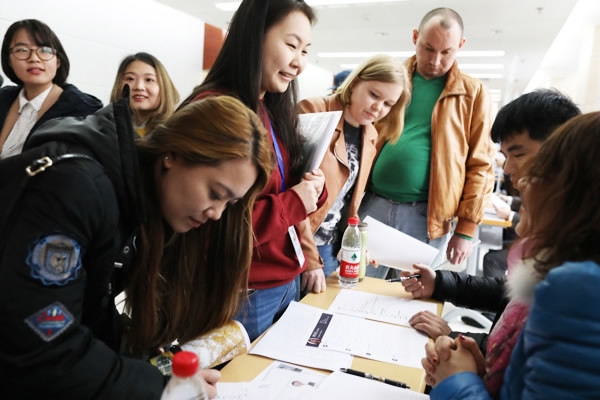
International students attend a job fair at Beijing's Zhongguancun high-tech zone on March 23, 2017. /China Daily Photo
In addition, it was reported by Bloomberg that China is setting up its first immigration office, as the country seeks overseas talent to help drive the transition of an economy led by consumer spending and innovation.
"China didn't need to do that over the past decades because it had double-digit growth simply by enjoying the demographic dividend," said Wang Huiyao, president of the Center for China and Globalization, a think tank headquartered in Beijing. "But now it needs a new dividend of foreign talent to help support the economic growth."
As the most populous country in the world, China is not a major destination for immigrants in the way the US, Australia and New Zealand have been. But it is making systematic efforts to integrate global talent into its epic reform and opening up in an era of rising nationalism in the West, which is a welcoming message to professionals from around the globe seeking new opportunities.
Related stories:
Copyright © 2017
SHARE
- EXPLORE
- MORE
FOLLOW US