
16:14, 12-Dec-2017
The Conscience of Japan: Japanese activist seeks the truth about wartime atrocities
 []
[]
Share







Copied
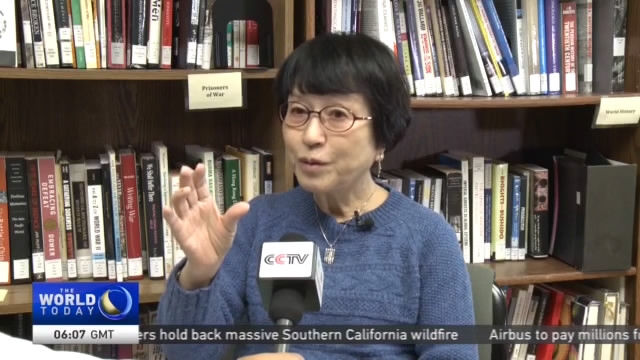
In Japan, one brave scholar and social activist has dedicated her life to uncovering the truth about the 1937 Nanjing Massacre and to documenting the victims' stories. CGTN's Li Jianhua has more.
Meet Tamaki Matsuoka. The 71-year-old Japanese social activist is widely known as "the conscience of Japan". Since 1988, she has committed herself to uncovering the truth about the Nanjing Massacre. She has spent decades seeking out survivors in order to record their testimony and collect historical documents.
TAMAKI MATSUOKA SOCIAL ACTIVIST "I have been engaged in collecting testimonies for more than 30 years. I have written books and held exhibitions. I even started making films 9 years ago. Films help viewers witness the regret and repentance of Japanese veterans, directly and emotionally. I made this film trilingual, in Chinese, Japanese and English, in order to let young people not only in Japan, but all around the world, learn more about the truth."
About 300 survivors have told their wartime stories to Matsuoka. Most were extremely elderly. Some have even passed away.
TAMAKI MATSUOKA SOCIAL ACTIVIST "I walked over every street in Nanjing and found Chang Shouying, an 87-year-old woman who survived the massacre. She said she was raped by Japanese soldiers as many as three times. Her three-month old baby girl was killed and burned. She embraced a strong hatred towards the Japanese. I asked her to come to Japan because she had a very good and convincing memory, and people in Japan right now are denying historical facts. The old lady immediately said: I am the living witness of the Nanjing massacre, I want to go to Japan to sue!"
Matsuoka has also tried to track down former Japanese soldiers who had knowledge of the massacre or who took part in it themselves. Many veterans told her their stories, some even changed their original perspectives towards the massacre.
TAMAKI MATSUOKA SOCIAL ACTIVIST "One of them, called Sho Mitani, a veteran who served in the Navy, told me he saw many bodies floating in the Yangtze River while his vessel navigated the river from Shanghai to Nanjing. He even fired at Chinese people swimming upstream the river. During the interview, he gradually realized that he took part in the Nanjing Massacre. In 2007, he came to Nanjing and apologized for his crimes in front of many Chinese people, and later even helped me with my testimonial work. I was so pleased to see that."
Matsuoka's work hasn't been easy. The political attitude in Japan has gotten worse over the past 30 years. Japanese history books use vague, non-descript words to describe the Nanjing Massacre. Matsuoka says she is angered by her country's attempts to whitewash history.
TAMAKI MATSUOKA SOCIAL ACTIVIST "Teachers still have to teach our students history according to the textbooks, even though we know the truth. The government has put pressure on us. It has denied facts, because many Japanese war crimes weren't accounted for after the war. Some Japanese right wingers denounced me for investigating the Nanjing Massacre. But I think that Japan, as the instigator of the war needs to make profound introspections."
Matsuoka says she remains committed to helping more people learn the truth.
TAMAKI MATSUOKA SOCIAL ACTIVIST "Only true historical facts can be passed on to the next generation. I provide young people in Japan with historical facts and hope they can learn and think independently. We need to face up to our history, and meet the future together."
Matsuoka says she has never thought about giving up on promoting friendly ties between China and Japan, and safeguarding world peace. LJH, CGTN.