
Mandarin is the common language in China, but each region has its own dialect. For travelers, a familiar accent can evoke the memory of their hometown.
A recent survey showed that 62.8 percent of respondents could speak the dialect of their hometown, 65.8 percent reckoned dialects carried history and culture, and half thought dialects will still exist in 50 years. The Institute of Social Survey at China Youth Daily and a Chinese company www.wenjuan.com spoke to 2,002 interviewees of different age groups and regions.

A wall of character modules of Chengdu dialect beside a subway station. /VCG Photo
Huang Yuan, a junior undergraduate at a university in Hebei Province, talks to his parents in Mandarin. But while chatting with grandparents, he shifts into the local dialect as they have spoken it in their whole life.
Indeed Mandarin is the standard tongue in people's daily lives. Is it necessary for the youngsters to learn a local dialect? According to the survey, 70.2 percent of those interviewed said yes.
"Dialects have been a way of communication, and more importantly a precious local culture." Huang told China Youth Daily. Huang believes that because less people can speak and understand different dialects, protecting them is important.
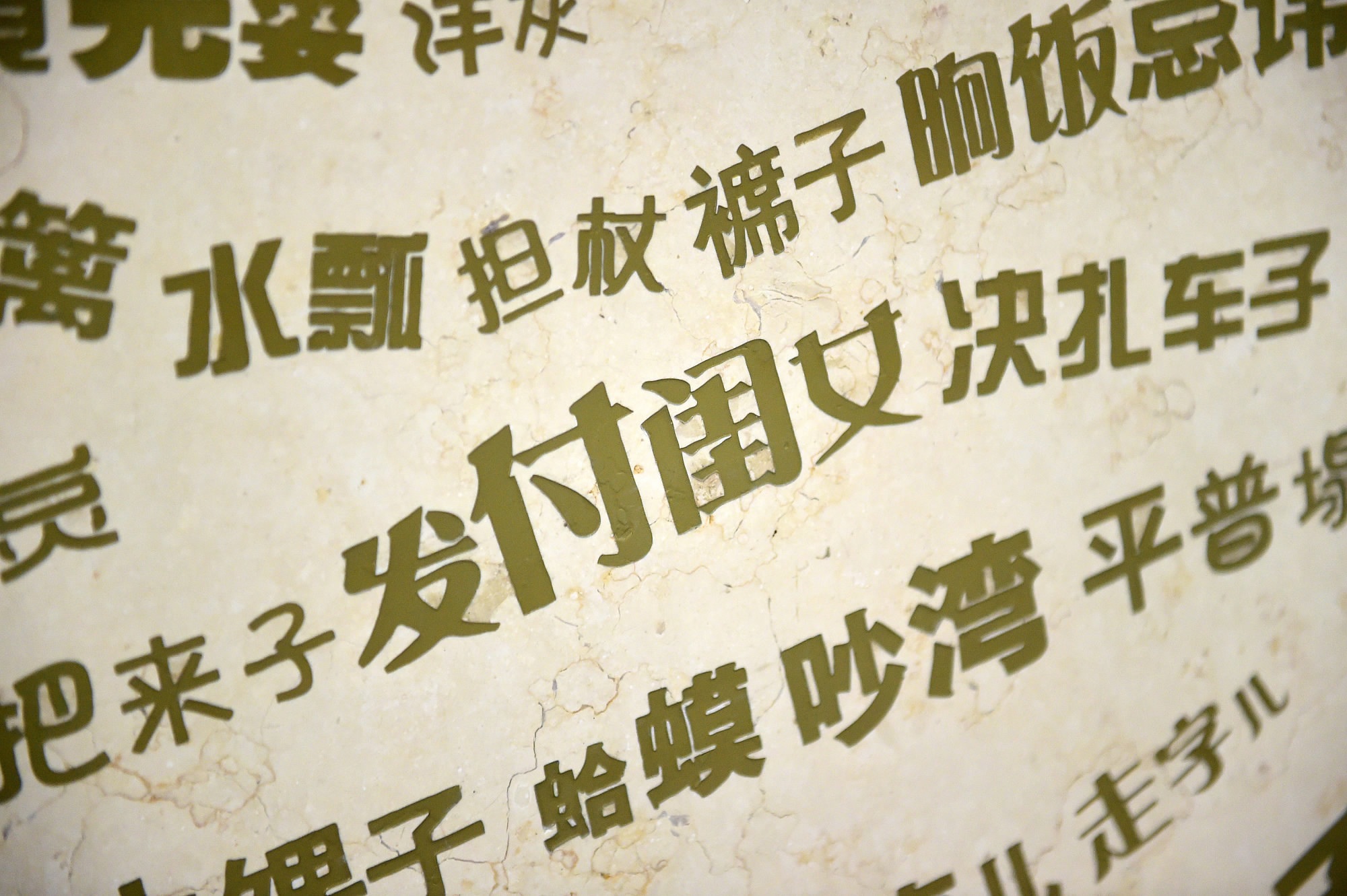
An art wall with Qingdao dialect at the subway station. /VCG Photo
Over 6,000 languages exist in the world. But with globalization and urbanization, languages and accents wither away.
Each dialect represents a local culture, and a knowledge system. When a certain dialect dies out, a knowledge system dies with it.