
13:58, 25-Nov-2017
Fujian at Work: Elements of ancient Silk Road in Xunpu Village
 []
[]
Share







Copied
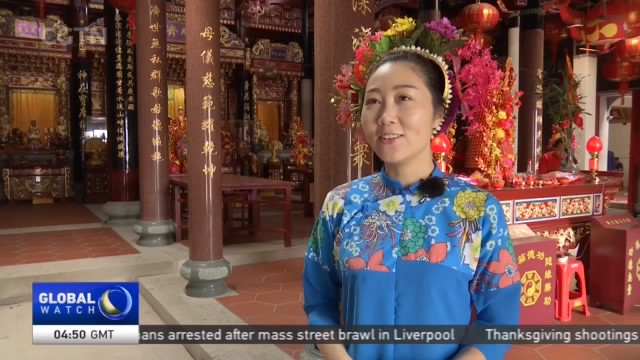
The southeastern coast of Fujian began trading with African countries as early as the Song and Yuan Dynasties (960-1368). Tourists today can still spot some Arabic elements in villages near Quanzhou. CGTN's Zhao Yunfei takes us to Xunpu Village to find out more.
Visitors flock to this village near Quanzhou to see colourfully dressed women, richly decorated with flowers. Locals call them the mobile flowers over head.
JIANG LINGLING VILLAGER "Since Quanzhou is the starting point of the Maritime Silk Road, the jasmine flowers we are wearing were originally from Arabic countries. They followed the Maritime Silk Road and were replanted here."
But there's more to the flowers than their Arabic roots. Jiang Lingling spoke with us in a Mazu Temple. Xunpu locals are loyal followers of Mazu, goddess of sea. And in keeping with life at sea, villagers make their living by selling oysters, a blending of eastern and western culture.
ZHAO YUNFEI QUANZHOU Walking in the Xunpu Village, one can easily spot the houses made with big oyster shells. Compared with shells sold in local markets, these are much bigger. In fact, they are not from here, they are from Africa. In ancient times, Xunpu villagers traded goods with African countries. They went there with silk and tea, and came back with oyster shells to increase the weight of the vessels and prevent capsizing.
HUANG RONGHUI XUNPU VILLAGE CULTURE PRESERVATION ACTIVIST "If you don't preserve cultural relics, they will eventually disappear. We should let our next generation know about their predecessors' living conditions."
Huang Ronghui was born and raised in Xunpu, and for years since his retirement, he has worked on documenting the village's special culture. His efforts have attracted more followers, like Jiang Lingling.
JIANG LINGLING VILLAGER "While preserving our culture, we should also pass it along to our children."
The village is actively developing its tourism industry, but many villagers believe that protecting the ancient architecture is far more important than making financial profit. Located at the estuary of the Jinjiang River, the Xunpu village has already benefited from the prosperous sea resources.
ZHAO YUNFEI QUANZHOU The sparkling fishing village of Xunpu boasts cultural charm just south-east of downtown Quanzhou. Quanzhou was Asia's largest port during the Song and Yuan dynasties. And when Marco Polo bid farewell to China in the late 13th century, he called it "the Alexandria of the East". Its beauty the norm in the coastal city of China. Zhao Yunfei, CGTN, Xunpu, Fujian Province.