
16:09, 15-Nov-2017
Venezuela Debt: Credit rating agency declares Venezuela officially in default
 []
[]
Share







Copied
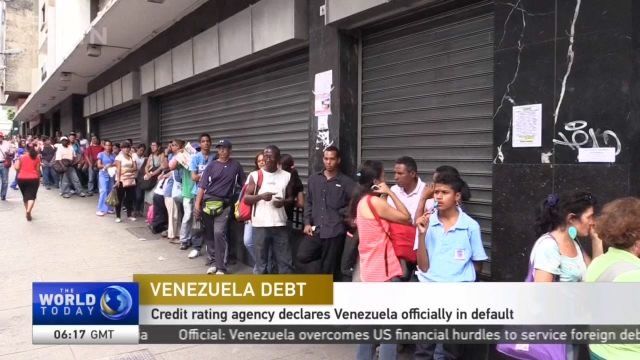
Venezuela has been declared in selective default by financial company Standard and Poor's. Vice President Tareck El Aissami met with creditors in Caracas on Monday, but offered no way out of the impasse. Venezuela is expected to become more reliant on both Russia and China for its immediate financial needs. An agreement has already been reached with Russia on $3 billion of debt. CGTN's Stephen Gibbs has more from Caracas.
It has been the moment long predicted. And now it has arrived almost. Venezuela, once the most prosperous country in Latin America, can no longer pay its debts. But this is not a full default, yet. The government emphasized that - when it called in all its creditors to explain the situation. Venezuela said still intends to pay its debts. The meeting was chaired by the country's vice president. He faces U.S. sanctions for alleged drug trafficking. The U.S. has also banned U.S. companies from trading in new Venezuelan debt. So, no surprises as to whom Mr. El Aissami blames.
TARECK EL AISSAMI VENEZUELAN VICE PRESIDENT "This assault on behalf of the U.S. government, along with factors of the Venezuelan opposition, finished off with the few ways that still allowed Venezuela to widely develop within the international financial market. Today, Venezuela is limited in seeking finance from what has historically been our market."
Cut off from U.S.-sourced financing, Venezuela is expected to become more reliant on both Russia and China for its immediate financial needs. A restructuring of its billions of dollars of Russian debt is likely to be announced on Wednesday.
The question now is what the cost be for President Maduro. A full default is likely to worsen the already chronic recession this country is experiencing.
Caracas based political analyst, Luis Vicente Leon - a critic of the government - believes that any cut in funding for the Maduro government risks backfiring.
LUIS VICENTE LEON POLITICAL ANALYST "We don't produce anything. We depend on dollars. And what you are cutting is not the dollars for the government. It is the dollars for me and for the people inside."
His argument is that as Venezuelans get even poorer they become more dependent on the government. So political change is less likely.
STEPHEN GIBBS CARACAS "And one update and that is on Tuesday in late trading the price of Venezuelan bond did drop quite sharply, reflecting doubt in the markets over the government's real ability to settle its debts. Stephen Gibbs, CGTN, Caracas."