SOCIAL


What happened to last year’s ‘3.15 Gala’ offenders?
2017-03-15 22:53:16 GMT+8







Editor
Yan Qiong
World Consumer Rights Day is an annual event in China, in which companies are called out and exposed for bad practices every March 15.
Last year’s “3.15 Gala” show, which aired on the Chinese network CCTV, revealed a variety of practices that hurt consumers. It featured 14 companies, including a food delivery app, a used car O2O Platform, and a mobile app developer.
It has been a year since those companies were reported. What has happened to them? And more importantly, have they corrected their wrongdoings?
Ele.me

CFP Photo
Ele.me, a food delivery app backed by Tencent and JD.com, was last year’s highest-profile culprit. It allowed unlicensed restaurants with poor sanitary conditions and false images of their outlets to sell food on its platform.
Immediately after the program aired, the company announced it had removed the offending restaurants from its platform, and had formed a special working team to conduct a full-scope check on all restaurants on ele.me.
However, customers were not satisfied with the response. In July 2016, the newspaper, Legal Daily, reported that a customer found worms in food ordered via an Ele.me-listed restaurant. Two months later, CCTV launched a series about “ghost restaurants”, referring to restaurants on the platform that were not properly registered or did not have sanitary licenses.
Apparently, the problem has not been entirely resolved, and the fight over food safety in China looks like a long-term battle.
Cheyipai.com
Used car sales website Cheyipai.com received the second-highest number of complaints, according to CCTV. Most of the grievances related to attempts to take advantage of sellers or demands that buyers purchase insurance and license plates.
In response, the company explained that they charged buyers a price asked by the seller plus a commission fee, which is a very common practice in the industry. Following the statement, they also issued an apology and disclosed their standard fee and commission rate.
However, the company’s sales were hit hard by customer grievances. With that trust gone, it may never be repaired.
Daoyoudao
Faulty mobile phones and software that maliciously charged users were publicly shamed, and mobile app developer Daoyoudao was the main offender in this instance. "Brushing," the practice of creating fake online sales to improve a vendor's rating, also came under the microscope.
Daoyoudao is listed on the New Third Board, China's over-the-counter stock market. After the exposure, the company suspended trading and released a statement on social media platform Weibo pledging to compensate customers for their losses.
Also, the company announced it would remove all the offending software from the platform and step up scrutiny on products.
Over the past year, the company was fined three times for a total 260,000 yuan (37,500 US dollars) for illegal advertisements.
Daoyoudao has not resumed trading since March of last year.
One in three consumers give up defending their consumer rights
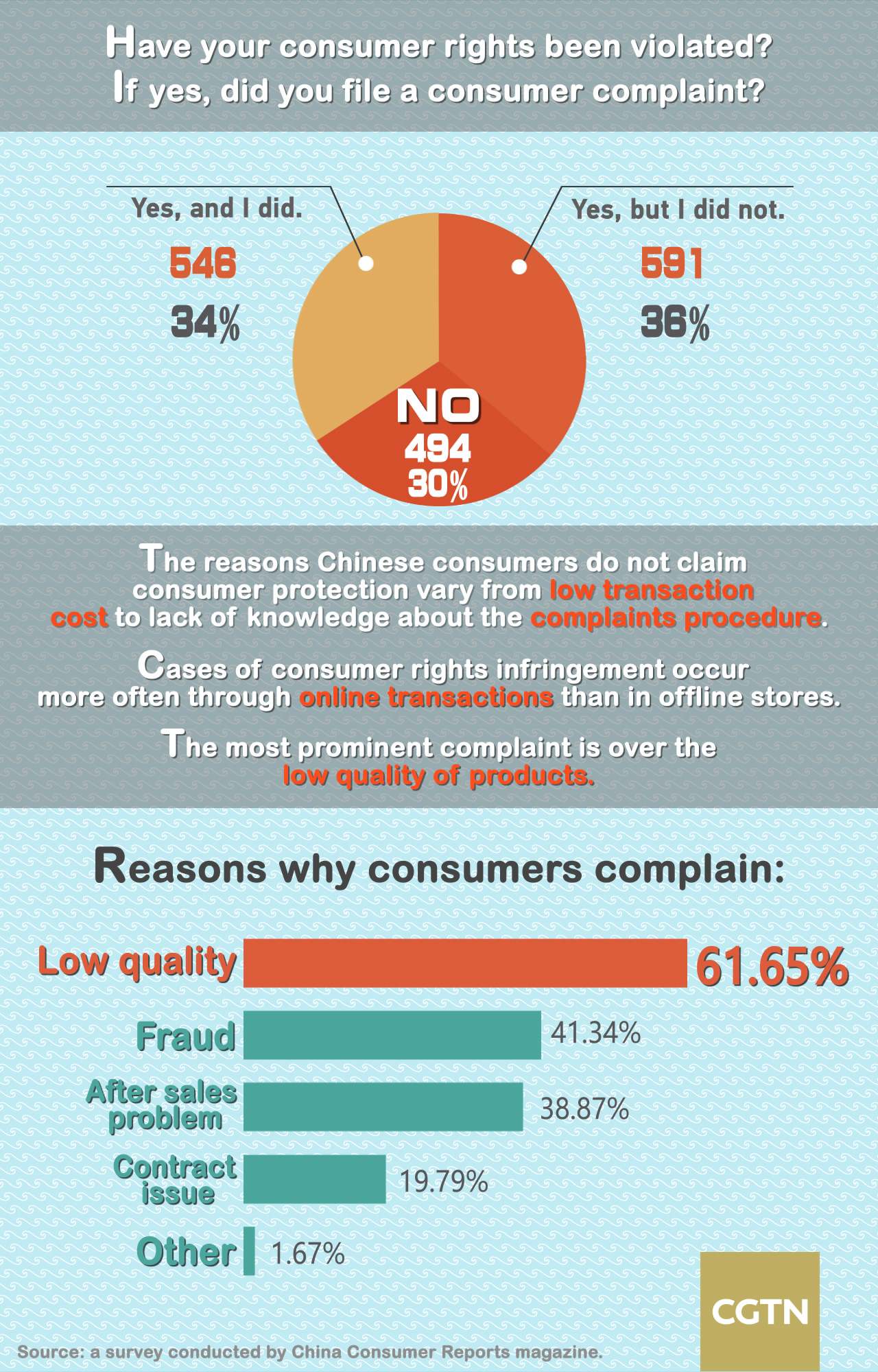
Overall, low quality remains the big issue in terms of protecting consumer rights. China’s Consumers Protection Law encourages the public to supervise and report the violations to relevant authorities.
Copyright © 2017
SHARE
- EXPLORE
- MORE
FOLLOW US