
13:56, 04-Nov-2017
A Further Look at the 19th Congress: Strength in China's multi-ethnic culture
 []
[]
Share







Copied
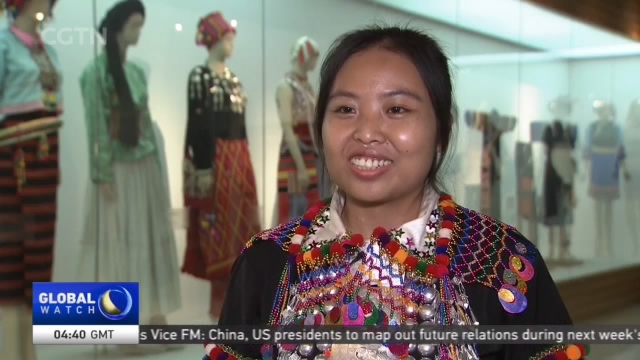
Now let's take a further look at the recently concluded 19th CPC National Congress. Today we will focus on China's multi-ethnic culture. The country's diverse range of ethnic minorities make up over 8% of China's 1.3 billion people. Our reporter Wei Lynn Tang explores how this landscape, especially for minority groups, has been preserved and developed, over the years.
YANG XIAOPING POSTGRADUATE STUDENT, MINZU UNIVERSITY "My name is Yang Xiaoping. I am 25 years old, from the De'ang ethnicity. I have been studying here at Minzu University for 8 years now."
Yang Xiaoping belongs to one of China's 55 ethnic minority groups, also known as the non-Han Chinese. She's also one of the 16,000 students studying at Minzu University, where almost 60% of students belong to an ethnic minority group.
Yang is presently studying linguistics and applied linguistics, majoring in her mother tongue, the De'ang language. She says her perspective on her nation's various cultures have broadened, ever since attending the school.
YANG XIAOPING POSTGRADUATE STUDENT, MINZU UNIVERSITY "I feel very happy studying here, as I never got the chance to experience other ethnic group's cultures before this. For example, you can hear different languages when you walk on the street. Although I may not understand it, I find it euphonic. Also, for the first time in my life, I feel that my ethnic minority identity is advantageous. Many of my schoolmates are amazed that I am able to speak my mother tongue, because many of them can't. This makes me feel a sense of pride."
Yang gets excited when asked about some of her ethnicity's features, immediately pointing out her unique attire.
The highlight, she says, lies in the waist belt which is exclusive to De'ang women, and was used by men to trap flying ladies, as the men sought equality.
However, with a scattered population of just over 20,000, Yang says the De'ang ethnicity is relatively weak, and is already facing the scenario of its language and culture being acculturated with the Han and Dai ethnic groups.
Yang is concerned, but also optimistic, at the same time, citing the Chinese government's increasing efforts in protecting the ethnic minority culture.
YANG XIAOPING POSTGRADUATE STUDENT, MINZU UNIVERSITY "We have been working on a project by the State Council for a few years now, called the Language Protection project, where an all-round study into one's language such as vocabulary, grammar and folktales are recorded and uploaded to a website archive. Additionally, the country has also provided good conditions to inheritors in my hometowns, so they do not have to worry about their lives and can fully participate in activities related to our ethnic group."
The Vice President of Minzu University, Professor Song Min, says interest towards learning about ethnic minorities' cultures such as anthropology and language studies, has increased not just from locals, but also from overseas students.
PROFESSOR SONG MIN VICE PRESIDENT, MINZU UNIVERSITY "We provide support for weaker ethnic students, where they will first undergo 1 to 2 years in preparatory courses before they enter university to do their undergraduate or Masters courses. The government has also provided scholarships to its neighbouring countries, especially those along the One Belt One Road, so that students can come and learn Chinese culture. In the past 5 years, we have also increased our overseas cultural exchange programmes. Our ethnic minorities have since brought forth their arts and dance skills to the rest of the world."
Despite only accounting for more than 8% of China's population, Professor Wu Da says these ethnic minorities have a place in society. Professor Wu Da himself is from the ethnic Yi minority, and teaches cultural anthropology and ethnology.
WU DA, DIRECTOR CENTER FOR THE STUDY OF ETHNIC AND CULTURAL DIVERSITY MINZU UNIVERSITY "Within the cultural differences in the 56 ethnic groups, there are also a lot of similarities. As the country's cultural landscape develops, we should continue to focus on the similarities and not on the differences. This is what we emphasize on in our classes. And in last year's graduation ceremony, I told the students that we are still a multi-ethnic country, and that should rise above each ethnic group's differences."
When asked about contributions, Professor Wu Da says ethnic minorities have played a vital role in helping secure China's borders. This comes as nearly all of China's land borders are located in ethnic minority areas.
WEI LYNN TANG BEIJING China's 56 ethnic groups is one of the country's unique features. As Chinese culture further develops, let us also not forget the contribution from these ethnic minorities. In the CPC's 19th National Congress report, General Secretary Xi Jinping said China must strive to build itself into a great modern socialist country that is prosperous, strong, democratic, culturally advanced, harmonious and beautiful. And he has called upon all ethnic groups in China to unite, in the pursuit of this. Wei Lynn Tang, CGTN, Beijing.