
17:59, 28-Feb-2019
Highlight - How Does the Institutionalization of China’s Policies Affect the Poverty Alleviation Program?

Share






Copied

The leadership of the Communist Party of China (CPC) guarantees the targeted poverty alleviation program. The CPC Central Committee has made it official, requiring that heads of local CPC departments and governments sign letters of responsibility and make promises. It also requires that heads of CPC departments at provincial, city, county, township and village levels have clear and demarcated responsibilities and coordinate their work. Party cadres at all levels must immerse themselves in the task of eliminating poverty – and do so with a good spirit. They should mobilize the poor’s wish to work for a better life. What’s more, considering that China has been moving toward institutionalization aspects of society, transitioning away from just single human being intervention, how does such institutionalization of China’s policies affect the poverty alleviation program, both currently and plans for the future? Robert Lawrence Kuhn asked Wu Guobao, Director of Center for Poverty Studies, CASS, to share his views.
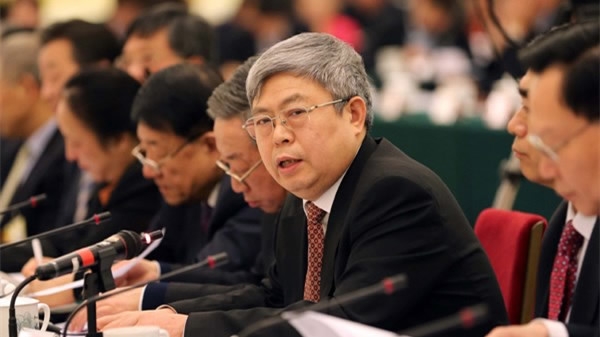
Liu Yongfu, Director of Poverty Relief Office of the State Council, is answering questions raised by members of the Standing Committee of the NPC on December 27, 2013.
Liu Yongfu, Director of Poverty Relief Office of the State Council, is answering questions raised by members of the Standing Committee of the NPC on December 27, 2013.
“I think China’s political and institutional advantages in poverty alleviation are mainly reflected in the following aspects. First, it helps build up a top-down organizing system and task force in poverty alleviation from the central level to the village level in a short period of time. That is to say, it enables effective implementation of our poverty alleviation policies and plans. For instance, in China’s roughly 128,000 poor villages, more than a million cadres are assigned there to help. With this rapid establishment of an effective task force that has the organizing ability to ensure implementation of our poverty alleviation plans, poor people can really benefit.
Secondly, in terms of mobilizing resources and investment for poverty alleviation, thanks to China’s current governance system, the central government can make decisions rapidly to increase investment in poverty alleviation. Such an increase in the fiscal budget is quite difficult to achieve in many countries. However, for China, it is easily achieved through NPC discussions. China’s governance system can motivate and coordinate various government departments to offer favorable arrangements for poor areas. To give you an example, the transport departments arrange construction of highways and railways every year, and the central government can demand that they prioritize construction for roads leading to poor areas. In this way, poverty-stricken areas can first enjoy better resources.
Thirdly, in my view, China’s special systems can enable rapid application of best practices in certain areas across the nation. As far as I can recall, we have had many such examples since 1986. When we initiated some small-scale pilot programs in poverty alleviation, and witnessed effective results, our government was able to make use of its influence and quickly promote the practice nationwide, so as to make all areas in China benefit from the innovative tests and measures in poverty alleviation.”