
17:35, 19-Oct-2017
19th CPC National Congress: Technology brings about new era in China's manufacturing sector
 []
[]
Share







Copied
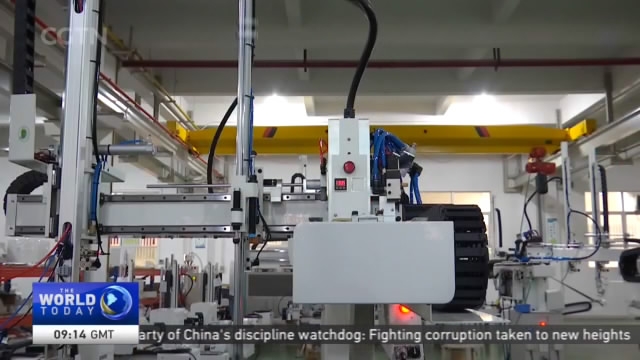
As the world's biggest manufacturing powerhouse, China has been attempting to upgrade its manufacturing sector for years now. Has the strategy worked out well? Our reporter Ge Yunfei in southern China's Guangdong Province finds out.
Polishing glass lenses, sewing stuffed toys, and making cellphone protective cases, China's huge population of skilled workers and cheap cost of labor propelled the country to become the world's factory over the past two decades. But things took a turn when suddenly many Chinese manufacturers found they were lagging behind their global competitors and market demand.
ZENG ZHIYONG CARL ZEISS VISION TECHNOLOGIES (GUANGZHOU) LTD. "In 2012, the Zeiss Group informed us that labor in China was twice as expensive as in Mexico and four times of that in India."
HUANG HE, GENERAL MANAGER JANUS PRECISION MANUFACTURING, DONGGUAN "In early 2015, we signed around 20 big deals. But by the end of that year, lots of clients had canceled orders and we only had 3 orders left. We knew we had a big problem."
Robots and automated machines were introduced to factories on a massive scale.
In this Chinese factory of the German brand Carl Zeiss, robots reduced the cost per lens to the lowest of all the Zeiss factories in the world.
ZENG ZHIYONG CARL ZEISS VISION TECHNOLOGIES (GUANGZHOU) LTD. In 2012, the factory had 440 workers producing 4 million lenses every year. In 2015, the number of workers decreased by 70 people but output increased to 5 million.
And some firms even took it a step further, building an unmanned factory, boasting 160 automated machines, no workers, relying solely on robots to carve metal plates without human instruction.
HUANG HE, GENERAL MANAGER JANUS PRECISION MANUFACTURING, DONGGUAN "And the whole manufacturing process is connected on the cloud. Now we can monitor all the real-time statistics and the situation inside the factory."
GE YUNFEI GUANGZHOU "China is going through a new type of industrialization. And experts say the final result is vital to whether China can keep its economic prosperity in the following decades."
In 2015, the Chinese government issued the "Made in China 2025" strategy, encouraging intelligent manufacturing. And later that year, President Xi Jinping brought forward the idea of "supply-side reform", vowing to upgrade China's manufacturing sector.
PROF. LIANG QI SUN YAT-SEN UNIVERSITY "We've been talking about economic transformation for many years, but I think the real change started two years ago. In the past decade, China's real economy was at a difficult time as many entrepreneurs chose to leave the manufacturing sector for the financial or property sectors. But now the real economy is gradually gaining hope and confidence back.”
President Xi said on Wednesday that the principle contradiction facing Chinese society is imbalanced and inadequate development, and at the same time, the people's ever-growing need for a better life.
Professor Liang Qi said the new type of industrialization is a crucial part of the solution.
PROF. LIANG QI SUN YAT-SEN UNIVERSITY "We're not only catching up with developed countries but also pursuing new heights in the global manufacturing sector. And the new fortunes created in this process can be used to support the development of underdeveloped regions. "
Experts say while China's fresh industrialization may be an ongoing process, it's definitely worth the anticipation.GE YUNFEI CGTN GUANGZHOU