
11:34, 03-Oct-2017
2017 Nobel Prize For Medicine: Three Americans are laureates in Physiology and Medicine
 []
[]
Share







Copied
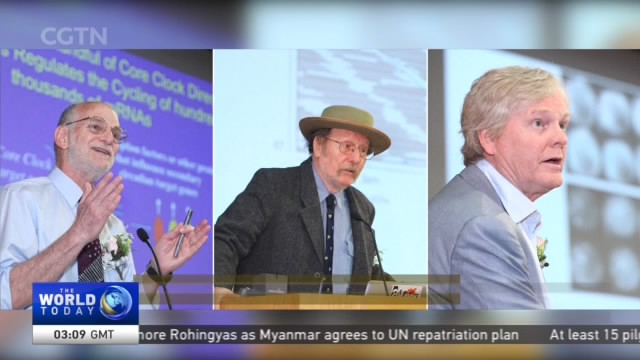
Three American scientists have won the Nobel Prize in Medicine for their research on the human body's biological clock. The trio's work has greatly changed what we know about sleep. C-G-T-N's Roee Ruttenberg has more.
If you've ever wondered why you're tired after a late night at work, or a long trans-Pacific flight, the answer might have just gotten a bit clearer.Three American scientists working on the circadian rhythm - more commonly known as the body's biological clock - have been awarded the Nobel Prize in medicine, for isolating the gene that controls our internal clocks. And, for confirming that there are indeed clocks - plural - in each of us, in each cell.All three said they were surprised on Monday when the committee in Stockholm informed them of the decision.
MICHAEL YOUNG, CO-WINNER NOBEL PRIZE IN PHYSIOLOGY OR MEDICINE "I really had trouble even getting my shoes on this morning. I go and I'd pick up the shoes, and then I'd realize I need the socks and then I realize I need to put my pants on first."
MICHAEL ROSBASH, CO-WINNER NOBEL PRIZE IN PHYSIOLOGY OR MEDICINE "The phone call at 5:10am this morning destroyed my circadian rhythm by waking me up."
The trio proved that a key protein -- known as PER, or period -- accumulates at night, and then degrades during the day. A 24-hour cycle. Disrupting that pattern, they say, has consequences not just for sleep, but for things like depression and heart disease.
MICHAEL ROSBASH, CO-WINNER NOBEL PRIZE IN PHYSIOLOGY OR MEDICINE "The clock - the mechanism that we discovered - governs at least half of all expression in the human body."
The research was conducted over decades on fruit flies. But the science, they say, is transferable.
MICHAEL YOUNG, CO-WINNER NOBEL PRIZE IN PHYSIOLOGY OR MEDICINE "You look for a similar kind of machinery in more complex organisms. First mice, yes it's there. And humans, yes it's there. And then you start finding that the mutations are associated with clear patterns of aberrant sleep in humans."
Better understanding our clocks, they say, may help determine the best time to rest, to eat, to work, and even to take medicine.
ROEE RUTTENBERG WASHINGTON, DC Thanks to these men - and their nearly 30 plus years of research - chronobiology, or the study of biological clocks, is now a growing field. And thanks to their Nobel prizes, it'll likely keep on ticking. Roee Ruttenberg, CGTN, in Washington.