
14:41, 24-Oct-2017
Towards Better Education: China's Henan Province rebalancing educational resources
 []
[]
Share







Copied
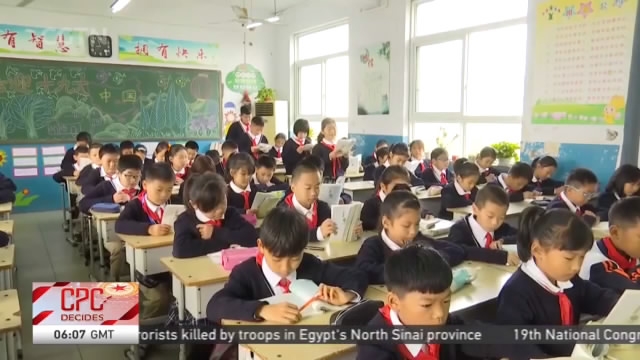
General Secretary Xi Jinping in his work report to the 19th CPC National Congress last week said strengthening standards in education is fundamental to China's pursuit of national rejuvenation. He called for particular attention to be given to rural areas, in an effort to address the country's unbalanced development. CGTN reporter Meng Qingsheng travelled to Henan in central China – China's third most populous province where many live in rural areas – to see how authorities there are trying to overcome this issue.
At Daqiaolu Primary School in downtown Zhengzhou City, two thousand pupils gather to start a new week. They are all looking sharp, dressed neat and tidy. Yet only about a quarter of them are actually from the area – the vast majority of them are only there because the school offers a good education.
WANG YIFEI PRIMARY SCHOOL PUPIL I got transferred to this school from my village two years ago. I was really impressed by the spacious playground here. This school also offers a number of interesting extra-curricular activities. And the classes are interesting.
WANG YIFEI used to attend an under-resourced village school in Yuzhou City, about 70 kilometres from Zhengzhou. Now, she's enjoying her new surroundings, and developing her own academic interests thanks to the help of qualified teachers and the inspiring facilities. We drove for an hour southward to the county-level city of Xinzheng, and then found our way inside a typical rural primary school one much like Yifei's old one. Xugang Primary School was founded in the late 1940s, yet it was only this year that the pupils started learning English – a core subject in China nowadays.
XU WEICAI, HEADMASTER XUGANG PRIMARY SCHOOL, HENAN PROVINCE No new graduates have come here to teach in the past ten years. We have only six teachers on the campus, teaching pupils from six different grades. The building needs to be repaired, as the roof leaks during the rainy season. However, I've been working here for eight years, and have developed a deep fondness for everything. I wish the school never disappears.
MENG QINGSHENG ZHENGZHOU, HENAN PROVINCE This is one of the 20 thousand primary schools in central China's Henan Province. It had 200 pupils in its prime back in 2012, but due to a shortage of teachers, inadequate resources and a canteen unable to meet health and safety standards, more than half the pupils have been taken out by their parents to seek a better school elsewhere.
As the school has no canteen, the pupils have to return home for lunch. But this is only a petty inconvenience for most of those who choose to stay. They have much greater desires for other improvements.
SHI JINGYU PRIMARY SCHOOL PUPIL I hope I can study at a bigger school, with a library, and where my fellow students could learn and play together. I also hope to have more teachers working here. It's better if each of them will focus on just one subject to teach.
As of the end of last year, the province had injected more than 16 billion yuan into improving the basic facilities and teaching resources of compulsory education schools.
MAO JIE, DEPUTY DIRECTOR GENERAL EDUCATION DEPARTMENT, HENAN PROVINCE This year, the province recruited three thousand general teachers. They are helping rural children get education close to their homes. Though not all of them can move to the big city for a good education, we hope we can provide them with a fair start to their lives”
China has pledged to prioritize education in its next step of work. While more and more pupils are benefiting from the recent improvements, for the time being, more efforts need to be made to strike a fairer balance into how educational resources are distributed. Meng Qingsheng, CGTN, Henan Province.