
16:43, 03-Dec-2017
Qingdao Automatic Port: Asia's first fully-automated port
 []
[]
Share







Copied
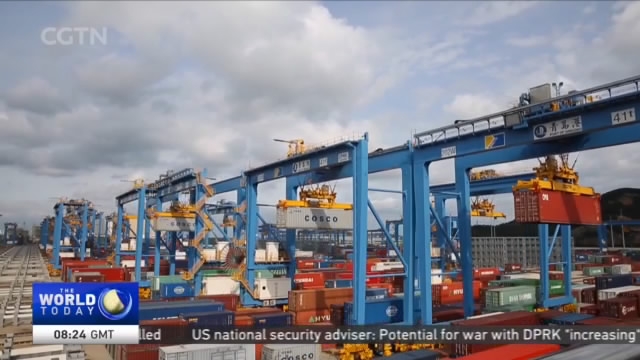
New breakthroughs have been made at the container terminal in China's port city of Qingdao. It's Asia's first fully-automated port, and has set a record in terms of operation efficiency, processing more than 30 containers per hour by a single crane. CGTN's Cui Hui'ao takes a look at what this means for the future of the shipping business, and regional economic integration.
Nearly 1800 containers, handled in just 9 hours. The speed it takes to unload a cargo ship here is now the fastest in the world.
MARK WELLES, VICE PRESIDENT NAVIS COLLABORATION CENTER "The end of the day, the ocean carriers, they are focused on minimizing their time in port. Think about it like a formula one race where they change the tires and you head on out again. It's all about speed. They are starting to now achieve levels that you can get at a manual terminals but they are on their way to consistently exceed what's happening at a manual level."
New technologies are behind this record breaking speed and efficiency. Unlike manual terminals, this one is fully-automated, meaning you won't see any workers on site. It can operate at night, even in complete darkness. All of which are thanks to what they call the "super brain".
ZHANG LIANGANG, GENERAL MANAGER QINGDAO NEW QIANWAN AUTOMATIC CONTAINER TERMINAL "It's essentially a large computing system that is able to calculate, process and make optimal decisions based on the massive data collected through the program."
For example, more than 20,000 transponders are buried under ground, generating data on the locations of each automatic guided vehicle, which then helps the program control the routes and tasks of the AGVs from afar.
CUI HUI'AO QINGDAO, SHANDONG PROVINCE There are 30 of these AGVs operating at Qingdao port. As you can see, they are completely unmanned, automatically taking containers to the designated area. This is something you might expect to see in a sci-fi film. But technologies like artificial intelligence have now made it possible in real life.
As vessels become larger and larger, demands for greater operation efficiency has never been higher.
ZHANG LIANGANG, GENERAL MANAGER QINGDAO NEW QIANWAN AUTOMATIC CONTAINER TERMINAL "We are working to make our system smarter, hopefully within the next year we could take our productivity to the next level, reaching an operation efficiency of handling 40 containers per hour."
However, one expert points out that the smart port initiative of Qingdao needs to go hand-in-hand with traditional supply chains and port industries.
LIU SHUGUANG, DEPUTY DEAN SCHOOL OF ECONOMICS, OCEAN UNIVERSITY OF CHINA "What's lacking at the moment is the headquarters economy. There needs to be a strategic transformation of the city of Qingdao in attracting FDI, financial industries clustering, talent agglomeration, as well as global level value chain governance."
In that way, Liu says the integration of the regional economy will benefit the Qingdao port in the long run, making it one of the busiest in the world. Cui Hui'ao, CGTN, Shandong Province.