
10:45, 31-Aug-2017
Confucius Institute: Teaching Chinese to enhance ties between China and Brazil
 []
[]
Share







Copied
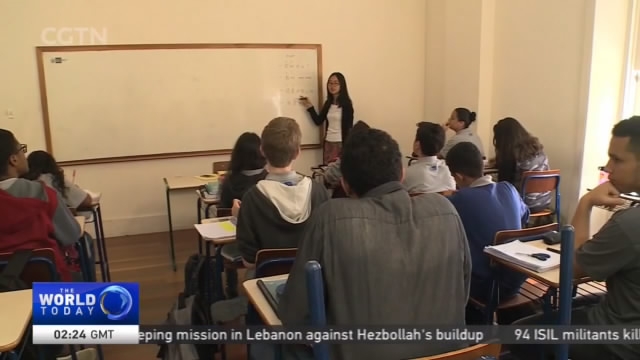
China is Brazil's largest trading partner. There's also a growing number of Chinese firms operating in Latin America's biggest country. But there remains a language and culture barrier between the two nations, and those are what one Chinese woman wants to break down. CGTN's Lucrecia Franco brings us this report from Rio.
This is the first and only bilingual Portuguese- Chinese school in Brazil. It is the dream of one Chinese educator who moved to Rio de Janeiro in 2012. Qiao Jianzhen, the director of Rio's Confucius Institute, has a long-term plan to turn as many Brazilians as possible into experienced Chinese speakers:
QIAO JIANZHEN, DIRECTOR CONFUCIUS INSTITUTE, RIO DE JANEIRO "I really wish to begin with young people, the young students, so they are 14, 15 -years- old so when they reach 45-50 years they will step into the middle age and they will shoulder the responsibility to diminish the distance between Brazil and China, so that is for me like thirty- day plan."
Qiao says Brazil still has a long way to go despite the growing number of Chinese companies interested in investing here: QIAO JIANZHEN, DIRECTOR CONFUCIUS INSTITUTE, RIO DE JANEIRO "It is really difficult to find Brazilians who speak Chinese so that is one of the greatest difficulties for these Chinese enterprises to enter Brazil."
The school opened three years ago with 72 students, mostly from poor communities. Enrolment has now reached 250 and hundreds more are waiting for spots.
LUCRECIA FRANCO, RIO DE JANEIRO "Besides the daily mandarin classes, the school offers other activities to help students understand Chinese culture."
Here , for example, they learn the ancient art of paper cutting to provide an emotional link with the country where some of them want to live and study. Eighteen year old Guilherme Santos is one of them. He is applying for admission to a University in China.
GUILHERME SANTOS, STUDENT "I have this opportunity to study Physical Education so for me this is very important, it is huge, and will change my life to go to China and study at a university there."
Qiao, says that because China is Brazil's main trading partner, learning the language is key to going beyond commerce and boosting cultural ties between the two regional powers. Lucrecia Franco, CGTN, Rio de Janeiro.