
18:51, 27-Dec-2017
Development in Tibet: Monastery and people in need benefit from incense revival
 []
[]
Share







Copied
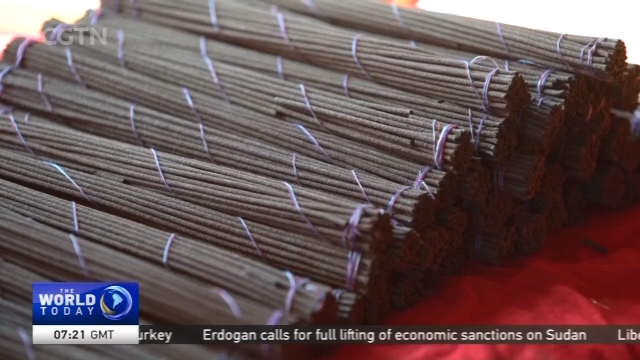
We now continue our six-episode series on the changes taking place in the Tibet Autonomous Region. In a small village in Xigaze, the second largest city in southwest China's Tibet Autonomous Region, a centuries-old monastery is drawing attention. The revival of Tibetan incense-making and its products are bringing benefits which were far more than expected. CGTN's Yang Jinghao has the story.
The smoke and aroma of Tibetan incense is all around.
In a small village in Xigaze, Kelsang Tsring at the Dalhathubten Monastery starts his morning the same way every day: Making this Tibetan specialty. In July 2017, a small factory was set up within the centuries-old monastery to revive this lost craft.
KELSANG TSRING
MONK AND MONASTERY MANAGER
"Tibetan incense making can be traced back to over 400 years ago. However, there was a break in this craft for some reason, and we just retrieved the recipe by looking up the sutras with related records."
Incense burning is common in this region. Tibetan incense is considered a representation of their culture, and can be found in almost all monasteries and homes.
Kelsang says what make their products special are the ingredients – wild herbs from the nearby mountains and farmlands. He says the incense, made with more than 180 herbs, releases a pleasant aroma and is also good for health and wellbeing.
YANG JINGHAO
XIGAZE, TIBET AUTONOMOUS REGION "The revival of traditional incense-making is not only good news for the vast number of Buddhists of the region. It also benefits local villagers by providing them with working opportunities, and other assistance."
The factory currently employs 12 local villagers from impoverished families. Eight of them, who are also disabled, are responsible for the incense production and packing. The rest gather herbs and do deliveries. They all earn about 130 yuan every day.
YUDRON
INCENSE FACTORY EMPLOYEE "My family was listed as impoverished. Now I can earn more than 3,000 yuan here and I have become the family breadwinner. I feel lucky to work here."
The market has been reacting favorably to the monastery's attempt in reviving this craft. Nine different kinds of incenses are sold to different cities in Tibet and have even made it to as far northeastern Heilongjiang Province.
In the first four months of production, the factory made a profit of more than 170-thousand yuan, or 26 thousand US dollars, far more than what was expected.
TSEDAN TASHI,
DIRECTOR DALHATHUBTEN MONASTERY MANAGEMENT COMMITTEE "Part of the money will go to the monastery's own development. Some will also be used to help college students from poor families."
With only 33 monks, Dalhathubten Monastery is not a big one in the region, despite its 500-year history. But Kelsang says what they have is great ambition. And now, off to a good start with this initiative, the monastery hopes it can help more people in need, and better contribute to the society.Yang Jinghao, CGTN, Tibet Autonomous Region.