SOCIAL


The last soldier of the China Expeditionary Force in Myanmar – 70 years in a foreign land
2017-04-11 15:20 GMT+8







Editor
Gong Rong
For most of his life, Li Guangdian has dreamed of returning to his motherland. Indeed it’s a dream buried deep in his heart, as this 95-year-old Chinese Expeditionary Force veteran has lived in a foreign land for more than 70 years.
In 1942, China sent 100,000 expeditionary soldiers to Myanmar and India to fight the Japanese forces with the Allies. During the war, nearly half of the Chinese soldiers were killed or injured.
Li Guangdian left home and joined the army after the outbreak of war, without even leaving a message to his parents.
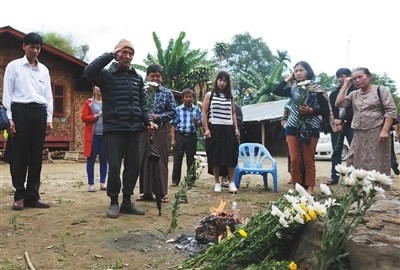
Li paid tribute to his counterparts who died in battle./Photo by Beijing News
The Battle of Northern Burma and Western Yunnan broke out in 1943. One of the most important battles was at Mount Song, where the Chinese Expeditionary Force aimed to retake the Burma Road from the Japanese Army, an important transportation line for international supplies to and from China. The road had been cut off by the Japanese Army.
This was the fiercest fight in Li's memory, and he still remembers how his comrades were shot to death one after another, and how their bodies were simply left behind on the battlefield.
At the back of his head, there is a slender scar from a bullet wound that he got in battle. He rubs it gently every time he talks about his wartime experiences.
The surrender of the Japanese Army in 1945 did not bring Li back to his hometown. The outbreak of the War of Liberation in China left him – as a soldier of the Chinese Guomindang Nationalist Party – with no choice but to stay in Myanmar.
A life-time guest
He met Yang Zengfen, who also fled to Myanmar from southwest China’s Yunnan because of the war. They got married and have four children. Although they were born in Myanmar, Li insisted his four children were raised in the “Chinese way”. They went to Chinese schools, learned to write and read in Chinese characters and were asked to study Chinese poems. His home in Myanmar was decorated with lanterns and couplets—all part and parcel of a traditional Chinese home.
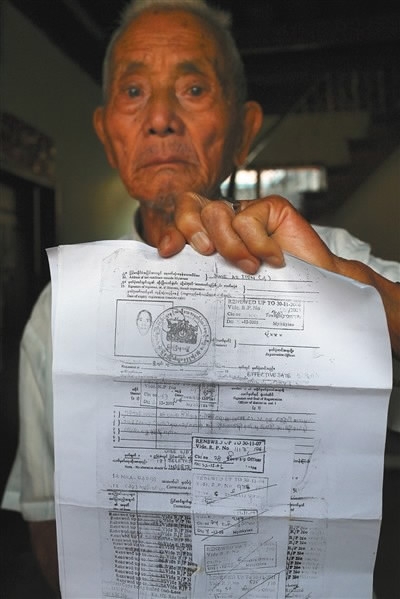
Li Guangdian shows his Foreigner’s Registration Certificate./Photo by Beijing News
During his 70 years in Myanmar, Li has never thought of changing his nationality. He insisted on holding his Foreigner’s Registration Certificate (FRC), which needs the holder to pay extra tax to the local government, restricts travel in and out of Myanmar and limits commercial activities such as running a business.
Li Yuming, the son of Li Guangdian, recalled the toughest time his family had during the 1990s, when holders of FRCs has to stay in a designated area. The family had to stay around the northern bank area of The Irrawaddy River delta, where on-going armed conflicts constantly forced the family to move and seek safety.
Whenever he was asked about his identity, he said, “I have been a guest here and always will be.”
Never going back again
Li had to remain quiet about his past as a Chinese Expeditionary Force soldier until Myanmar society was open enough to talk about the war. In 1997, Li returned to Xuanwei, Yunnan and hoped that this could be the beginning of his journey home. He wanted to move his whole family back to where he grew up.
While local authorities have granted Li permission to stay in Yunnan, issuing him a much longed for identification card, Li’s four children have however been unable to get permanent residence because they were born in Myanmar.
Li again had no choice but to return to Myanmar to stay with his family.

Li Guangdian's home in Myitkyina, Myanmar/ Photo by Beijing News
In 2015, the remains of 347 soldiers were repatriated after the Chinese government opened discussions with parties in Myanmar on handling the remains of soldiers, looking to succeed where a nongovernmental foundation had failed.
Li now stays in Myitkyina, northern Myanmar, with his children, knowing that he is probably never going back home again. On an “identification card” he carries with him, Li has written “Veteran Li Guangdian, a native from Huidong village, Xuanwei County, Yunnan.”
Li has already picked a tomb in Myanmar, and prepared a 300-word inscription, half of which describes how he joined the army and his unforgettable experiences in battle.
For him, the most unforgettable memory of his childhood was the pond behind his school where he and his friends usually went fishing, and a small cave where they would often hang out together.
Copyright © 2017
SHARE
- EXPLORE
- MORE
FOLLOW US