
Business
15:43, 11-Apr-2017
Opinion: The economics of pandas explained
 []
[]
Share







Copied

Guest commentary by Patrick Musgrave
Two giant pandas will arrive in the Netherlands on April 12 and will take up residence in a €7 million ($7.4 million) enclosure specially built for the iconic bears, but, like all pandas around the world, they will still be owned by China. Ouwehand zoo's “acquisition” of the two pandas, following 16 years of consultations and preparations, is being hailed as an accomplishment on a national scale, and not simply because only 18 zoos worldwide house the cuddly creatures. Why is that? For the answer, we have to enter the world of Panda diplomacy and "pandanomics".
A Meaningful Exchange
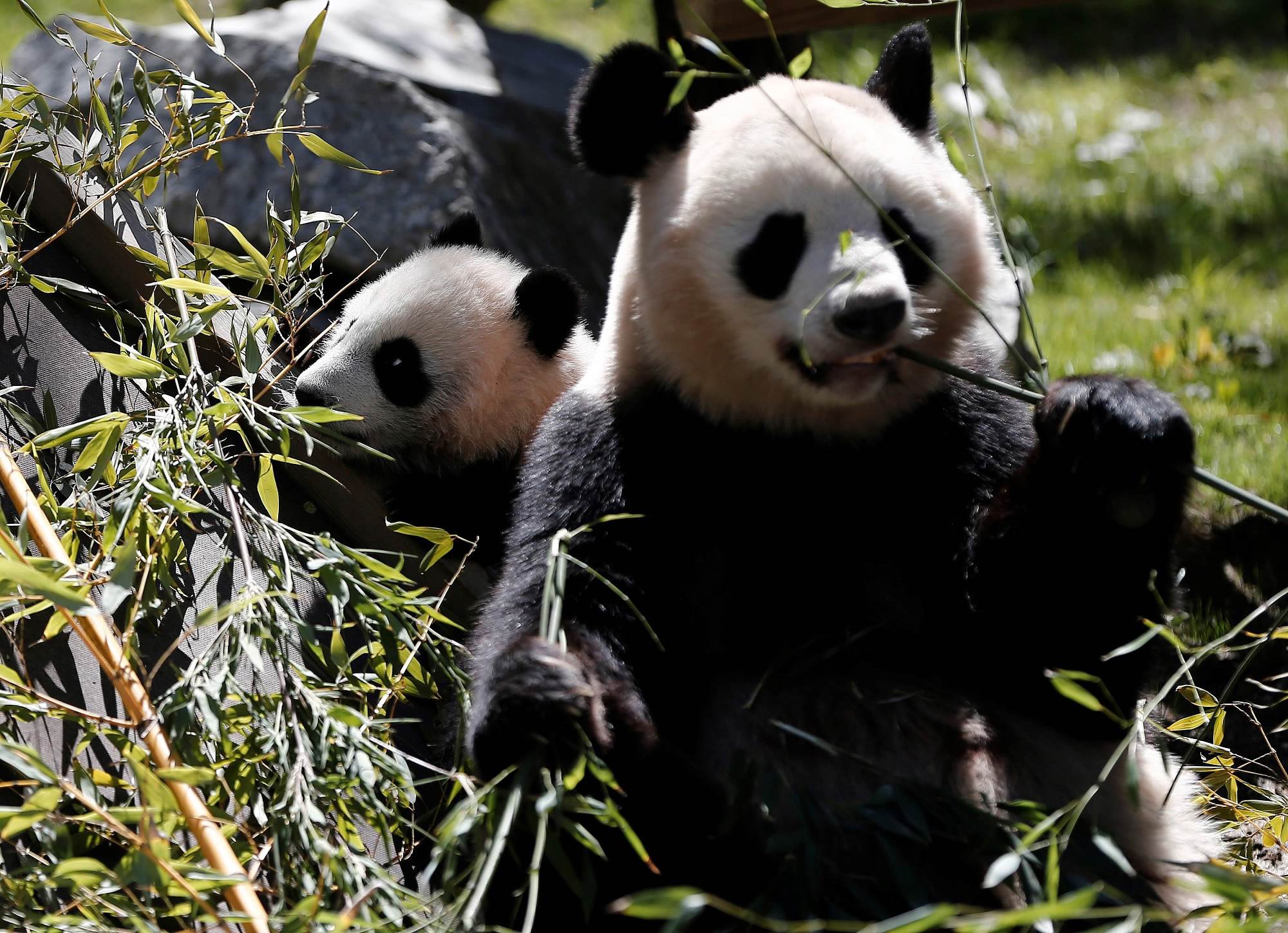
Female panda "Chulina" (L), who was born last August, goes enters the open space with its mother Hua Zui Ba (R) for the first time at a zoo in Madrid, Spain on April 5, 2017. / CFP Photo
Female panda "Chulina" (L), who was born last August, goes enters the open space with its mother Hua Zui Ba (R) for the first time at a zoo in Madrid, Spain on April 5, 2017. / CFP Photo
Researchers at Oxford recently investigated the intangible economic value pandas bring to international political relationships with China in a paper published in the journal, Environmental Practice. It's a dynamic closely related to the Chinese concept of “guanxi”, a term used to describe personal relationships and an emphasis on trust and loyalty highly valued in Chinese society. "When China loans a panda," explains lead author Kathleen Buckingham, "they're in some ways accepting the host nation into their 'inner circle'." Pandas are often used to "seal the deal and signify a bid for a long and prosperous relationship," says Buckingham. "If a panda is given to the country, it does not just signify the closing of a deal - they have entrusted an endangered, precious animal to the country; it signifies in some ways a new start to the relationship."
The strength of these international bonds run deeper than meets the eye. Over the past decade, the team found there has been a clear relationship between overseas panda loans from China and trade deals for valuable resources and technology. Shortly after Scotland's Edinburgh Zoo received its pandas in 2011, claim the researchers, trade deals were signed for renewable energy technology, fish, and vehicles, injecting billions of dollars into the local economy. "We are committed to working hard to deepen existing ties and establish new areas of cooperation - an approach that is clearly paying dividends," a Scottish government spokesperson told BBC News. As a sign of the fortuitous trend, Scottish exports to China have almost doubled over the past half-decade.
The international politics are intriguing, but zoos play a different game
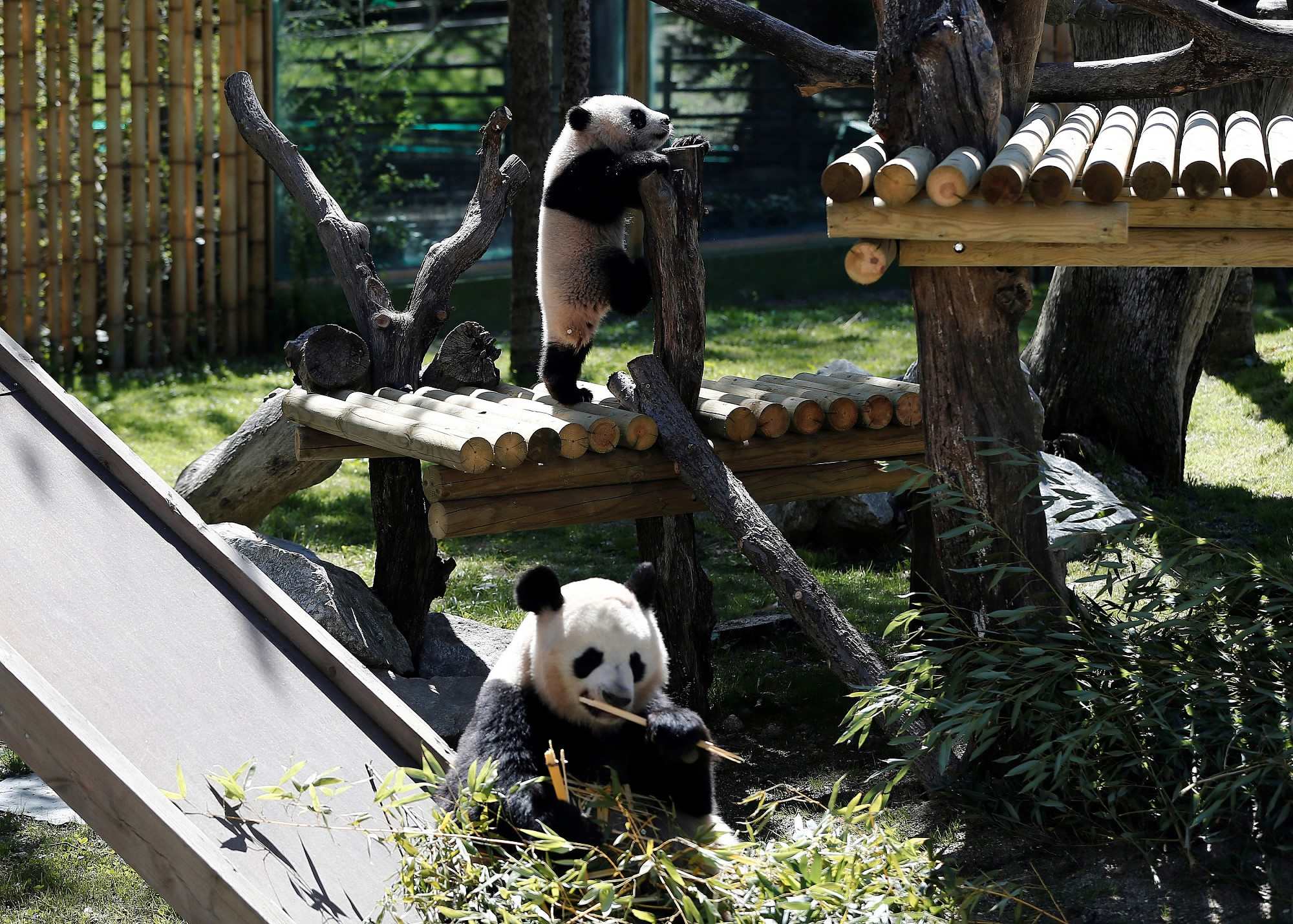
Female panda "Chulina", which was born last August, goes open space with its mother Hua Zui Ba for the first time at the zoo in Madrid, Spain on April 5, 2017.
Female panda "Chulina", which was born last August, goes open space with its mother Hua Zui Ba for the first time at the zoo in Madrid, Spain on April 5, 2017.
While a "Panda loan" signifies China's faith in future cooperation with a country, the zoos themselves aren't making multi-billion dollar trade and investment deals. Panda loans carry an annual fee of about $1 million, according to analysis from Aljazeera. Moreover, the price tag for building habitable enclosures for them is an up-front cost of seven or eight figures. There are also various unpredictable additions such as a conservation fee, running some $400,000, to be paid to China if pandas give birth (China then owns the cubs as well, which are transferred back after a couple years); and regardless of climate, zoos have to come up with 11-16 kg of bamboo per panda per day for the picky eaters.
This sort of undertaking is a lot for an individual zoo to shoulder on its own. So while a panda is certainly a badge of pride for host countries, how do they affect the zoo's bottom line? Luckily, visitors' fascination with the cuddly creatures tends to cover their costs and then some. The National Zoo in Washington, DC, for example, estimates a $1.2 million payoff over their decade hosting the pandas. Even more if there are cubs. "A panda cub would be a conservation superstar, attracting millions of visitors at up to £16 a head," The Guardian observes of Edinburgh zoo. They are the "animal equivalents of Premier League footballers; they cost a fortune to buy and maintain, but are guaranteed to draw crowds". Merchandise – not just entrance tickets which are sometimes augmented by a "Panda tax" – are a boon the zoos. “Kids can take home little plushes, panda backpacks," says Megan Winokur, publicist for Zoo Atlanta. They even have "panda toasters that put the face of a panda on every piece of toast that you put in there.”
(Patrick Musgrave is an independent journalist based in Beijing. He previously worked as Senior Technical Editor and Content Manager with CSOFT International. The article reflects the author's opinion, not necessarily the view of CGTN.)
7835km