
10:53, 26-Sep-2017
The 'Haenyo' of South Korea: Ocean-diving women try to preserve dying tradition
 []
[]
Share







Copied
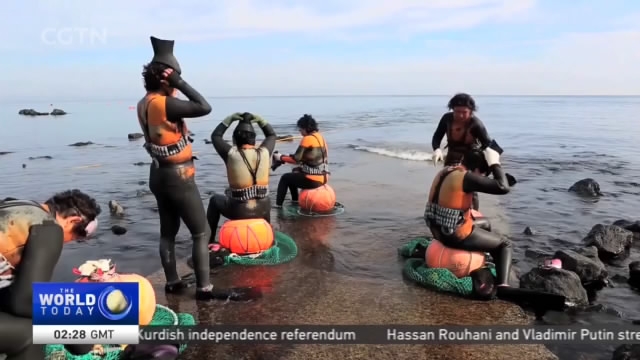
For more than a millennia, South Korea's "haenyo" diving women have spent their days exploring the ocean floor to provide food and a livelihood for their families. But 90 percent are now over the age of 60, and their tradition is quite literally dying out. Can a school trying to revive the art, and a push for a UNESCO listing, stop this ancient tradition from sinking? CGTN's Jack Barton went to Jeju Island to find out.
Diving women known in Korean as haenyo. Using traditional tools and diving methods the haenyo harvest shellfish and seaweed on South Korea's islands. Their tradition stretches back more than a thousand years and as late as the 1960's they numbered in the tens of thousands. Now there are only a few thousand left, mostly on Jeju Island. And 80 year old Kim Sim-nyeong says haenyo numbers continue to dive.
KIM SIM-NYEONG HAENYO, JEJU ISLAND "In the past we usually had in my town 70 haenyo, but it kept declining -- 60, 50, 40 -- now we have 37 or 38 haenyo left. The number of older people is getting smaller and younger people are no longer doing it.”
It's a tough job with little appeal to a younger generation that grew up amid an economic boom.
LEE TYEO-HEE HAENYO, JEJU ISLAND "My daughters could do this job, but they don't. I don't want to teach because it's a hard job.”
The dwindling numbers have led to the establishment of a haenyo museum on Jeju, where tourists can learn more about the contribution of these women and not just their diving skills.
JACK BARTON JEJU ISLAND "What this museum really pays tribute to is the fact that haenyo have been pioneers in gender equality. They were the divers and the farmers and often the sole breadwinners for their families."
That's all the more remarkable given that among developed countries South Korea ranks near the bottom when it comes to female employment rates and has one of the biggest wage gaps between men and women.
KIM SIM-NYEONG HAENYO, JEJU ISLAND "The women have more income because a man can only do one job. But a woman can farm AND go diving. That's why we usually have more income than men.”
The traditional was usually passed from mother to daughter, and while that is now rare, some young Koreans are showing an interest. Kim Do-yeon enrolled at this haenyo school on Jeju Island.
KIM DO-YEON HAENYO STUDENT, JEJU HANSUPUL HAENYO SCHOOL "They gamble with life and death. I fantasize about the haenyo lifestyle."
Fantasy quickly turns to reality. The school has turned out 430 graduates since it opened nine years ago, but few now work beneath the waves.
LEE HAK-CHEUL PRINCIPAL, JEJU HANSUPUL HAENYO SCHOOL "Only 30 students actually became haenyo."
These elderly divers say they will continue to work until its physically impossible. But once this generation is gone there may be little left of one of Korea's most iconic traditions. Jack Barton, Jeju Island.