
17:03, 05-Dec-2017
Tech It Out: Meet the soft robotic manta ray without a motor!
 []
[]
Share







Copied
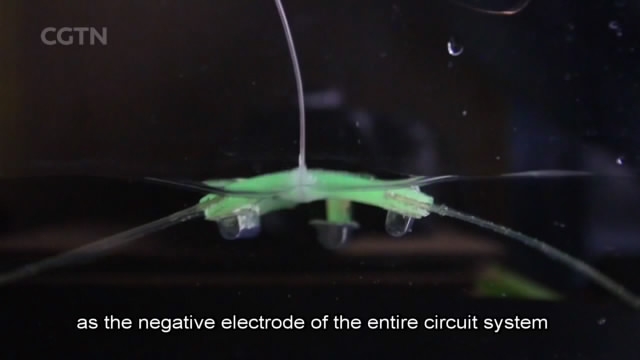
Build a robot? Easy; Build a robot with soft parts. Ehh, still doable; Build a soft, bendable robot that can swim as well as a real fish? A much trickier task. Meet this new underwater species. The robotic manta ray created by Zhejiang University can swim up to 6 centimeters per second. That's twice as fast as the next best bot of its kind, and even faster than Michael Phelps, based on its less than 20 centimeter body length.
LI TIEFENG ASSOCIATE PROFESSOR, ZHEJIANG UNIV. We actually want to use these robotic fish in the ocean or in lakes to gather hydrological information. They can closely observe marine life and survey fishery resources
YANG ZHAO The robot weighs in at just 90 grams, making it as light as a pair of sunglasses. Its body is made of silicone, very soft, very stretchy. There's a small battery pack to power the robot, and wait, where's the motor?
That's probably the trickiest part of engineering. With no rigid motor, the soft belly of this robot can flex when powered by electricity. It is probably the softest engine in the world. In fact, it works just like a piece of muscle
LI TIEFENG ASSOCIATE PROFESSOR, ZHEJIANG UNIV. The material we use in the center of the fish is called Dielectric Elastomer, which is a kind of artificial muscle that is deformed by the electric drive. This material consists of two layers of film sandwiching the middle layer of conductive hydrogel. When a voltage is applied, the two dielectric films will be compressed to the center, and the middle layer will be squeezed. If I stop the voltage, the films will return to their original state.
Using such a motor underwater was thought to be impossible, because the thick electrical insulation required would have hampered flexing ability. That's why Professor Li and his team came up with a solution to counter this problem.
LI TIEFENG ASSOCIATE PROFESSOR, ZHEJIANG UNIV. The solution is water. Instead of isolating the surface of the fish from the water, we instead use the water's own conductive properties as the negative electrode of the entire circuit system. The hydrogel part is positively charged. The gel is then attracted to negatively charged electrons in the water outside the robot, squeezing the fish body in between and causing movement of the fins. The final result is that the electricity pulses make the fins flap up and down and move the fish forward.
YANG ZHAO Imitating nature is a lot harder than it looks. But soft robotics can free designers from the rigid constraints of construction, allowing us to dream a little bigger.
LI TIEFENG ASSOCIATE PROFESSOR, ZHEJIANG UNIV. Such an artificial muscle can also wear on our body, or woven into the clothes, such as knee pads that are applied with this technology can help improve the stability of walking elderly, and gloves can provide us some stronger grip in outdoor activities. This technology may bring a revolution in the future robot or mechanical equipment.