
Astronauts Jing Haipeng and Chen Dong of the Shenzhou-11 space mission were awarded medals on Monday, at the end of a year in which they set a national record for time spent in orbit and cemented China’s reputation as a new space power.
The Central Committee of the Communist Party of China (CPC), the State Council and the Central Military Commission (CMC) jointly announced to confer Jing Haipeng, commander of the Shenzhou-11 spacecraft, a first-class aerospace achievement medal, and Chen Dong, a third-class medal and the honorary title "heroic astronaut."
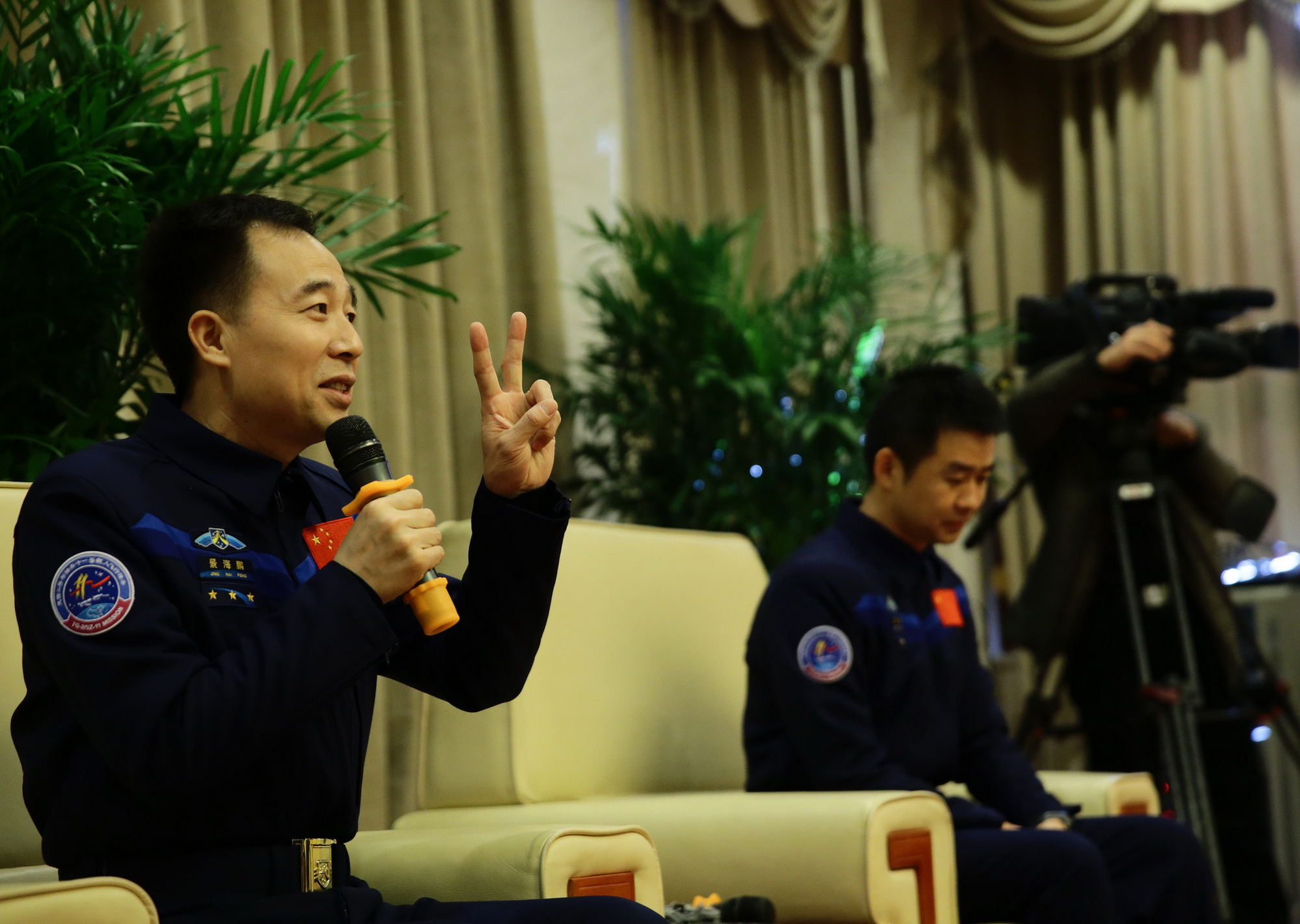
Jing Haipeng (L), commander of the Shenzhou-11 spacecraft, answers questions during a press conference in Beijing, on December 7, 2016. /CFP Photo
The Shenzhou-11 spacecraft blasted into the sky on October 17 and two days later successfully docked with the Tiangong-2 space lab. Jing and Chen spent 30 days conducting experiments in the lab and returned to Earth on November 18 safe and sound.
It was the third space mission for Jing, who also participated in the Shenzhou-7 and Shenzhou-9 voyages, while it was Chen's first time in space.
Last Tuesday, Chinese President Xi Jinping, who is also General Secretary of the CPC Central Committee and Chairman of the CMC, met Jing and Chen, applauded their achievements and stressed the importance of aerospace science and technology.
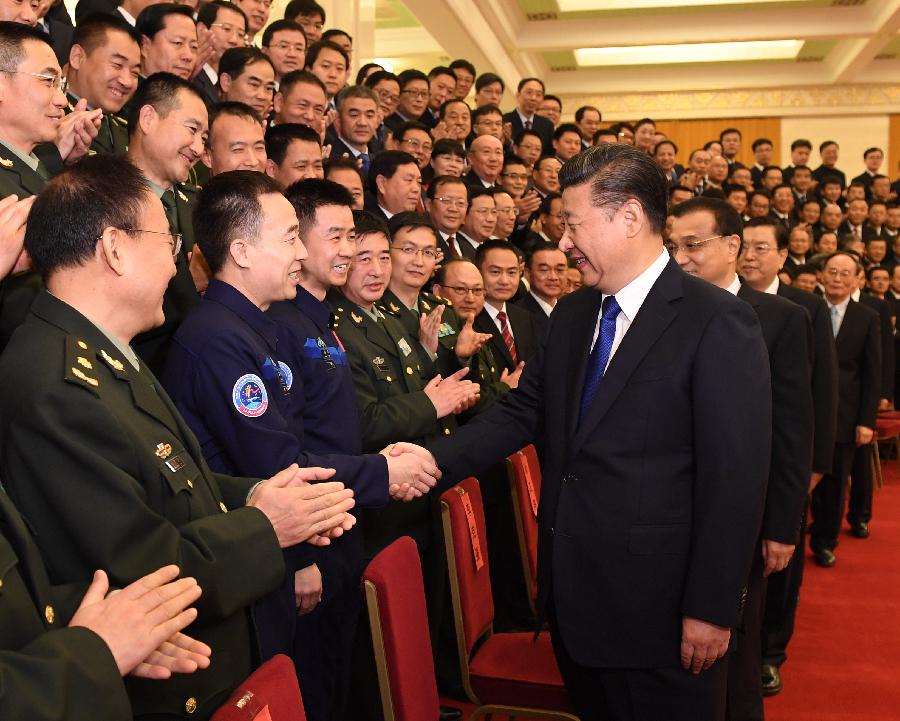
Chinese leaders including Xi Jinping, Li Keqiang, Zhang Dejiang and Yu Zhengsheng meet with astronauts as well as people involved in the research and testing of the Tiangong-2 and Shenzhou-11 space missions in Beijing, on December 20, 2016. /Xinhua Photo
China has made breakthroughs in developing key space technology itself, enabling Jing and Chen to stay in orbit for longer than any previous Chinese astronauts.
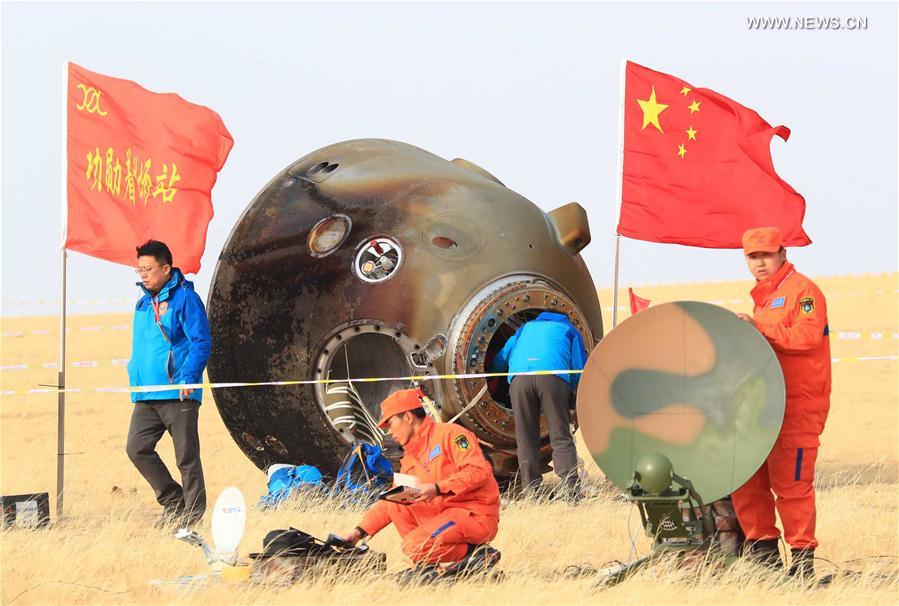
The return capsule of Shenzhou-11 is seen on the main landing area after landing in north China's Inner Mongolia Autonomous Region on November 18, 2016. /Xinhua Photo
The country still has plenty of ambitions to fulfill in space. In April 2017, its first cargo spacecraft Tianzhou-1 will be launched to dock with Tiangong-2, which remains in orbit. China is also aiming to build its own permanent manned space station and launch a mission to Mars by around 2020.