
15:39, 08-Sep-2017
Korean Peninsula Tensions: Nuclear issue simmering for decades
 []
[]
Share







Copied
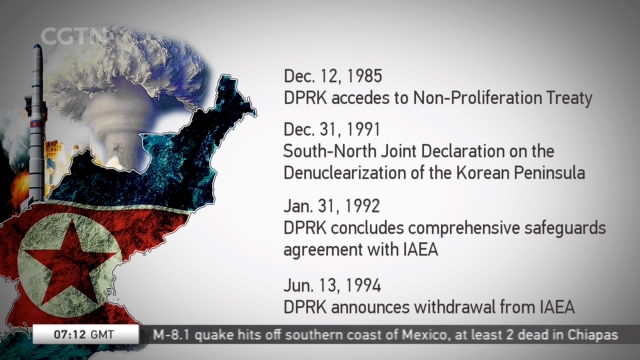
After the DPRK's sixth and most powerful nuclear test this week, US President Donald Trump again pointedly declined to rule out a possible US military response. nSouth Korea, in response, has completely deployed its THAAD anti-missile system, despite opposition from China and Russia. nBut these are just the latest events for an issue that's been simmering for decades. So, let's look at how things arrived at this point.
The tensions on the Korean Peninsula have been lingering since the 1950s when the Korean War broke out. In the 1980s, tensions lifted slightly, in particular when the DPRK agreed to the nuclear Non-Proliferation Treaty (NPT) in 1985. Six years later, along with South Korea, the DPRK signed the South-North Joint Declaration on the Denuclearization of the Korean Peninsula, under which both sides agreed not to use nuclear weapons in any way. In 1992, more than six years after signing the Non-Proliferation Treaty, the DPRK concluded a comprehensive safeguards agreement with the International Atomic Energy Agency. Then in 1994, the country announced its withdrawal from the organization after the director of the US Central Intelligence Agency speculated the DPRK may have produced one or two nuclear weapons.
Between 1994 and 2002, the relationship between the US and the DPRK remained stable. The two countries concluded four months of negotiations by adopting an "Agreed Framework" in Geneva. The agreement called on the DPRK to freeze and eventually eliminate its nuclear facilities. In return, the US promised to normalize relations with the DPRK.
However, after Former US President George W. Bush took office in 2002, the relationship between the two countries turned sour, especially after Bush labelled the DPRK as part of an "axis of evil". In 2003, the Six-Party Talks started, aiming to end the DPRK's nuclear activity. In return, the country called for the US to conclude a "non-aggression treaty" and to normalize diplomatic relations. But the Bush administration responded that a formal non-aggression pact was "off the table", despite a US promise to not attack the DPRK. The Six-Party Talks suspended in 2007. And in 2009, Pyongyang announced it would withdraw from the negotiations.